Softship launches Port Cost Calculator to streamline and automate port costs and voyage calculations


Global shipping software solutions provider, Softship, has launched an innovative, web-based Port Cost Calculator for carriers to maintain up-to-the-minute, fully accurate records and full visibility of expenses at all stages of each individual port call.
Thomas Wolff, Softship’s Managing Director, explains:
“Vessels will call at many ports across the world and each port call requires a significant number of services to be provided by a large range of service providers. Multiply this by the number of vessels in an average fleet and the process quickly becomes unwieldly and error-prone. Port calls are expensive and a carrier needs to know, in advance, the anticipated cost of a call so that the overall voyage result can be accurately predicted. Carriers must also be confident that the costs they incur in port are legitimate and accurate and can be reconciled against services actually delivered for the pre-agreed tariff. Our new web-based tool – which slots seamlessly into a carrier’s own internal IT environment – streamlines this time-consuming process and injects a much higher level of confidence and accuracy into the overall port cost calculations.”
A vessel’s expected port activities are pre-loaded into the Softship Port Cost Calculator from the original port call templates and unforeseen or real-time adjustments can be taken direct from vessel reports. Based on this, the Calculator will present a list of all expected charges and costs. These are then automatically applied to the overall voyage result giving the carrier full visibility over the financial performance of each voyage.
As the port call progresses, vendor invoices are automatically reconciled and approved for payment which reduces staff time and errors. Discrepancies are identified and rapidly resolved.
The Calculator integrates seamlessly within a carrier’s existing IT systems using the Softship WebAPI (web application programming interface) and data is exchanged by standard JSON or XML files. The use of these “web services” also facilitates easy data exchange within a carrier’s own company and between external business partners.



Related News.

Columbia Group calls for greater focus on retaining women at sea as second She Beyond Conference takes place
Columbia Group has called on the maritime industry to create a future where women can thrive, progress and lead at sea, as it celebrated the second…
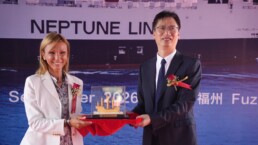
Neptune Group Welcomes “NIKOS TRAVLOS”
The new vessel proudly bears the name of Neptune's founder, who laid the foundation for the creation and enduring evolution of the Group. Her…

Wildcat Defense enters into exclusive agreement to acquire Fraser Shipyards
American family firm takes the next step in its strategy to rebuild U.S. shipbuilding and repair capacity, following its offer for Austal USA.…

Kawasaki signs strategic partnership MOU with Romania’s Transgaz for Onshore Hydrogen Gas Transport
Establishing a model for large-scale hydrogen supply and transport via pipelines Kawasaki Heavy Industries, announced at the Romania–Japan…

UK P&I Club and TT Club secure regulatory approval for Thomas Miller acquisition
The UK P&I Club and TT Club announce the successful completion of their joint acquisition of the Thomas Miller Holdings group, marking a major…

Valenciaport presents its Sandbox at PEIC’26 as a tool to bridge the gap between innovation and implementation
The opening session featured a discussion between Valenciaport President Mar Chao and Valenciaport Foundation Director Antonio Torregrosa. The…

Major investments strengthen Gothenburg RoRo Terminal
Expanded terminal areas, new rail connections and modernised quays are among the investments that have strengthened Gothenburg RoRo Terminal in…

ABP appoints key roles in the Humber
Associated British Ports has made two key appointments at its container terminals strengthening its unitised operations at the ports of Immingham…

Xinhua Silk Road 2026 North Bund Forum unveils 20 shipping-related achievements
The 2026 North Bund Forum opened in Shanghai on October 20 with 20 key shipping-related achievements spanning international cooperation, green…

Ports encouraged to prepare now for advanced nuclear in maritime and clean energy
New joint Lloyd’s Register and British Ports Association paper sets out a practical readiness pathway for ports considering nuclear-powered vessels,…
Subscribe to our newsletter!
if you dont want to swim alone in the ocean of news, sign up for the newsletter, and you will receive daily all the important news of world shipping!
