First LNG-powered ferry to serve UK takes to the water
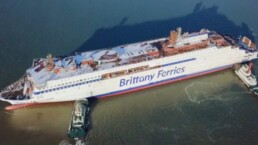

The next ship to join Brittany Ferries’ fleet will be called Salamanca, she will be powered by cleaner LNG and she took to the water for the first time last week.
Salamanca’s launch ceremony took place on 6 January 2021 at the CMJL shipyard in Weihai, China, where she is under construction. She is the second of three E-Flexer class ships ordered by Brittany Ferries and will join sister-ship Galicia, when she enters service in the spring of 2022.
Fleet renewal is one of the pillars of Brittany Ferries’ five-year recovery plan. The investment in new ships was made well before the pandemic began, but a trio of cleaner, more efficient and comfortable vessels will help secure the company’s future ensuring the continuity of passenger and freight services.
“In spite of Brexit and Covid which have cost our company several hundred million euros already, I am resolved to remain on our path towards eco-responsibility and energy transition,” said Jean-Marc Roué, president Brittany Ferries. “It is a formal commitment I’ve made: we will continue, despite these crises, to reduce our carbon footprint, to keep on improving our fleet and to contribute to the development of the regions we serve. Salamanca is a good illustration of this. By renewing our fleet today, we are ensuring a return to growth tomorrow and Brittany Ferries and our partners remain confident in the future.”
Galicia entered service in December 2020. Salamanca will join her in 2022 with Santoña following in 2023. Both Salamanca and Santoña will be powered by LNG (Liquefied Natural Gas) and will serve the company’s long-distance routes connecting the UK with Spain.
Each E-Flexer vessel promises a significant reduction in air quality and greenhouse gas emissions. They are also smoother, quieter and benefit from less vibration with better sea handling, to the benefit of passengers.
Salamanca will be powered by cleaner LNG (liquefied natural gas). This is a fuel which emits virtually no sulphur dioxide, nitrogen dioxide or particulate emissions, following combustion. In addition, because LNG burns more efficiently than diesel, there is a reduction in carbon dioxide (CO2) output of around 25 percent.
The facilities for storing LNG will be supplied by Repsol in Spain. Under the terms of the agreement, the fuel company will build two quayside LNG bunkering terminals in the ports of Santander and Bilbao, including a 1,000 m3 storage tank to ensure uninterrupted supply for Salamanca and Santoña.
“Passengers expect more comfortable, cleaner, greener vessels and society rightly demands sustainability as standard. Shipping companies that fail to improve are therefore destined to fail,” added Christophe Mathieu, chief executive Brittany Ferries. “It’s why these E-Flexer ships are so important as we look to emerge from the current crisis. Galicia, Salamanca and Santoña, are clear evidence that we are determined to sail towards a sustainable and a successful future.”
Aside from fuel, all E-Flexer vessels have been designed with the environment and efficiency in mind. Particular attention has been given to fuel-efficient propulsion plants and long, slender hull and bow design. Friction-reducing silicon paint that coats the underwater hull, further reduces fuel consumption while propeller and rudder design brings improved manoeuvrability.
Salamanca is equipped with two Wartsila 12V46DF engines generating 13,740 kW each (18,500 horsepower per engine). Thanks to energy recovery, electricity production on board comes with low CO2 emissions. Alternators installed on shaft lines produce energy even at very low speeds, which means the ship’s electrical generators are only needed when the ship is alongside.
Bow thrusters work in harmony with articulated rudders, making it possible to facilitate the tightest turns in the harbour. There is no need for stern thrusters. And when it comes to vibration, passengers will notice just how little there is. Fin stabilisers have already proved effective on sister-ship Galicia, minimising roll and smoothing the choppiest of seas through the Bay of Biscay.
This combination of LNG propulsion, efficient design and greater carrying capacity, compared with the ships she will replace, means a significant reduction in carbon footprint on Brittany Ferries’ long-haul services between the UK and Spain.
Like her sister, Salamanca will weigh-in at over 42,000 gross tonnes. That means she will be one of the largest ships ever to serve the company, and at 215 metres long she will be joint-longest. She will carry 1,015 passengers, with over 2.7km of lane-space to house passenger and freight vehicles.
She will of course be French-flagged and crewed by dedicated French seafarers.



Related News.
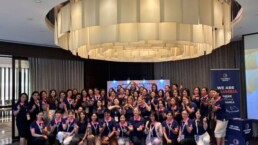
Columbia Group calls for greater focus on retaining women at sea as second She Beyond Conference takes place
Columbia Group has called on the maritime industry to create a future where women can thrive, progress and lead at sea, as it celebrated the second…
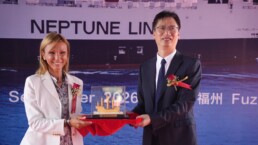
Neptune Group Welcomes “NIKOS TRAVLOS”
The new vessel proudly bears the name of Neptune's founder, who laid the foundation for the creation and enduring evolution of the Group. Her…

Wildcat Defense enters into exclusive agreement to acquire Fraser Shipyards
American family firm takes the next step in its strategy to rebuild U.S. shipbuilding and repair capacity, following its offer for Austal USA.…

Kawasaki signs strategic partnership MOU with Romania’s Transgaz for Onshore Hydrogen Gas Transport
Establishing a model for large-scale hydrogen supply and transport via pipelines Kawasaki Heavy Industries, announced at the Romania–Japan…

UK P&I Club and TT Club secure regulatory approval for Thomas Miller acquisition
The UK P&I Club and TT Club announce the successful completion of their joint acquisition of the Thomas Miller Holdings group, marking a major…

Valenciaport presents its Sandbox at PEIC’26 as a tool to bridge the gap between innovation and implementation
The opening session featured a discussion between Valenciaport President Mar Chao and Valenciaport Foundation Director Antonio Torregrosa. The…

Major investments strengthen Gothenburg RoRo Terminal
Expanded terminal areas, new rail connections and modernised quays are among the investments that have strengthened Gothenburg RoRo Terminal in…
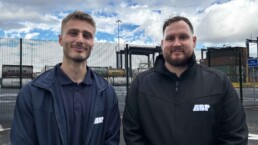
ABP appoints key roles in the Humber
Associated British Ports has made two key appointments at its container terminals strengthening its unitised operations at the ports of Immingham…

Xinhua Silk Road 2026 North Bund Forum unveils 20 shipping-related achievements
The 2026 North Bund Forum opened in Shanghai on October 20 with 20 key shipping-related achievements spanning international cooperation, green…
Ports encouraged to prepare now for advanced nuclear in maritime and clean energy
New joint Lloyd’s Register and British Ports Association paper sets out a practical readiness pathway for ports considering nuclear-powered vessels,…
Subscribe to our newsletter!
if you dont want to swim alone in the ocean of news, sign up for the newsletter, and you will receive daily all the important news of world shipping!
