An analysis of the upstream industry’s dirty laundry: Whose production has the lowest CO2 intensity?
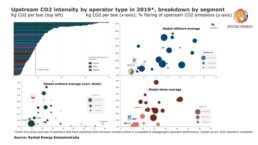

The carbon footprint of exploration and production companies (E&Ps) is having an increasing impact on investment levels, access to capital and – in some regions – the social license to operate. Rystad Energy has conducted a comprehensive company-level analysis of the world’s upstream industry, identifying the top carbon-intensity performers in each of the offshore, onshore and shale segments.
Rystad Energy has analyzed the upstream CO2 footprint from sources that are owned or controlled by each of the operators that have published emission reporting for 2019. Their global CO2 intensity average is calculated at about 17 kg per barrel of oil equivalent (boe), but the estimate for all operators (including those that do not report) is 18-19 kg/boe. The total span ranges from less than 5 kg per boe to well above 100 kg per boe, but the vast majority of operators fall in the 10-40 kg per boe range.
At field level, the variations are even higher, and the global transaction market has been rife with mature (typically high carbon intensity) assets. To create a meaningful best-in-class list we have excluded smaller, single-asset operators and only rate the ones with more than 150,000 boe per day (boepd) in gross operated production.
Onshore producers have a higher carbon intensity on average, while offshore producers are scattered, some performing in the low-emitter category, others in the highest. Shale producers dominate the cleaner end of our list, while their oil sands peers have by far the heaviest CO2 footprint.
Offshore
In the offshore segment, which has an average intensity of approximately 17 kg per boe, the top three performers in terms of CO2 intensity in 2019 were Neptune Energy (1st), Sakhalin Energy (2nd) and Aker BP, with the three companies having a score close to 7 kg per boe.
Neptune has electrified its Gjoa platform off Norway and has an overall gas-heavy portfolio, setting the company well on track to reaching its target of 6 kg of CO2 per boe in 2030. On the podium is also Norway-based Aker BP, which has low-emission solutions such as electrification as a key focus. The company’s Valhall and Ivar Aasen fields are prime examples, obtaining the necessary operating power with close to zero emissions.
Sakhalin Energy, a Russian consortium consisting of Gazprom, Shell, Mitsui and Mitsubishi, produces oil and gas (roughly one-third liquids) from a challenging subarctic environment off the northeastern coast of Sakhalin Island. Sakhalin Energy has had a strong focus on emissions-reducing initiatives, including measures to cut equipment downtime and shorten shutdowns, which has led to a dramatic decrease in flared gas. Output from the underlying fields is also close to peak production, which enables the operator to be among the best in class offshore.
For offshore operators with production above 1 million boe per day, Equinor is the frontrunner, boasting an average intensity of about 9 kg per boe for all production. Equinor’s ambition is to reduce the operated intensity to below 8 kg per boe by 2025.
Onshore
The shale industry’s CO2 emission intensity is calculated at around 12 kg per boe. Shale gas players (marked in light red) consistently score lower on both flaring and overall emissions than shale oil players, and the three lowest are Antero Resources, EQT Corporation and Range Resources – each with a production intensity of around 6 kg per boe, with Antero being the top performer. Among the shale oil players, Concho Resources has the lowest intensity at approximately 9 kg per boe produced.
The oil sands segment has a more energy-intensive extraction process, and as long as this process is fueled by fossil fuels without CCS, the companies in this segment will be on the higher end of the spectrum. Average CO2 intensity for oil sands is calculated at a staggering 73 kg per boe. There are also differences between in-situ and mining in terms of emissions, and an effect of maturity seen, but more in terms of differences in the technologies applied.
Conventional onshore producers have an average CO2 intensity of 19 kg per boe. Saudi Aramco, Lukoil and Vermilion Energy all performed well in terms of CO2 intensity in 2019 and are the three top performers on our list. Saudi Aramco benefits from hosting large field developments with stable production and low amounts of associated gas, which helped it lead the category with emission intensity at just about 9 kg per boe. Vermilion followed with about 11 kg per boe and Lukoil with 12 kg per boe.
“The environmental “E” in ESG is seen as a leading indicator for the robustness of E&P companies in the face of the energy transition. Investors will increasingly be looking at their targets’ carbon footprint before making any business decisions, and the best-in-class companies will be prime investment targets,” says Jon Erik Remme, product manager for Emissions Solution at Rystad Energy.
Individuals and companies with an interest in the oil and gas industry are continuously being challenged on carbon topics, and as E&P performance varies significantly between different companies and individual fields, the risk imposed can be very inhomogeneous. To help navigate these risks and adjacent opportunities, Rystad Energy offers a CO2 dashboard for all E&P operators and companies globally, along with tailored advisory services.
Source: Rystad Energy



Related News.

Columbia Group calls for greater focus on retaining women at sea as second She Beyond Conference takes place
Columbia Group has called on the maritime industry to create a future where women can thrive, progress and lead at sea, as it celebrated the second…
Neptune Group Welcomes “NIKOS TRAVLOS”
The new vessel proudly bears the name of Neptune's founder, who laid the foundation for the creation and enduring evolution of the Group. Her…

Wildcat Defense enters into exclusive agreement to acquire Fraser Shipyards
American family firm takes the next step in its strategy to rebuild U.S. shipbuilding and repair capacity, following its offer for Austal USA.…
Kawasaki signs strategic partnership MOU with Romania’s Transgaz for Onshore Hydrogen Gas Transport
Establishing a model for large-scale hydrogen supply and transport via pipelines Kawasaki Heavy Industries, announced at the Romania–Japan…

UK P&I Club and TT Club secure regulatory approval for Thomas Miller acquisition
The UK P&I Club and TT Club announce the successful completion of their joint acquisition of the Thomas Miller Holdings group, marking a major…

Valenciaport presents its Sandbox at PEIC’26 as a tool to bridge the gap between innovation and implementation
The opening session featured a discussion between Valenciaport President Mar Chao and Valenciaport Foundation Director Antonio Torregrosa. The…

Major investments strengthen Gothenburg RoRo Terminal
Expanded terminal areas, new rail connections and modernised quays are among the investments that have strengthened Gothenburg RoRo Terminal in…

ABP appoints key roles in the Humber
Associated British Ports has made two key appointments at its container terminals strengthening its unitised operations at the ports of Immingham…

Xinhua Silk Road 2026 North Bund Forum unveils 20 shipping-related achievements
The 2026 North Bund Forum opened in Shanghai on October 20 with 20 key shipping-related achievements spanning international cooperation, green…
Ports encouraged to prepare now for advanced nuclear in maritime and clean energy
New joint Lloyd’s Register and British Ports Association paper sets out a practical readiness pathway for ports considering nuclear-powered vessels,…
Subscribe to our newsletter!
if you dont want to swim alone in the ocean of news, sign up for the newsletter, and you will receive daily all the important news of world shipping!
