US shale oil output set to stabilize in 2021 as cost efficiencies offset falling operator capex
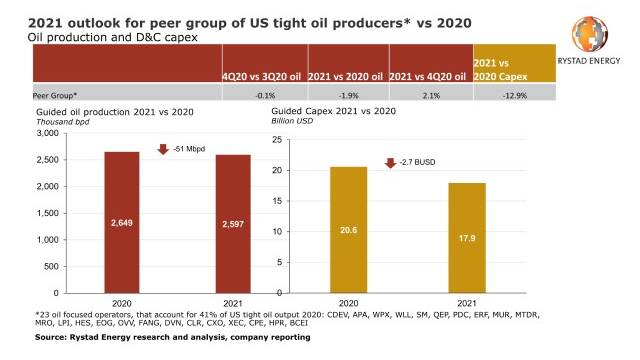

US’ shale oil output is set to decline this year thanks to the ravages of COVID-19, and as a result, 2020 average production is expected to fall by 3.1% year over year, or 7.5 million barrels per day (bpd) from 2019’s 7.7 million bpd, Rystad Energy estimates. The full-year trend will not change in 2021, when shale oil output is estimated to decline further by 2-3% year over year. However, most of this decline has already occurred throughout 2020 and no further impact is anticipated in a $40 to $45 WTI environment.
US operators’ D&C capex, which enjoyed strong levels in 2019 at $98.7 billion, will more than halve in 2020, Rystad Energy projects, and decline to just $45.2 billion. Operators’ have now shifted focus towards preserving as much output as possible while implementing capital efficiency measures, which means 2021’s capex is projected to decline by a wider margin compared to output, a drop we believe will be between 7-9% year over year.
Rystad Energy has also analyzed the third quarter guidance of a peer group of oil-focused public operators comprised of 23 companies, which together account for about 41% of this year’s US shale oil production. Interpreting the group’s released guidance, its 2021 onshore oil production will likely shrink slightly by 1.9% while D&C capex will be considerably lower at 12.9% compared to the group’s stated 2020 plans. When the plans of larger producers and private operators are added to the analysis, capex decline will likely be slower, at 7-9%, and the output cuts larger.
“Amid a second wave of Covid-19 in North America and Europe, and uncertainty related to potential new regulation the industry may face once a new US administration settles in, operators largely remain disciplined. They aim to increase cost efficiencies and spend only the minimum amount needed to prevent next year’s output from declining too much,” says Alisa Lukash, Senior Analyst at Rystad Energy.
The largest spending drop in the peer group will be about $1.6 billion, or 16% below this year’s target, and is expected for Permian-focused companies. Operators with a presence across multiple basins will follow suit, with a $800 million, or 11%, spending decrease. Bakken-focused peers will see a $200 million, or 9%, spending decrease.
Despite the fact that operators in the Permian Basin are leading capex reduction efforts, the group has guided an almost 2% increase in oil output in 2021 compared to 2020. The factors driving this drastic cost reduction per barrel include service cost reductions and the price deflation of completion components.
Besides the above mentioned cyclical factors, other drivers behind increased output include the continuous high grading of operations, maturity in base decline rates, and a large accumulation of drilled but uncompleted (DUC) wells, which are likely to be put on production in the first half of next year.
For more analysis, insights and reports, clients and non-clients can apply for access to Rystad Energy’s Free Solutions and get a taste of our data and analytics universe.
Source: Rystad



Related News.

Global Flag State Ranking 2026 who is up, who is down
Lorrendraaier publishes Global Flag State Ranking 2026: 148 flags measured on objective data, Singapore leads, Pakistan falls 35 places, the Dutch…
Will Germany have enough gas this winter?
As of mid-September 2026, Germany had stored just about 141 terawatt-hours of gas, accounting for around 57% of the country’s total storage…

Record diesel prices put US policy options in focus
Record-high diesel prices and tight inventories have put US exports under scrutiny, but keeping more barrels at home may offer only temporary…

IUMI elects Sean M. Dalton as President and says farewell to Frédéric Denèfle
The International Union of Marine Insurance (IUMI) has elected Sean M. Dalton as its new President. The election took place today at a meeting of the…
F/V MISTRESS Shipwreck ‘Lost’ Near Block Island Located After Seven Years
Green Oceans’ Underwater Investigation Reveals a Shipwreck Presumed to be the F/V Mistress found at the Base of Block Island Turbine #1 - Asks…

OCEAN at 50 celebrating a proud past and Maritime Future
OCEAN, the European sub-committee of ISSA, celebrated half a century of service to Europe’s ship supply sector with a landmark anniversary conference…

DORIC MONTHLY BRAZIL BAROMETER SEPTEMBER 2026
Pls find below the DORIC MONTHLY - BRAZIL BAROMETER SEPTEMBER 2026 BRAZIL_BAROMETER_SEPTEMBER_2026

Steel flows face fresh challenges in the final quarter of 2026
Steel flows slip into negative growth in July 2026 Global steel flows fall 1% y/y in July 2026 to reach 22.2 Mt. China’s share of global steel…

Insurance must shift “from repair to prevention”, says IUMI
Marine insurers will need to place greater emphasis on loss prevention as risks become more complex and costly to insure, according to Pascal Dubois,…

BIMCO’s Container Shipping Market Overview & Outlook September 2026 is out
Container Shipping Market Overview & Outlook Supply pressure is mounting "Disruptions and strong growth in head-haul trades continue to support…
Subscribe to our newsletter!
if you dont want to swim alone in the ocean of news, sign up for the newsletter, and you will receive daily all the important news of world shipping!
