ESPO publishes the 2020 Environmental Report for the European port sector
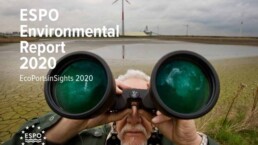

This morning, the European Sea Ports Organisation (ESPO) presented its fifth annual Environmental Report during a dedicated Webinar. The ESPO Environmental Report 2020 includes more than 60 different environmental performance benchmarks, such as the Top 10 Environmental Priorities of the European ports, and figures on the green services to shipping (shore-side electricity, LNG and environmentally differentiated port dues).
Air quality continues to be the top environmental priority for ports, as air quality has become a key determinant of sustainable port activity and ports’ license to operate. Climate change has become the second top priority of ports in 2020, having entered the Top 10 environmental priorities for the first time in 2017. In 2020, seven out of ten European ports take climate change into consideration when they develop new infrastructure projects. The threat posed by climate change is demonstrated by the fact that 65% of European ports have taken steps to strengthen the climate resilience of existing infrastructure, and over half of surveyed ports have already dealt with operational challenges due to climate change. Energy efficiency (formerly referred to as energy consumption) is the third top priority after air quality and climate change.
Noise remains an important priority for ports, as they are continuing to take steps to avoid or decrease noise pollution from port activities. The relationship with the local community, which is of outmost importance for ports, remains a high priority coming in fifth place this year. In 2020, ports have continued their efforts to ensure that ports are more transparent, involved, and accountable to local communities. Close to all (91%) of participating ports communicate their environmental policy to all relevant stakeholders, and 86% of them makes it publicly available on their website.
With regard to the green services to shipping, a growing share of ports are offering shore-side electricity for ships at berth (OPS) in 2020, with 58% of sampled ports providing this service in 2020. It is important to mention, that, out of this total, 46% of these ports provide high voltage electricity which is suitable for seagoing vessels. Notably, 40% of ports are planning to offer OPS in the coming two years.
When it comes to LNG, one third of ports has made LNG bunkering available, LNG being mainly provided by trucks (100%) and by barges (34%). In parallel, 57% of ports provide environmentally differentiated fees for ships that go beyond regulatory standards, with air emissions, waste and climate change being important targets of these discounts.
In addition, around two thirds of European ports are certified with an environmental standard (ISO, EMAS, EcoPorts’ PERS), which is an increase by 11% since 2013. 81% of ports have set up an environmental monitoring program, waste being the most monitored issue.
Aiming to further increase the transparency and accountability of the European port sector and to enhance the relationship of ports with their local communities, ESPO decided to publish the annual Environmental Report of the European port sector starting in 2016. The report provides quality data on ports’ environmental performance and is becoming a point of reference for policy makers and stakeholders, including local communities, civil society, researchers and industry. 97 ports have been participating in this year’s report.

“This year’s ESPO Environmental report shows, that despite the challenging times ports are going through, environmental engagement and support has not been put on hold. The top three environmental priorities do not come as a surprise. It clearly shows what ports are having on their radar. Ports continue to invest in green infrastructure such as shore-side electricity for ships at berth, and have improved their transparency towards European citizens and local communities. We will have to keep an eye on the share of ports certified with an Environmental Management System, which went down slightly. ESPO is therefore committed to continue helping ports demonstrate excellence in environmental management through the EcoPorts PERS certification, which is the only port-specific environmental standard on the market.
I am happy though to see that the sample used for the Annual Report becomes bigger. I would like to encourage all our members to join EcoPorts and make the sample even more comprehensive and representative for all maritime EU Member States,” says ESPO’s Secretary General, Isabelle Ryckbost.



Related News.

Connected Fleets under Siege: Navigating Geopolitical Cyber Threats and Modern Maritime IT
An exclusive CSN interview between Adonis Violaris and Dr Matthew Maheras As commercial shipping becomes ever more digitally integrated, the industry…
InterManager warns enclosed space deaths demand urgent industry action
InterManager has called for urgent industry action on enclosed space safety after its latest research highlighted persistent failures in procedures,…
ATPI Greece marks 50 years at the heart of global crew changes
Five decades supporting the Greek and global shipping community 35% of ATPI’s marine business now managed from Greece More than 130 professionals…
Euroseas announces a new time charter contract for its 2001-built 2,556 teu Feeder Containership, M/V EM Corfu, and the sale of its sister vessel, M/V Evridiki G
Euroseas an owner and operator of container carrier vessels and provider of seaborne transportation for containerized cargoes, announced a new…
Possible further delay to road transport’s inclusion in EU ETS causes serious concern
Interferry, the global trade association representing the ferry shipping industry, is raising serious concerns over the current state of EU Emissions…

ABP appoints new head of commercial for Humber
Associated British Ports, the UK’s largest port operator, has appointed Sandrine Lagrost as its new Head of Commercial for the Humber, joining the…
Commodity Radar | Spotlight: Bauxite – Week 43.2026
The final quarter of 2026 is expected to see softer bauxite flows Chinese front-loading is expected to have run its course, pointing to softer…
Japan IMO attempt to weaken the IMO Net-Zero Framework
Japan has put forward a proposal to the International Maritime Organization to remove the Net-Zero Fund and put shipping companies in control of…

xclusiv S&P Report 19th October 2026
Pls find below the [xclusiv] S&P Report 19th October 2026 [xclusiv] 2026_10_19
Glencore achieves land access for the Coroccohuayco project at Antapaccay
Antapaccay, a Peruvian entity controlled by Glencore, has completed the access agreements required for the last blocks of land to unlock the…
Subscribe to our newsletter!
if you dont want to swim alone in the ocean of news, sign up for the newsletter, and you will receive daily all the important news of world shipping!
