Crane collisions & allisions
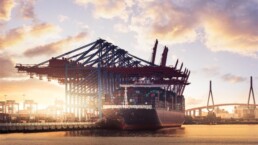

Whether for bulk handling or container operations, the quayside crane is critical for performing ship to shore services. This vital tool is also vulnerable to significant damage when impacted by a ship during berthing. While relatively low frequency, such incidents carry high consequence in direct damage, business disruption and potential for injury.
Every port or terminal operator will be acutely aware of the importance of the fixed infrastructure exposed on the waterfront. News of damage through ship allisions1 with quay walls and jetties in other locations must give pause for thought for all port management, but the greatest concern may be reserved for the ‘meccano-like’ equipment that is necessarily positioned ready for action – and highly exposed – at the edge of the berth.
“2020 has seen its share of crane wreckage caused by inadvertent ‘nudging’ of the superstructure as a ship berths”
2020 has seen its share of crane wreckage caused by inadvertent ‘nudging’ of the superstructure as a ship berths. On rare occasion the damage may be limited to partial derailing, without resulting in total collapse, but the cost to verify the extent of any damage or distortion and return the crane to operation can still be considerable. Apart from challenges presented by sheer size and mass, a crane is engineered to sustain predicted operational stresses related to the specific use – for example, container cranes are designed around lifting vertical loads – and therefore sudden impacts from a ship (or another crane) can cause more complex damage than visually apparent.
Low(ish) frequency but high impact
TT Club’s market position in marine ports results in consideration of many of such incidents, although the ease with which video imagery can be captured and posted online has significantly increased awareness amongst a broad swathe of interested parties. This ease – and immediacy – of posting contemporaneous images may well help managers to be alert to the risks, but often belies the need to consider the complex causation in order to assess what mitigation might be appropriate. And since analysis is less driven by statistical frequency, the importance of teasing out relevant causative factors for risk evaluation aligned to specific local conditions is material.
While there are a number of causative factors that can be drawn from incident analyses, a recurrent theme is the reducing margin for the ‘human factor’. This fundamentally underlines the importance of thorough and appropriately revisited risk assessments, sound and enforced systems and procedures, and ongoing training. And entwined in all of these activities is the constant challenge of effective communication, not simply in such framework matters, themselves best formed collaboratively, involving the varied port community disciplines and stakeholders, including workforce. It is worth noting that the outputs will be tested under the pressure of the moment, often in the crucible of different languages and experiential perspectives.
It is a given that the increasing size of ship tonnage necessarily presents greater challenge in both preparation and operation – and this relates not only to the largest ships in service, but also the cascaded trading impact that sees port facilities accepting ships that are simply larger than previously experienced.
Considered causation – and mitigation
Some of the factors gleaned from incident investigations relate to ‘physics’; despite improved main engine and thruster performance on recent tonnage, manoeuvrability may be impacted by load draft (such that the propeller may be incompletely immersed) or sheer momentum, together with limited under keel clearance and, for container ships, potentially significant sail effect on the ship’s beam. These variables concerning the parameters of the ship itself are affected by issues apart from the ship, which may include tug performance or prevailing weather and harbour conditions. All these dynamic conditions need to be taken into account, specifically by the pilot, in order that correct judgements are formed and actions are taken in a timely fashion.
“All these dynamic conditions need to be taken into account, specifically by the pilot, in order that correct judgements are formed and actions are taken in a timely fashion”
In most port locations there will be a designated authority taking overall responsibility for the movement of shipping, alongside a range of general conservancy duties. For all the reasons stated here from incident experience, this type of authority is primarily responsible to carry out formal risk assessments into the berthing and unberthing of all the shipping that will be using the port facilities, drawing in affected stakeholders.
Such work may necessitate drawing in technical expertise to combine the understanding of diverse disciplines with practical and local knowledge and experience. Models and scenarios may be utilised to demonstrate that operations can be carried out safely and identify the conditions under which alternative measures need to be implemented.
Equally, account will have to be taken in such risk assessments of the evolving need for tugs, both in terms of quantity and power. Similarly, pilots are ordinarily self-employed and contracted to provide pilotage services to the port, albeit in relationship to the ship’s master at the point of that service delivery.
In the final analysis, the approach to compiling the risk assessment may well be indicative to the experience that follows; those operating on the quayside – and often having the ownership interest in the quay cranes – have a substantial interest alongside other stakeholders in ensuring that there is a thorough understanding of the risks involved, clear operating procedures are in place (followed through with training and monitoring), and protocols are established for all communications, including escalation when required.
We hope that you have found the above interesting. If you would like further information, or have any comments, please email us, or take this opportunity to forward to any colleagues who you may feel would be interested.
Source: TT Club



Related News.

Connected Fleets under Siege: Navigating Geopolitical Cyber Threats and Modern Maritime IT
An exclusive CSN interview between Adonis Violaris and Dr Matthew Maheras As commercial shipping becomes ever more digitally integrated, the industry…
InterManager warns enclosed space deaths demand urgent industry action
InterManager has called for urgent industry action on enclosed space safety after its latest research highlighted persistent failures in procedures,…

ATPI Greece marks 50 years at the heart of global crew changes
Five decades supporting the Greek and global shipping community 35% of ATPI’s marine business now managed from Greece More than 130 professionals…

Euroseas announces a new time charter contract for its 2001-built 2,556 teu Feeder Containership, M/V EM Corfu, and the sale of its sister vessel, M/V Evridiki G
Euroseas an owner and operator of container carrier vessels and provider of seaborne transportation for containerized cargoes, announced a new…

Possible further delay to road transport’s inclusion in EU ETS causes serious concern
Interferry, the global trade association representing the ferry shipping industry, is raising serious concerns over the current state of EU Emissions…

ABP appoints new head of commercial for Humber
Associated British Ports, the UK’s largest port operator, has appointed Sandrine Lagrost as its new Head of Commercial for the Humber, joining the…

Commodity Radar | Spotlight: Bauxite – Week 43.2026
The final quarter of 2026 is expected to see softer bauxite flows Chinese front-loading is expected to have run its course, pointing to softer…
Japan IMO attempt to weaken the IMO Net-Zero Framework
Japan has put forward a proposal to the International Maritime Organization to remove the Net-Zero Fund and put shipping companies in control of…

xclusiv S&P Report 19th October 2026
Pls find below the [xclusiv] S&P Report 19th October 2026 [xclusiv] 2026_10_19

Glencore achieves land access for the Coroccohuayco project at Antapaccay
Antapaccay, a Peruvian entity controlled by Glencore, has completed the access agreements required for the last blocks of land to unlock the…
Subscribe to our newsletter!
if you dont want to swim alone in the ocean of news, sign up for the newsletter, and you will receive daily all the important news of world shipping!
