Large, deep Antarctic ozone hole to persist into November
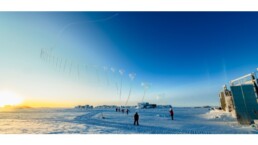

Persistent cold temperatures and strong circumpolar winds supported the formation of a large and deep Antarctic ozone hole that will persist into November, NOAA and NASA scientists reported today.
The ozone hole reached its peak size at about 9.6 million square miles (or 24.8 million square kilometers), roughly three times the area of the continental United States, on September 20. Observations revealed the nearly complete elimination of ozone in a four-mile-high column of the stratosphere over the South Pole.
This year will go down as having the 12th-largest ozone hole in 40 years of satellite records, with the 14th-lowest ozone readings in 33 years of balloon-borne instrumental measurements, the scientists said. Declining levels of ozone-depleting chemicals controlled by the Montreal Protocol prevented the hole from being as large as it would have been 20 years ago.

“We have a long way to go, but that improvement made a big difference this year,” said Paul A. Newman, chief scientist for Earth Sciences at NASA’s Goddard Space Flight Center. “The hole would have been about a million square miles larger if there was still as much chlorine in the stratosphere as there was in 2000.”
What is ozone and why does it matter?
Ozone, composed of three oxygen atoms, is highly reactive with other chemicals. In the stratosphere, roughly 7 to 25 miles above Earth’s surface, the ozone layer acts like sunscreen, shielding the planet from ultraviolet radiation. Closer to Earth’s surface, ozone created by photochemical reactions between the sun and pollution from vehicle emissions and other sources can form harmful smog in the lower atmosphere.
This year represented a dramatic turnabout from 2019, when warm temperatures in the stratosphere and a weak polar vortex limited ozone hole growth to 6.3 million square miles (16. 4 million square kilometers), the smallest on record.
How do NOAA and NASA measure ozone?
NASA and NOAA monitor the ozone hole by using three complementary instrumental methods.
Satellites, including NASA’s Aura satellite and NASA-NOAA Suomi National Polar-orbiting Partnership satellite, measure the size of the ozone hole from space. The Aura satellite’s Microwave Limb Sounder estimates levels of ozone-destroying chlorine.
NOAA staff at the South Pole also launch weather balloons carrying ozone-measuring sondes that directly sample ozone levels vertically through the atmosphere. Once sunshine returns after the long polar night, with a ground-based instrument called aDobson spectrophotometer.
Bryan Johnson, a scientist with NOAA’s Global Monitoring Lab, said ozonesonde measurements recorded a low daily value of 104 Dobson units on October 1. In late October, ozone levels between 8 and 13 miles in altitude were still “about as close to zero as we can measure.” A Dobson unit is the standard measurement for the total amount of ozone in the atmosphere above a point on Earth’s surface.
The amount of ozone in the atmosphere is exceedingly small. Prior to the emergence of the ozone hole in the 1970s, the average amount of ozone above the South Pole in September and October ranged from 250 to 350 Dobson units. If 300 Dobson units of ozone were compressed into a layer of pure ozone, it would approximate the thickness of two pennies stacked one on top of the other.



Related News.

Connected Fleets under Siege: Navigating Geopolitical Cyber Threats and Modern Maritime IT
An exclusive CSN interview between Adonis Violaris and Dr Matthew Maheras As commercial shipping becomes ever more digitally integrated, the industry…

InterManager warns enclosed space deaths demand urgent industry action
InterManager has called for urgent industry action on enclosed space safety after its latest research highlighted persistent failures in procedures,…

ATPI Greece marks 50 years at the heart of global crew changes
Five decades supporting the Greek and global shipping community 35% of ATPI’s marine business now managed from Greece More than 130 professionals…

Euroseas announces a new time charter contract for its 2001-built 2,556 teu Feeder Containership, M/V EM Corfu, and the sale of its sister vessel, M/V Evridiki G
Euroseas an owner and operator of container carrier vessels and provider of seaborne transportation for containerized cargoes, announced a new…

Possible further delay to road transport’s inclusion in EU ETS causes serious concern
Interferry, the global trade association representing the ferry shipping industry, is raising serious concerns over the current state of EU Emissions…

ABP appoints new head of commercial for Humber
Associated British Ports, the UK’s largest port operator, has appointed Sandrine Lagrost as its new Head of Commercial for the Humber, joining the…

Commodity Radar | Spotlight: Bauxite – Week 43.2026
The final quarter of 2026 is expected to see softer bauxite flows Chinese front-loading is expected to have run its course, pointing to softer…

Japan IMO attempt to weaken the IMO Net-Zero Framework
Japan has put forward a proposal to the International Maritime Organization to remove the Net-Zero Fund and put shipping companies in control of…

xclusiv S&P Report 19th October 2026
Pls find below the [xclusiv] S&P Report 19th October 2026 [xclusiv] 2026_10_19

Glencore achieves land access for the Coroccohuayco project at Antapaccay
Antapaccay, a Peruvian entity controlled by Glencore, has completed the access agreements required for the last blocks of land to unlock the…
Subscribe to our newsletter!
if you dont want to swim alone in the ocean of news, sign up for the newsletter, and you will receive daily all the important news of world shipping!
