Equinor sets ambition to reach net-zero emissions by 2050
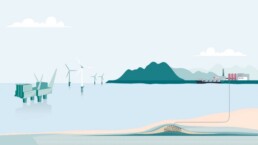

Equinor today announces its ambition to become a net-zero energy company by 2050. The ambition includes emissions from production and final consumption of energy. It sets a clear strategic direction and demonstrates Equinor’s continued commitment to long-term value creation in support of the Paris Agreement.
“Equinor is committed to being a leader in the energy transition. It is a sound business strategy to ensure long-term competitiveness during a period of profound changes in the energy systems as society moves towards net zero. Over the coming months, we will update our strategy to continue to create value for our shareholders and to realise this ambition,” says Anders Opedal who today took over the position as Chief Executive Officer (CEO) and President of Equinor.
Earlier this year, Equinor announced its plans to achieve carbon neutral global operations by 2030 and to reduce absolute greenhouse gas (GHG) emissions in Norway to near zero by 2050. At the same time, Equinor outlined a value-driven strategy for significant growth within renewables, as well as a new net carbon intensity ambition. Continuing to deliver on the short and mid-term ambitions will be key to achieving net-zero emissions.

“Equinor has for years demonstrated an ability to deliver on climate ambitions and has a strong track record on lowering emissions from oil and gas. Now, we are ready to further strengthen our climate ambitions, aiming to reach net zero by 2050,” Opedal says.
Equinor expects to deliver an average annual oil and gas production growth of around 3 percent from 2019 to 2026. Equinor is well positioned with world-class global assets in attractive areas with substantial value creation potential. By optimizing its portfolio through financial discipline and prioritization, Equinor will continue to develop competitive and resilient projects whilst maintaining industry-leading recovery rates, unit costs and carbon efficiency. The net-zero ambition will strengthen future competitiveness and value creation at the Norwegian continental shelf (NCS). Equinor’s plans for production, development and exploration at the NCS remain firm.
Equinor is preparing for an expected gradual decline in global demand for oil and gas from around 2030 onwards. Value creation, not volume replacement, is and will be guiding Equinor’s decisions. In the longer term, Equinor expects to produce less oil and gas than today.
To develop Equinor as a broad energy company, renewables will be a significant growth area. Equinor has previously set ambitions for profitable growth within renewables and expects a production capacity of 4-6 Gigawatts (GW) by 2026 and 12-16 GW by 2035 (1). Equinor now plans to expand its acquisition of wind acreage, with the aim of accelerating profitable growth and will continue to leverage its leading position in offshore wind. Equinor will establish renewables as a separate reporting segment from first quarter 2021. (1) Equity share.
To achieve net-zero emissions requires a well-functioning market for carbon capture and storage (CCS) and natural sinks, as well as the development of competitive technologies for hydrogen. Building on its capabilities from oil and gas, Equinor is well positioned to provide low-carbon technologies and establish zero-emission value chains. Equinor is driving the development of these technologies through projects such as Northern Lights, which aims to store CO2 from industrial sites across Europe. Equinor also assumes that an increasing share of oil and gas will be used for petrochemicals towards 2050.
“Climate change is a shared challenge. The combined efforts of governments, industries, investors and consumers are crucial to reaching net-zero emissions, for Equinor and for society. Together, we can overcome technological and commercial challenges, cut emissions, and develop CCS and zero-emission value chains for a net-zero future,” says Opedal.
Equinor expects to present an updated strategy at its Capital Markets Day in June 2021.
Equinor’s net-zero ambition covers scope 1 and 2 GHG emissions (operated basis 100%) and scope 3 GHG emissions (use of products, equity share).



Related News.

Connected Fleets under Siege: Navigating Geopolitical Cyber Threats and Modern Maritime IT
An exclusive CSN interview between Adonis Violaris and Dr Matthew Maheras As commercial shipping becomes ever more digitally integrated, the industry…
InterManager warns enclosed space deaths demand urgent industry action
InterManager has called for urgent industry action on enclosed space safety after its latest research highlighted persistent failures in procedures,…

ATPI Greece marks 50 years at the heart of global crew changes
Five decades supporting the Greek and global shipping community 35% of ATPI’s marine business now managed from Greece More than 130 professionals…

Euroseas announces a new time charter contract for its 2001-built 2,556 teu Feeder Containership, M/V EM Corfu, and the sale of its sister vessel, M/V Evridiki G
Euroseas an owner and operator of container carrier vessels and provider of seaborne transportation for containerized cargoes, announced a new…
Possible further delay to road transport’s inclusion in EU ETS causes serious concern
Interferry, the global trade association representing the ferry shipping industry, is raising serious concerns over the current state of EU Emissions…

ABP appoints new head of commercial for Humber
Associated British Ports, the UK’s largest port operator, has appointed Sandrine Lagrost as its new Head of Commercial for the Humber, joining the…
Commodity Radar | Spotlight: Bauxite – Week 43.2026
The final quarter of 2026 is expected to see softer bauxite flows Chinese front-loading is expected to have run its course, pointing to softer…
Japan IMO attempt to weaken the IMO Net-Zero Framework
Japan has put forward a proposal to the International Maritime Organization to remove the Net-Zero Fund and put shipping companies in control of…

xclusiv S&P Report 19th October 2026
Pls find below the [xclusiv] S&P Report 19th October 2026 [xclusiv] 2026_10_19
Glencore achieves land access for the Coroccohuayco project at Antapaccay
Antapaccay, a Peruvian entity controlled by Glencore, has completed the access agreements required for the last blocks of land to unlock the…
Subscribe to our newsletter!
if you dont want to swim alone in the ocean of news, sign up for the newsletter, and you will receive daily all the important news of world shipping!
