Mauritius oil spill puts spotlight on ship pollution

Small island nations face an existential and developmental threat from ship-source pollution endangering their vulnerable marine ecosystems and ocean economies. An effective international legal regime can help.
Often close to world shipping lanes, small island and coastal nations are at particular risk from oil spills.
Reliant on the marine environment and its biodiversity for tourism, fishing and aquaculture, islanders face an existential threat when oil spills happen in their waters.
This is why the environmental crisis unfolding in Mauritius is of grave concern.
It also brings into focus the international legal framework in place to provide support when ship-source environmental disasters strike, a new UNCTAD article says.
The seas and their use are governed by several international conventions. But some are not ratified by all countries that might benefit, and others are yet to enter into force.
This creates murky waters when oil spills happen, as not all parties have the same liability and compensation recourse, depending on which kinds of ships are responsible for the pollution and whether they have signed up to existing conventions.
“There’s a need for universal participation in the existing international legal framework, where all nations are party to agreements, so when incidents like this occur, vulnerable countries are protected,” said Shamika N. Sirimanne, UNCTAD’s technology and logistics director.
She said such oil spills herald negative environmental and socio-economic consequences for developing countries, especially small island developing states (SIDS).
Ms. Sirimanne added: “Sustainable Development Goal 14 calls on us to protect life below water and this means minimizing pollution at every possible turn, including putting all necessary precautions in place to manage environmental disasters when they do happen.”
Using legal mechanisms to protect nations, blue economy
Different kinds of ships are subject to different international legal conventions.
The UNCTAD article maps out all the recent and applicable legislation which would apply to Mauritius based on the fact that liability and compensation will be critical in the spill aftermath on two fronts: economic and environmental.
The challenge in the Mauritius case is that the legislation that would provide higher compensation to the island nation does not apply, because the ship which ran aground is from a bulk carrier, not an oil tanker.
Oil tanker pollution is governed by a different convention to that of bulk carriers, which is covered by the International Convention on Civil Liability for Bunker Oil Pollution Damage (Bunkers Convention).
It provides for a lower financial cap on liability, dependent on ship size or gross tonnage.
In the case of the MV Wakashio (101.932GT), the maximum compensation for economic losses and costs of reinstatement of the environment would be about $65.17 million.
If it were an oil tanker, the applicable International Oil Pollution Compensation Funds regime could have provided compensation of up to $286 million.
This is more than four times the Bunkers Convention provision and for Mauritius, could mean less financial aid to restore the environment and economic activity in the wake of the spill.
The UNCTAD article’s authors, Regina Asariotis and Anila Premti, emphasize the need for all countries to adopt the latest international legal instruments, given the potentially high costs and wide-ranging environmental and economic implications of ship-source pollution incidents.
What happened to the bulk carrier MV Wakashio?
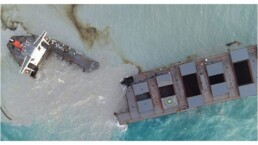
The MV Wakashio, a Japanese-owned and Panamanian-flagged bulk-carrier, was sailing without cargo when it grounded on a coral reef on 25 July in an environmentally sensitive and biodiverse area off the east coast of Mauritius. The cause is still unknown.
At the time of the grounding, the ship reportedly contained approximately 3,894 tons of fuel oil, 207 tons of diesel and 90 tons of lubricant oil on board.
By 11 August, some estimates indicated that between 1,000 and 2,000 tons of fuel oil had reportedly leaked from a breached tank and drifted into the surrounding lagoon, including areas of mangrove.
On 15 August, the ship split in two, at which point most of the fuel on-board had been recovered, according to the Japanese firm that owns the wrecked vessel.
The spill is considered as the worst in the history of Mauritius. It has endangered coral, fish and other marine life, imperiling the economy, food security, health and the $1.6 billion tourism industry in the country, already suffering from the negative effects of COVID-19.
Source: United Nations



Related News.

Navigating the Multi-Orbit Era: In Conversation with Intellian’s Jon Harrison at SMM 2026
At SMM 2026 in Hamburg, the rapid evolution of maritime satellite communications took centre stage. Across the exhibition halls, discussions among…
Cyprus ports need joint energy and investment strategy, shipping agents chief says
Cyprus needs a coordinated strategy for shipping, energy and environmental protection to support port investment and modernisation, Cyprus shipping…
MASO Public Affairs introduces MASO Regulatory Intelligence
A new subscription service helping businesses understand what is changing and what it means for them MASO Public Affairs introduces MASO Regulatory…
Anglo-Eastern helps turn CMBTECH’s ammonia ambition into an operational reality
From early feasibility study and risk-based design to newbuilding supervision, crew readiness and technical management, Anglo-Eastern drew on its…
Escalation of attacks threatens to derail recovery in Middle East oil exports
World oil demand is forecast to fall by 2.5 mb/d y-o-y in 4Q26 and 2.6 mb/d on average in 2026. As the Iran war manifests itself through restricted…
New study finds shipping pays twice its share to EU ETS earmarked revenues should triple to help build market for sustainable fuels and technologies
Shipping is responsible for around 10% of EU ETS emissions but pays almost 20% of the ETS bill. Unlike other sectors, it has never received free…
MSARC strengthens maritime mass rescue readiness through training and national live exercise off Dakar, Senegal
Joint MSARC–FHAS programme combines three days of SAR training with a national multi-agency live exercise The Maritime Search and Rescue Council ,…
Sogese report deliveries are still being delayed as container freight rates fluctuate
FOR IMPORTERS Spot rates into the Mediterranean are back at January levels, Far East to Europe reliability sits at pandemic lows, and nearly…
Glencore begins trading on Australian Securities Exchange
Glencore has begun trading on the Australian Securities Exchange under the ASX code GLC. Gary Nagle, Glencore’s CEO, said it was an exciting day for…
BIMCO Shipping Number of the Week
Suez Canal container ship transits exceed 50% of pre-disruption levels "During the first two weeks of October, weekly container ship capacity…
Subscribe to our newsletter!
if you dont want to swim alone in the ocean of news, sign up for the newsletter, and you will receive daily all the important news of world shipping!
