Ferry Operator & Passengers are Moved by the Wind
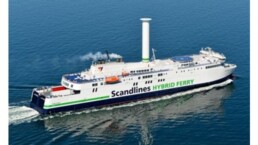

Passengers aboard the Scandlines ferry, the MV Copenhagen have been getting a little extra experience for their standard ticket price as people start to emerge from lockdown and start to stretch their legs and commence travelling again. The EU Green Deal aims to lower pollution and carbon levels across Europe and the experience of taking a ferry in part powered by the wind is something quite out of the ordinary, but hopefully not for much longer.
The end of May saw the key installation of a new Norsepower Rotor Sail on the MV Copenhagen, the Scandlines hybrid ferry operating on the Rostock-Gedser route between Germany and Denmark. The installation was undertaken as part of the EU funded Wind Assisted Ship Propulsion (WASP) project that was launched in late 2019 with the aim to install five wind assisted propulsion units on to a series of different vessels operating in the North Sea and Baltic Sea to test, validate and help facilitate the uptake off wind-assisted propulsion technologies. These systems are expected to deliver between 4 – 5% fuel savings – corresponding to the same amount of CO2 – in average, and more than 20% in optimal wind conditions.
A couple of months of daily operations on the MV Copenhagen have been completed since this wind-assisted system was installed and initial impressions of the technology from the crew, the captain and the passengers are already in.
The necessary steel foundation (21 tons) for the Rotor Sail (42 tons) was put in place during an ordinary yard stay back in November 2019. The installation of the Norsepower supplied Rotor Sail itself, the 30 metre rotor was installed on the vessel during an overnight stay in the port of Rostock.
This is key as the senior captain of the MV Copenhagen Alan Bach explains: “We were able to complete almost everything within the limited time of just a few hours. This was key as we are operating on a 24/7 basis, every loss of service or revenue is naturally critical for ferry operations.”
Another key part of the WASP project is the monitoring and validation of the equipment and performance itself, the Scandlines COO Michael Guldmann Petersen spoke to this: “We’re expecting 4-5% reduction in CO2 emissions which is not an insignificant amount and if everything goes well, we are considering further installations in the future.” He continued, “We are very happy that the system is fully automated and we’re expecting little in the way of technical problems, the last month of operations has been quite smooth and we see that continuing throughout the test period.”
Also the German environmental association NABU (Nature and Biodiversity Conservation Union), that has a long-term partnership with Scandlines focussing on the improvement of the companies’ environmental footprint, is very satisfied with the steps taken: “This is great news for climate and environment. NABU is happy to see real change following the ambitious announcements made by Scandlines. Scandlines is driving forward the way to decarbonise shipping and pioneering green technologies” says Sönke Diesener, Transport Policy Officer at NABU headquarters in Berlin. What makes this installation particularly interesting and important for the region is that it is installed on a ferry, one of the few places that shipping connects or interfaces with the wider public, and it is at this nexus point that a whole different conversation takes place: What is this cylinder used for?
How does it work? Why is it here?
Tuomas Riski, CEO, Norsepower, said: “Scandlines has a strong track record of investing in new clean technologies to reduce emissions across its fleet. The ability to harness the wind through Norsepower’s Rotor Sail – alongside hydrodynamic hull optimisation, and hybrid electric propulsion system with a battery powered energy storage – makes the M/V Copenhagen one of the world’s most energy-efficient ferries.”
Shipping for the most part is hidden away and an opportunity to showcase one of its most
important technology developments in the drive to decarbonise is really important, especially with the IMO initial decarbonization strategy of at least 50% GHG reduction across the fleet by 2050 based on a 2008 baseline, the first global industry to set such a target. Wind propulsion technologies are a very visible statement from a shipping company about their commitment to decarbonise their vessels.



Related News.
Navigating the Multi-Orbit Era: In Conversation with Intellian’s Jon Harrison at SMM 2026
At SMM 2026 in Hamburg, the rapid evolution of maritime satellite communications took centre stage. Across the exhibition halls, discussions among…
Cyprus ports need joint energy and investment strategy, shipping agents chief says
Cyprus needs a coordinated strategy for shipping, energy and environmental protection to support port investment and modernisation, Cyprus shipping…

MASO Public Affairs introduces MASO Regulatory Intelligence
A new subscription service helping businesses understand what is changing and what it means for them MASO Public Affairs introduces MASO Regulatory…
Anglo-Eastern helps turn CMBTECH’s ammonia ambition into an operational reality
From early feasibility study and risk-based design to newbuilding supervision, crew readiness and technical management, Anglo-Eastern drew on its…

Escalation of attacks threatens to derail recovery in Middle East oil exports
World oil demand is forecast to fall by 2.5 mb/d y-o-y in 4Q26 and 2.6 mb/d on average in 2026. As the Iran war manifests itself through restricted…
New study finds shipping pays twice its share to EU ETS earmarked revenues should triple to help build market for sustainable fuels and technologies
Shipping is responsible for around 10% of EU ETS emissions but pays almost 20% of the ETS bill. Unlike other sectors, it has never received free…
MSARC strengthens maritime mass rescue readiness through training and national live exercise off Dakar, Senegal
Joint MSARC–FHAS programme combines three days of SAR training with a national multi-agency live exercise The Maritime Search and Rescue Council ,…
Sogese report deliveries are still being delayed as container freight rates fluctuate
FOR IMPORTERS Spot rates into the Mediterranean are back at January levels, Far East to Europe reliability sits at pandemic lows, and nearly…
Glencore begins trading on Australian Securities Exchange
Glencore has begun trading on the Australian Securities Exchange under the ASX code GLC. Gary Nagle, Glencore’s CEO, said it was an exciting day for…
BIMCO Shipping Number of the Week
Suez Canal container ship transits exceed 50% of pre-disruption levels "During the first two weeks of October, weekly container ship capacity…
Subscribe to our newsletter!
if you dont want to swim alone in the ocean of news, sign up for the newsletter, and you will receive daily all the important news of world shipping!
