DNV GL defines renewable energy solutions to accelerate the energy transition and limit global warming


Report “Transition Faster Together: Renewable solutions, strategies and policies for a clean energy future” outlines focus areas to further stimulate renewable energy generation and reduce CO2 emissions
DNV GL today published a new report outlining how the energy transition can be accelerated through the rapid uptake of renewable energy to limit global warming to 1.5°C.
Global experts from across technology, policy, markets and financial disciplines, as well as industry leaders including RES, Equinor and Vestas contributed to the report, outlining their strategies to accelerate the global energy transition and defining what needs to happen to meet the 2050 climate goals under the Paris Agreement.
The recent coronavirus crisis has demonstrated the resilience of renewable energy sources, demonstrating the maturity of this generation form. By 2050, DNV GL forecasts that 66% of the world’s electricity will be generated from renewable energy sources. Thanks to the continuously decreasing cost of energy for onshore and offshore wind projects, and the availability of lower cost and more efficient solar modules, combined with advanced energy storage solutions, DNV GL predicts another significant rise in renewables deployment this decade.
However, although a promising prospect, this will not be enough to meet the Paris Agreement target of keeping global warming well below 2°C by the end of the century compared to pre-industrial temperatures.
The report “Transition Faster Together: Renewable solutions, strategies and policies for a clean energy future”, outlines focus areas where concentrated efforts can enable the large-scale uptake of renewable energy, helping to limit the global temperature rise to 1.5°C and meet the goals of the Paris Agreement. These focus areas include:
- Technologies: Wind, solar and, to some extent, energy storage have become mature and cost competitive. As we enter the next phase of the energy transition, the expansion and evolution of these technologies is critical. Consequently, the development and adoption of floating renewables and next-generation battery storage technologies need to be accelerated. Equally, emerging technologies such as electric vehicles, carbon capture and storage, hydrogen and digitalization need to be scaled-up and integrated effectively into the power system.
- New business models: System operators, utilities and electricity market regulators must provide greater focus on how the increasing volume of renewable energy is to be integrated efficiently while maintaining high levels of grid reliability for consumers. Solutions will include the development of new business models to grow the role of the prosumer, allowing energy users to play an active role in the energy transition and enabling dynamic balancing of the supply and demand of green power.
- Policies and regulations: The current regulatory environment is fragmented, making it difficult to implement infrastructure investments with long-term payback. The relaxation of local restrictions and support for renewable energy projects are urgently needed, as countries and governments are looking for dynamic solutions in the post-corona landscape. Additionally, policies are required that provide predictable costs which favour investment in renewable energy by reducing risk and increasing rewards, including carbon tax or cap and trade system which fund subsidies for green energy projects.
- Investment: Solar and wind power generation has demonstrated that it can reliably supply a larger proportion of energy demand. Economic stimulus programmes built around the proven resilience of renewable energy provide opportunity to further accelerate the expansion, as they strengthen local labour markets and deliver high returns for international investors and financial institutions.
Ditlev Engel, CEO at DNV GL – Energy said: “We know we need to change the forecast to prevent a rise in the average global temperature to 2.4°C above pre-industrial levels. To do so, we must transition to a clean energy future faster, much faster. Although there is no silver bullet, there are steps that governments, businesses and society can take. Innovation is thriving and can deliver change at a rapid pace. But we need a combination of measures with technology, business models, policy and investment all working together to move towards a low-carbon future.”
The full report outlining the drivers, barriers and solutions to accelerate the energy transition through renewable energy is available to download for free here.
Source: DNVGL



Related News.

Navigating the Multi-Orbit Era: In Conversation with Intellian’s Jon Harrison at SMM 2026
At SMM 2026 in Hamburg, the rapid evolution of maritime satellite communications took centre stage. Across the exhibition halls, discussions among…
Cyprus ports need joint energy and investment strategy, shipping agents chief says
Cyprus needs a coordinated strategy for shipping, energy and environmental protection to support port investment and modernisation, Cyprus shipping…

MASO Public Affairs introduces MASO Regulatory Intelligence
A new subscription service helping businesses understand what is changing and what it means for them MASO Public Affairs introduces MASO Regulatory…
Anglo-Eastern helps turn CMBTECH’s ammonia ambition into an operational reality
From early feasibility study and risk-based design to newbuilding supervision, crew readiness and technical management, Anglo-Eastern drew on its…

Escalation of attacks threatens to derail recovery in Middle East oil exports
World oil demand is forecast to fall by 2.5 mb/d y-o-y in 4Q26 and 2.6 mb/d on average in 2026. As the Iran war manifests itself through restricted…

New study finds shipping pays twice its share to EU ETS earmarked revenues should triple to help build market for sustainable fuels and technologies
Shipping is responsible for around 10% of EU ETS emissions but pays almost 20% of the ETS bill. Unlike other sectors, it has never received free…

MSARC strengthens maritime mass rescue readiness through training and national live exercise off Dakar, Senegal
Joint MSARC–FHAS programme combines three days of SAR training with a national multi-agency live exercise The Maritime Search and Rescue Council ,…
Sogese report deliveries are still being delayed as container freight rates fluctuate
FOR IMPORTERS Spot rates into the Mediterranean are back at January levels, Far East to Europe reliability sits at pandemic lows, and nearly…

Glencore begins trading on Australian Securities Exchange
Glencore has begun trading on the Australian Securities Exchange under the ASX code GLC. Gary Nagle, Glencore’s CEO, said it was an exciting day for…
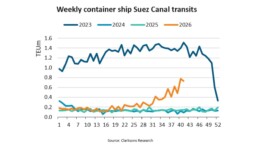
BIMCO Shipping Number of the Week
Suez Canal container ship transits exceed 50% of pre-disruption levels "During the first two weeks of October, weekly container ship capacity…
Subscribe to our newsletter!
if you dont want to swim alone in the ocean of news, sign up for the newsletter, and you will receive daily all the important news of world shipping!
