OP-ED: Empty Ships, Empty Seas
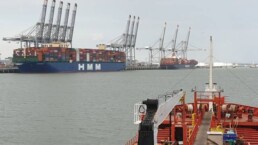

Reporting for Human Rights at Sea and following her previous OP-EDs, Port of London Authority Pilot, Ms. Ivana Carrioni-Burnett, provides another personal insight during the COVID-19 crisis.
“The current plight many seafarers are facing, unable to crew change or return home, is being described by many voices within the maritime community as the next humanitarian crisis.
At present, the solution being adopted by a significant number of flag states, companies and crewing agencies across the globe is to extend the contracts of those currently at sea. The continual extension of seafarer’s contracts, on a large scale, is not a sustainable solution. It does not take into account the increasing levels of exhaustion and deteriorating mental health of those onboard. Nor does it consider those seafarers stuck ashore, unable to financially support themselves and their families, who will in time look for work elsewhere.
There have been some suggestions that seafarers should go on strike or shipping should be suspended. What would such a world look like from a UK perspective?
Inevitably, there will be a run on the fuel stations. Just as toilet rolls flew off the shelves earlier in the year, any hint that demand could outstretch supply will cause queues and an increase in fuel prices. If it happens in reality, working from home will again become the norm as commuting in your own vehicle comes at too great a cost. The government will prioritise fuel to the emergency services, the military and the agricultural sector, not the general public.
Which may come as a good thing as there will be no more car imports. You may have been saving up for the latest BMW or Audi or Volkswagen, your preference may be for a Peugeot, a Renault or a Mazda. Instead you will have to buy a car made in Britain: a Vauxhall Astra, a Nissan Qashqai or a Honda Civic. That is if all the parts are available in the UK and the machinery, computer parts or electronics are not also among the imports no longer arriving in the country.
The common weekly shop will become a challenge, especially in the supermarkets which usually boast the greatest savings, selling produce from European countries. The shops which sell the most British produce will fare a little better, until supply no longer meets demand. At the height of the COVID 19 pandemic, fishermen who once sold their catch to restaurants or suppliers in Europe had to diversify rapidly in order to sell directly to the public. This will become commonplace, not just for fishermen but for farmers too. However, it will only work locally and they will not be able to supply the UK in its entirety. Allotments will see a surge in popularity and the COVID inspired gardeners will be forced to make their efforts a success. Dig for Britain posters will be back on the streets, a century after they were first used. City dwellers will have to queue in the fruit and vegetable aisles for fresh produce while the millennials learn to use a tin opener on canned vegetables.
GPs and doctors may even start prescribing vitamins. However, prescriptions will be another challenge as the list of medicines usually imported rapidly shrinks along with medical equipment. This will increase the strain on an already overburdened healthcare system. It will become common for pharmacies to refer patients back to their doctor when they run out of supply, recommending alternatives. Hospitals will have to share vital pieces of equipment and waiting-lists will continue to grow. There could be life-threatening consequences.
The government may start chartering flights to ensure vital imports and exports can continue.
The real issue will be in the winter. A significant percentage of gas arrives in the UK via LNG tankers, which then gets stored until required. Demand usually goes up during the colder months as we turn up our thermostats to heat our homes. This demand is also shared with the gas-fired power stations providing our electricity. A demand which will not be met if the gas ships are not operating.
Then there are the jobs which will be lost; not just the jobs in the ports and dockyards around the country… the truckdrivers who ferry the goods from the port to the distribution centres, the staff in the distribution centres, the suppliers without goods to sell… the technicians and engineers with no ships to work on or safety equipment to certify; the maritime schools; the marine insurance companies…
If such a scenario arose, the real solution would be British ships with British seafarers. Each country with its own ships and its own crews. Except world trade is just that: global. Economics is governed by trade, across borders. Countries are unable to meet the demands of their citizens solely with the produce of their own lands. Shipbuilding itself is an international feat.
In the UK, we would be rationing well before enough British ships, with enough British sailors, could sustain the current levels of shipping trade to and from Britain.
This is obviously all conjecture.
The truth of the matter is the significance shipping has on our daily lives. Shipping does not exist without seafarers. The health and well-being of seafarers, therefore, is something we should all have an interest in. We must take an interest in them.”
Source: Human Rights at Sea by Ivana Maria Carrioni-Burnett



Related News.

Navigating the Multi-Orbit Era: In Conversation with Intellian’s Jon Harrison at SMM 2026
At SMM 2026 in Hamburg, the rapid evolution of maritime satellite communications took centre stage. Across the exhibition halls, discussions among…
Cyprus ports need joint energy and investment strategy, shipping agents chief says
Cyprus needs a coordinated strategy for shipping, energy and environmental protection to support port investment and modernisation, Cyprus shipping…

MASO Public Affairs introduces MASO Regulatory Intelligence
A new subscription service helping businesses understand what is changing and what it means for them MASO Public Affairs introduces MASO Regulatory…
Anglo-Eastern helps turn CMBTECH’s ammonia ambition into an operational reality
From early feasibility study and risk-based design to newbuilding supervision, crew readiness and technical management, Anglo-Eastern drew on its…

Escalation of attacks threatens to derail recovery in Middle East oil exports
World oil demand is forecast to fall by 2.5 mb/d y-o-y in 4Q26 and 2.6 mb/d on average in 2026. As the Iran war manifests itself through restricted…

New study finds shipping pays twice its share to EU ETS earmarked revenues should triple to help build market for sustainable fuels and technologies
Shipping is responsible for around 10% of EU ETS emissions but pays almost 20% of the ETS bill. Unlike other sectors, it has never received free…

MSARC strengthens maritime mass rescue readiness through training and national live exercise off Dakar, Senegal
Joint MSARC–FHAS programme combines three days of SAR training with a national multi-agency live exercise The Maritime Search and Rescue Council ,…
Sogese report deliveries are still being delayed as container freight rates fluctuate
FOR IMPORTERS Spot rates into the Mediterranean are back at January levels, Far East to Europe reliability sits at pandemic lows, and nearly…

Glencore begins trading on Australian Securities Exchange
Glencore has begun trading on the Australian Securities Exchange under the ASX code GLC. Gary Nagle, Glencore’s CEO, said it was an exciting day for…
BIMCO Shipping Number of the Week
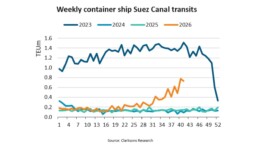
Suez Canal container ship transits exceed 50% of pre-disruption levels "During the first two weeks of October, weekly container ship capacity…
Subscribe to our newsletter!
if you dont want to swim alone in the ocean of news, sign up for the newsletter, and you will receive daily all the important news of world shipping!
