World’s first full scale ammonia engine test – an important step towards carbon free shipping
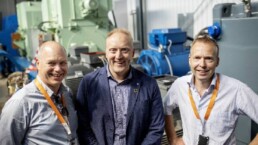

The technology group Wärtsilä, in close customer cooperation with Knutsen OAS Shipping AS and Repsol, as well as with the Sustainable Energy Catapult Centre, will commence the world’s first long term, full-scale, testing of ammonia as a fuel in a marine four-stroke combustion engine. The testing is made possible by a 20 MNOK grant from the Norwegian Research Council through the DEMO 2000 programme.
“This is a great example that illustrates the importance of dedicated petroleum R&D. This DEMO 2000 project is another steppingstone for reaching our ambitious climate targets and it is also aligned with our recently published hydrogen strategy. We need to develop and use new technologies that reduce emissions. We are very happy to support development work that can lead to increased use of ammonia as a fuel in shipping and in the offshore sector. Know-how from this project will also provide important input to the development of regulations for the use of ammonia and other low-carbon fuels”, says Tina Bru, Norwegian Minister of Petroleum and Energy.
Ammonia is promising as a carbon-free fuel for marine applications, in view of the maritime industry’s need to fulfil the International Maritime Organisation’s vision of reducing greenhouse gas emissions from shipping by at least 50 percent by 2050. Furthermore, ammonia has huge potential for providing green energy to remote power systems, such as offshore installations on the Norwegian Continental Shelf.
Development work by Wärtsilä, as it prepares for the use of ammonia as a fuel, continues with this testing programme, which will be the world`s first full-scale four-stroke combustion engine test. The project will commence in the Sustainable Energy Catapult Centre’s testing facilities at Stord, Norway during the first quarter of 2021.
“We are really excited to further develop and understand the combustion properties of ammonia as a carbon free fuel in one of our multi-fuel engines”, says Egil Hystad, General Manager, Market Innovation at Wärtsilä Marine Business.
“Ammonia storage and supply systems will be designed and developed for maximum personal safety, and in parallel with the Fuel Gas Handling System under development as part of the EU project ShipFC. This project is coordinated by NCE Maritime CleanTech, and it involves an ammonia driven fuel cell which will be tested on the Eidesvik Offshore supply vessel, Viking Energy”, Hystad continues.
From testing to real operations
Wärtsilä, as part of its development work on future fuels, has studied the use of ammonia as a future carbon-free fuel through the ZEEDS initiative. The company’s first ammonia combustions tests were commenced in Vaasa, Finland, in winter 2020, and will continue with this long-term testing at the Sustainable Energy Catapult Centre facilities in Stord.
“We are extremely pleased to be part of this project that will prove for the industry the robustness of ammonia as fuel. The project confirms our test facilities’ and Norway’s leading position within the testing and development of solutions for the use of maritime carbon-free fuels”, says Willie Wågen, CEO of Sustainable Energy Catapult Centre. The centre is part of the Norwegian Catapult programme that facilitates a national infrastructure for innovation. The programme is run by SIVA in close cooperation with Innovation Norway and the Norwegian Research Council and financed by the Norwegian Ministry of Trade, Industry and Fisheries.
The full-scale fuel testing programme can pave the way for ammonia engines to be used in real vessel operations within few years, and several shipowners have shown interest in this possibility. It will also provide important insights into the long-term effect of an ammonia fuelled engine in relation to other systems and components in a vessel, including the required safety measures.
Close cooperation between the government and industry
“A future implementation of ammonia as a carbon free fuel, combined with clean energy production from offshore wind or other renewable energy sources can be the start of a new industrial era for the Norwegian industry”, Egil Hystad points out.
“The Norwegian culture for collaboration and knowledge sharing across different companies and sectors, is a great support in closing big technology gaps. The assistance, cooperation and funding from governmental institutions are essential to drive the change towards a carbon free future”, he continues.



Related News.

Navigating the Multi-Orbit Era: In Conversation with Intellian’s Jon Harrison at SMM 2026
At SMM 2026 in Hamburg, the rapid evolution of maritime satellite communications took centre stage. Across the exhibition halls, discussions among…

Cyprus ports need joint energy and investment strategy, shipping agents chief says
Cyprus needs a coordinated strategy for shipping, energy and environmental protection to support port investment and modernisation, Cyprus shipping…

MASO Public Affairs introduces MASO Regulatory Intelligence
A new subscription service helping businesses understand what is changing and what it means for them MASO Public Affairs introduces MASO Regulatory…

Anglo-Eastern helps turn CMBTECH’s ammonia ambition into an operational reality
From early feasibility study and risk-based design to newbuilding supervision, crew readiness and technical management, Anglo-Eastern drew on its…

Escalation of attacks threatens to derail recovery in Middle East oil exports
World oil demand is forecast to fall by 2.5 mb/d y-o-y in 4Q26 and 2.6 mb/d on average in 2026. As the Iran war manifests itself through restricted…

New study finds shipping pays twice its share to EU ETS earmarked revenues should triple to help build market for sustainable fuels and technologies
Shipping is responsible for around 10% of EU ETS emissions but pays almost 20% of the ETS bill. Unlike other sectors, it has never received free…

MSARC strengthens maritime mass rescue readiness through training and national live exercise off Dakar, Senegal
Joint MSARC–FHAS programme combines three days of SAR training with a national multi-agency live exercise The Maritime Search and Rescue Council ,…

Sogese report deliveries are still being delayed as container freight rates fluctuate
FOR IMPORTERS Spot rates into the Mediterranean are back at January levels, Far East to Europe reliability sits at pandemic lows, and nearly…

Glencore begins trading on Australian Securities Exchange
Glencore has begun trading on the Australian Securities Exchange under the ASX code GLC. Gary Nagle, Glencore’s CEO, said it was an exciting day for…

BIMCO Shipping Number of the Week
Suez Canal container ship transits exceed 50% of pre-disruption levels "During the first two weeks of October, weekly container ship capacity…
Subscribe to our newsletter!
if you dont want to swim alone in the ocean of news, sign up for the newsletter, and you will receive daily all the important news of world shipping!
