Crew training will move online post pandemic predicts Danica


Seafarer training will change significantly as a result of the coronavirus pandemic predicts crew manager Henrik Jensen.
Crew learning has transferred almost exclusively to online methods due to the worldwide travel bans and quarantine restrictions imposed across the globe.
And Mr Jensen says he expects it to remain this way post-pandemic as the maritime industry becomes accustomed to new ways of working and studying.
“The Covid-19 coronavirus outbreak has forced us all to implement distance learning and, as a result, the maritime training sector has taken a big step forward in embracing the digital evolution which, in all probability, they should have taken five years ago,” he said.
“I think this will be the way forward for the maritime sector. This move was already happening but has been accelerated by the pandemic. There should be no difference in the standard of a seafarer who qualifies online and one who does so in person, and the cost savings for employers and seafarers are important at this difficult time.”
Many seafarers are also finding the digital revolution in maritime training to be beneficial. Mr Jensen points out that online methods, properly supported by mentoring or one-to-one digital support, enable students to learn in their own time and environment which can improve concentration, confidence and commitment.
“Online training is often more flexible,” he pointed out, “It often combines a mix of online tutorials, self-work and one-to-one teaching, backed up by verification processes.
“There are of course still training courses which need to be transited from the classroom format to the digital platform but is inevitably going to happen now. I believe that only training for the development of practical, hands-on skills such as welding, or bridge and engine simulation where the physical equipment is necessary, will continue in the same way – and even these may become a blended format, providing training spread between the online platform and a simulator,” he explained.
Mr Jensen, who specialises in the supply of Eastern European crew, even expects his own classroom-based crew training department to be impacted by the switch to online learning. He foresees training providers becoming more globally spread as the reliance on classroom training, which often incurs travel and accommodation costs, subsides.
He commented: “The development costs are high for many courses and a large through-put of students is needed to cover costs. With digital and online training methods the teacher does not have to be in the same physical location as the student making it possible for a teacher in the Philippines or India to easily train seafarers in Ukraine and Russia for example. This will open up the training marketplace to new competition.”
Source: Danica



Related News.

Navigating the Multi-Orbit Era: In Conversation with Intellian’s Jon Harrison at SMM 2026
At SMM 2026 in Hamburg, the rapid evolution of maritime satellite communications took centre stage. Across the exhibition halls, discussions among…
Cyprus ports need joint energy and investment strategy, shipping agents chief says
Cyprus needs a coordinated strategy for shipping, energy and environmental protection to support port investment and modernisation, Cyprus shipping…

MASO Public Affairs introduces MASO Regulatory Intelligence
A new subscription service helping businesses understand what is changing and what it means for them MASO Public Affairs introduces MASO Regulatory…
Anglo-Eastern helps turn CMBTECH’s ammonia ambition into an operational reality
From early feasibility study and risk-based design to newbuilding supervision, crew readiness and technical management, Anglo-Eastern drew on its…

Escalation of attacks threatens to derail recovery in Middle East oil exports
World oil demand is forecast to fall by 2.5 mb/d y-o-y in 4Q26 and 2.6 mb/d on average in 2026. As the Iran war manifests itself through restricted…
New study finds shipping pays twice its share to EU ETS earmarked revenues should triple to help build market for sustainable fuels and technologies
Shipping is responsible for around 10% of EU ETS emissions but pays almost 20% of the ETS bill. Unlike other sectors, it has never received free…
MSARC strengthens maritime mass rescue readiness through training and national live exercise off Dakar, Senegal
Joint MSARC–FHAS programme combines three days of SAR training with a national multi-agency live exercise The Maritime Search and Rescue Council ,…

Sogese report deliveries are still being delayed as container freight rates fluctuate
FOR IMPORTERS Spot rates into the Mediterranean are back at January levels, Far East to Europe reliability sits at pandemic lows, and nearly…

Glencore begins trading on Australian Securities Exchange
Glencore has begun trading on the Australian Securities Exchange under the ASX code GLC. Gary Nagle, Glencore’s CEO, said it was an exciting day for…
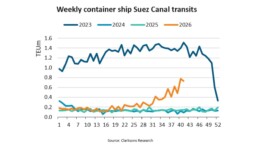
BIMCO Shipping Number of the Week
Suez Canal container ship transits exceed 50% of pre-disruption levels "During the first two weeks of October, weekly container ship capacity…
Subscribe to our newsletter!
if you dont want to swim alone in the ocean of news, sign up for the newsletter, and you will receive daily all the important news of world shipping!
