OP-ED. Crew Voices: Fearful, Frustrated, Fatigued, Forgotten
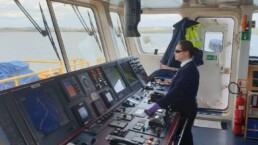

Reporting for Human Rights at Sea and following her first OP-ED on 13 April, ‘A UK Marine Pilot’s Perspective of Seafarer’s Challenges‘, Port of London Authority Pilot, Ms. Ivana Carrioni-Burnett, provides another insight from her recent experiences in UK waters in relation to her interactions with seafarers during the COVID-19 crisis.
Fearful, Frustrated, Fatigued, Forgotten
These are the feelings which have been voiced by the crews I have been in contact with during pilotage operations these last few weeks.
We have heard this said about many keyworkers in the UK over the last couple of months. First it was the NHS, then care workers and social workers, then bus drivers, train operators, lorry drivers and the supermarkets.
What about seafarers? Across all social media platforms, on all radio stations and in every news bulletin there seems to be no mention of these forgotten few (million!) unless you are connected with someone in the maritime industry.
Thankfully, the UK Government has exempted “seamen and masters” from their recent quarantine regulations. However, this does not help those seafarers whose home nations have no flights or whose reliefs cannot fly out from their place of residence. There are still many restrictions and limitations around the world which do not exempt seafarers.
Throughout the COVID19 pandemic, there has been no singular response or effort. Despite global networks, systems and businesses, each country has responded uniquely to the crisis. Despite the economic reliance every country has on many other nations and states, I do not believe the maritime industry has been adequately recognised.
The result has been a wide variety of policies, regulations and recommendations based on everything from science and logic to fake news and conspiracy theories. This poses a unique challenge to seafarers who may work for a crewing agency based in one country, while employed on a ship flagged in another country and run by a shipping company in a third country; all the while travelling between yet more countries, transporting goods and materials. Whose rules should they follow?
Shipping and trade is, by its very nature, a cross-border operation. Policies to protect seafarers should work across such boundaries. COVID19 does not recognise borders.
The mixed messages and mis-information have only caused more anxiety and fear, both ashore and at sea. The results are two-fold: first anger and frustration which soon becomes hopelessness and despair.
Performing safety critical duties with someone who has these feelings is challenging and difficult: giving those individuals the space to vent or providing encouragement and support, while protecting yourself, is a balancing act. Doing so while you are experiencing the same emotions is even more challenging.
We have recently ‘celebrated’ Mental Health Awareness Week.
Isolation. Fatigue. Stress. Fear. Anxiety. Lack of control. Lack of information.
These are all contributing factors to poor mental health. How much more are these experienced by seafarers, stuck onboard with only a few crewmates and limited access to internet, at work continuously for months, not knowing when they can disembark or how they will get home when they do, worried about their friends and families ashore?
Recently, a Dutch master was trying to explain something to me and he was visibly struggling to find the right words in English. He apologised, saying, “Sorry, I am fatigued.” In my experience, the Dutch have incredibly good English, sometimes better than many Englishmen. It takes a lot for someone in a professional environment to admit that they are so tired that they are struggling to articulate.
This ship had been conducting many shorts transits across the channel and around the west coast of Europe. These short journeys put particular stress on the crew as much of the time is spent either in pilotage with the master on the bridge, or in close-quarters shipping situations or conducting cargo operations. On departing London, many crews look forward to a longer transit, for example, to Belfast, the west coast of Scotland or Spain: it allows the crews to settle into a routine and rest.
Over the last few years, there have been a number of studies which suggest that between 75% and 96% of all marine accidents are the result of human error. It is only a matter of time before COVID19 starts taking lives at sea; not directly due to the virus but because of the inadequate support seafarers are receiving.
In an economically vital industry that has seen declining recruitment numbers in recent years, we now have a fantastic opportunity to appreciate our seafarers and their sacrifices; not with clapping or empty promises, but with meaningful and significant enhancements to both their facilities and welfare support.
We must work towards a comprehensive and globally sustainable shipping solution. Who is onboard?!
Source: Human Rights at Sea



Related News.

Navigating the Multi-Orbit Era: In Conversation with Intellian’s Jon Harrison at SMM 2026
At SMM 2026 in Hamburg, the rapid evolution of maritime satellite communications took centre stage. Across the exhibition halls, discussions among…
Cyprus ports need joint energy and investment strategy, shipping agents chief says
Cyprus needs a coordinated strategy for shipping, energy and environmental protection to support port investment and modernisation, Cyprus shipping…

MASO Public Affairs introduces MASO Regulatory Intelligence
A new subscription service helping businesses understand what is changing and what it means for them MASO Public Affairs introduces MASO Regulatory…
Anglo-Eastern helps turn CMBTECH’s ammonia ambition into an operational reality
From early feasibility study and risk-based design to newbuilding supervision, crew readiness and technical management, Anglo-Eastern drew on its…

Escalation of attacks threatens to derail recovery in Middle East oil exports
World oil demand is forecast to fall by 2.5 mb/d y-o-y in 4Q26 and 2.6 mb/d on average in 2026. As the Iran war manifests itself through restricted…
New study finds shipping pays twice its share to EU ETS earmarked revenues should triple to help build market for sustainable fuels and technologies
Shipping is responsible for around 10% of EU ETS emissions but pays almost 20% of the ETS bill. Unlike other sectors, it has never received free…
MSARC strengthens maritime mass rescue readiness through training and national live exercise off Dakar, Senegal
Joint MSARC–FHAS programme combines three days of SAR training with a national multi-agency live exercise The Maritime Search and Rescue Council ,…

Sogese report deliveries are still being delayed as container freight rates fluctuate
FOR IMPORTERS Spot rates into the Mediterranean are back at January levels, Far East to Europe reliability sits at pandemic lows, and nearly…

Glencore begins trading on Australian Securities Exchange
Glencore has begun trading on the Australian Securities Exchange under the ASX code GLC. Gary Nagle, Glencore’s CEO, said it was an exciting day for…
BIMCO Shipping Number of the Week
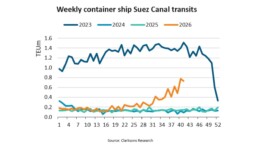
Suez Canal container ship transits exceed 50% of pre-disruption levels "During the first two weeks of October, weekly container ship capacity…
Subscribe to our newsletter!
if you dont want to swim alone in the ocean of news, sign up for the newsletter, and you will receive daily all the important news of world shipping!
