2016 déjà vu lurking as Baltic Dry Index lingers at lowest levels in decades
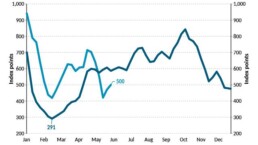

In yet another turn of extraordinary events, the Baltic Dry Index (BDI) is now hovering around the lowest level in at least 20 years.
The index currently sits at 520 index points (1 June 2020), 583 points below the reading one year ago and underscoring the difficulties currently faced by dry bulk shipowners.
While the advanced economies in Europe are starting to ease containment measures, the Covid-19 outbreak has already dealt a significant blow to the global economy, plunging both emerging markets and advanced economies into recession. Given that the dry bulk market thrives on global economic growth, the market outlook is bleak.
“The dry bulk market depends on global economic growth and with the current prospect of declining demand in 2020, the dry bulk outlook remains lacklustre for the rest of the year. The movements of the Baltic Dry Index in 2020, hovering at unusually low levels in June, underscores just how challenged the market is,” says BIMCO’s Chief Shipping Analyst, Peter Sand.
A 2016 déjà vu for dry bulk?
Some may argue that history repeats itself and the state of the dry bulk market is currently prompting flashbacks to previous years of extreme hardship. The year 2016 marked the bottom of the dry bulk market in recent decades, partly due to a slowdown of global economic activity, sluggish dry bulk demand in China and copious capacity in the market, caused by the largest ship delivery spree the market has ever seen. Consequentially, in 2016, the dry bulk fleet utilization rate also tumbled to the lowest level in this century, while the BDI bottomed out at 291 index points during the seasonal downturn of Q1 in 2016.
In May and early June 2020, the BDI reached the lowest level recorded for that period in the last 20 years. Overall, however, the BDI has yet to test the absolute low of the index. Nonetheless, 2020 is not a carbon copy of 2016, as the market is now facing a decline in demand with the global economy deep in recession. The dry bulk shipping market encountered such a decline in demand in 2009, but due to a relatively balanced supply-side back then, the market remained largely profitable that year.
“The dry bulk market is currently experiencing conditions seen in previous years of hardship. However, the conditions this time around also differ. With falling demand in 2020 and challenging fleet growth in recent years, the cards seem to be stacked against a year of profitability,” Sand says.
For now, it appears that the dry bulk market in 2020 has been served a toxic cocktail of the worst of both worlds with a drop in demand, as seen in 2009, but in addition, a substantial supply-side overcapacity as seen in 2016.
A Capesize-weighted index
The general dry bulk market started the year on a strong note on the back of a strong agricultural season in South America, much to the benefit of the Panamax and Supramax subsegments.
Yet, the market is currently facing some of the worst conditions in recent memory if only gauging by the BDI. Nonetheless, this is only half the story, as the BDI is weighted 40% to the Capesize subsegment, by far the worst performer of the dry bulk sectors in 2020.
On 31 January 2020, the Baltic Capesize Index (BCI) plummeted into negative territory for the first time since the index’s inception and subsequently remained sub-zero until the end of March 2020. Hereafter, the index recovered from the negative readings in line with usual seasonality, which was seemingly cut short, as the index once again briefly dipped to sub-zero territory on 13 May 2020. On 1 June 2020, the BCI stands at 82 index points, 1,568 points below the reading last year on 3 June 2019. At current earning levels (on 1 June 2020), Capesize owners are losing approximately USD 11,643 per day, losses which cannot be sustained for prolonged periods.
Disappointing off-season
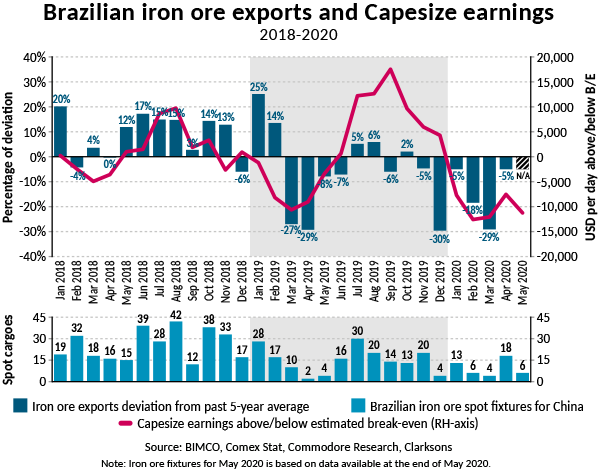
The tide in the Capesize market raises all boats, or subsegments in this case, so when conditions are gloomy, the rest of the market tends to feel the fallout. In 2020, the hardship of Capesize has largely been driven by relatively poor demand for iron ore, as witnessed by exports out of Brazil.
In the first four months of 2020, Brazil exported 93 million (m) tonnes of iron ore, 9% below last year’s levels. In April 2020, iron exports totalled 24 m, -5% below the 2015-2019 average, even with 18 spot iron fixtures headed for China. In the first four weeks of May, only six spot iron ore cargoes for China have been confirmed, suggesting that the total export figure for May will not be staggering either.
The decoupling of steel production and iron ore imports
China remains the largest demand driver for iron ore, but Chinese imports of iron ore portrays a less gruesome picture than what has been observed in the Capesize market. Chinese imports of iron ore are up 5% in total volumes year-on-year, not necessarily astonishing growth, but not fully explaining the adversity of the Capesize subsegment.
Chinese production of crude steel, one of the headline indicators for iron ore demand, has only risen by 1% in the first four months of 2020, according to data from the National Bureau of Statistics China. In part, this slowdown of steel production can be ascribed to the Covid-19 containment measures during Q1, which temporarily immobilized the Chinese labour force. However, BIMCO has previously documented a more structural change in the Chinese steel industry, which is increasingly embracing circular initiatives.
In a bid to address environmental pollution, the steel mills in China have started to shift away from blast furnaces, which utilize iron ore in its production, to the electric arc furnaces which can substitute the iron ore with scrap steel. This substitution diminishes the need for iron ore imports and is likely a trend that will continue to weigh on the Capesize market in the coming years.
A call for stimulus
Following the Global Financial Crisis in 2008, the Chinese government implemented wide-ranging fiscal stimulus. The stimulus aided a broad range of heavy industries while focusing on infrastructure and housing, much to the benefit of the Capesize subsegment and general dry bulk market. In 2020, the Chinese government is similarly faced with an economic slowdown that could damage their economy if adequate stimulus is not implemented. Nonetheless, conditions are different this time around.
First off, China’s infrastructure has undergone massive developments in the past decade, and it is limited how much additional capital can be allocated to infrastructure projects. Furthermore, stimulus will increasingly be directed at spurring consumer spending with smaller knock-on effects for the general dry bulk market.
Lastly, on 21 May 2020, the Chinese government suspended its economic growth target for 2020. This partly reflects significant uncertainty about the global economy but is also an indication that the government will no longer promise economic growth at any cost.
“In the years following the global financial crisis, Chinese economic stimulus was the saving grace for the dry bulk market, but several factors are currently suggesting that 2020 will not unfold along the same lines. The dry bulk market is likely to recover gradually and at a slow pace alongside the global economy, but losses from the first half of the year will be difficult to recoup, even with a large-scale roll out of stimulus,” says Sand.
Massive stimulus packages in China would perhaps be one of the only factors that could turn the tide of the dry bulk market back to sustained profitability, but as the world has learned in 2020, expectations should not be set too high. However, for now, it is one of few scenarios which could save the dry bulk market in 2020 from a repeat of 2016.
Source: BIMCO



Related News.

Navigating the Multi-Orbit Era: In Conversation with Intellian’s Jon Harrison at SMM 2026
At SMM 2026 in Hamburg, the rapid evolution of maritime satellite communications took centre stage. Across the exhibition halls, discussions among…

Cyprus ports need joint energy and investment strategy, shipping agents chief says
Cyprus needs a coordinated strategy for shipping, energy and environmental protection to support port investment and modernisation, Cyprus shipping…

MASO Public Affairs introduces MASO Regulatory Intelligence
A new subscription service helping businesses understand what is changing and what it means for them MASO Public Affairs introduces MASO Regulatory…

Anglo-Eastern helps turn CMBTECH’s ammonia ambition into an operational reality
From early feasibility study and risk-based design to newbuilding supervision, crew readiness and technical management, Anglo-Eastern drew on its…

Escalation of attacks threatens to derail recovery in Middle East oil exports
World oil demand is forecast to fall by 2.5 mb/d y-o-y in 4Q26 and 2.6 mb/d on average in 2026. As the Iran war manifests itself through restricted…

New study finds shipping pays twice its share to EU ETS earmarked revenues should triple to help build market for sustainable fuels and technologies
Shipping is responsible for around 10% of EU ETS emissions but pays almost 20% of the ETS bill. Unlike other sectors, it has never received free…

MSARC strengthens maritime mass rescue readiness through training and national live exercise off Dakar, Senegal
Joint MSARC–FHAS programme combines three days of SAR training with a national multi-agency live exercise The Maritime Search and Rescue Council ,…

Sogese report deliveries are still being delayed as container freight rates fluctuate
FOR IMPORTERS Spot rates into the Mediterranean are back at January levels, Far East to Europe reliability sits at pandemic lows, and nearly…

Glencore begins trading on Australian Securities Exchange
Glencore has begun trading on the Australian Securities Exchange under the ASX code GLC. Gary Nagle, Glencore’s CEO, said it was an exciting day for…

BIMCO Shipping Number of the Week
Suez Canal container ship transits exceed 50% of pre-disruption levels "During the first two weeks of October, weekly container ship capacity…
Subscribe to our newsletter!
if you dont want to swim alone in the ocean of news, sign up for the newsletter, and you will receive daily all the important news of world shipping!
