EU Commission approves €600 million Finnish guarantee scheme to support maritime companies affected by the coronavirus outbreak


The European Commission has approved a €600 million Finnish aid scheme to support the maritime companies in the context of the coronavirus outbreak. The scheme was approved under the State aid Temporary Framework adopted by the Commission on 19 March 2020, as amended on 3 April and 8 May 2020.
Executive Vice-President Margrethe Vestager, in charge of competition policy, said: “This €600 million Finnish guarantee scheme will help those maritime companies that transport essential supplies to Finland and are affected by the current coronavirus crisis to cover their immediate working capital needs and continue their activities. This is the first scheme we have approved specifically designed to support the maritime sector in these difficult times. We continue to work closely with all Member States to ensure that national support measures can be put in place in a timely, coordinated and effective way, in line with EU rules.”
The Finnish support measure
Finland notified to the Commission under the Temporary Frameworka €600 million guarantee scheme to support maritime companies affected by the coronavirus outbreak. Under the scheme, the public support will take the form of State guarantees on working capital loans. The measure will be directly operated by the Finnish State Treasury.
The scheme will be accessible to those maritime operators that are essential for maintaining the security of supply to Finland during the coronavirus outbreak. The aim of the measure is to help these companies cover their immediate working capital needs, maintain employment and have sufficient liquidity to continue their activities, which are vital to safeguard maritime cargo traffic and ensure essential supplies to Finland.
The Commission found that the Finnish measure is in line with the conditions set out in the Temporary Framework. In particular: (i) the underlying loan amount per company is limited to what is needed to cover its liquidity needs for the foreseeable future, (ii) the guarantees will only be provided until the end of this year, (iii) the guarantees are limited to a maximum six-year duration, and (iv) guarantee fee premiums comply with the minimum levels foreseen by the Temporary Framework; (v) the risk taken by the State is limited to up to 90%.
The Commission concluded that the Finnish measure is necessary, appropriate and proportionate to remedy a serious disturbance in the economy of a Member State, in line with Article 107(3)(b) TFEU and the conditions set out in the Temporary Framework.
On this basis, the Commission approved the measure under EU State aid rules.
Background
The Commission has adopted a Temporary Framework to enable Member States to use the full flexibility foreseen under State aid rules to support the economy in the context of the coronavirus outbreak. The Temporary Framework, as amended on 3 April and 8 May 2020, provides for the following types of aid, which can be granted by Member States:
(i) Direct grants, equity injections, selective tax advantages and advance payments of up to €100,000 to a company active in the primary agricultural sector, €120,000 to a company active in the fishery and aquaculture sector and €800,000 to a company active in all other sectors to address its urgent liquidity needs. Member States can also give, up to the nominal value of €800,000 per company zero-interest loans or guarantees on loans covering 100% of the risk, except in the primary agriculture sector and in the fishery and aquaculture sector, where the limits of €100,000 and €120,000 per company respectively, apply.
(ii) State guarantees for loans taken by companies to ensure banks keep providing loans to the customers who need them. These state guarantees can cover up to 90% of risk on loans to help businesses cover immediate working capital and investment needs.
(iii) Subsidised public loans to companies (senior and subordinated debt) with favourable interest rates to companies. These loans can help businesses cover immediate working capital and investment needs.
(iv) Safeguards for banks that channel State aid to the real economy that such aid is considered as direct aid to the banks’ customers, not to the banks themselves, and gives guidance on how to ensure minimal distortion of competition between banks.
(v) Public short-term export credit insurance for all countries, without the need for the Member State in question to demonstrate that the respective country is temporarily “non-marketable”.
(vi) Support for coronavirus related research and development (R&D) to address the current health crisis in the form of direct grants, repayable advances or tax advantages. A bonus may be granted for cross-border cooperation projects between Member States.
(vii) Support for the construction and upscaling of testing facilities to develop and test products (including vaccines, ventilators and protective clothing) useful to tackle the coronavirus outbreak, up to first industrial deployment. This can take the form of direct grants, tax advantages, repayable advances and no-loss guarantees. Companies may benefit from a bonus when their investment is supported by more than one Member State and when the investment is concluded within two months after the granting of the aid.
(viii) Support for the production of products relevant to tackle the coronavirus outbreak in the form of direct grants, tax advantages, repayable advances and no-loss guarantees. Companies may benefit from a bonus when their investment is supported by more than one Member State and when the investment is concluded within two months after the granting of the aid.
(ix) Targeted support in the form of deferral of tax payments and/or suspensions of social security contributions for those sectors, regions or for types of companies that are hit the hardest by the outbreak.
(x) Targeted support in the form of wage subsidies for employees for those companies in sectors or regions that have suffered most from the coronavirus outbreak, and would otherwise have had to lay off personnel.
(xi) Targeted recapitalisation aid to non-financial companies, if no other appropriate solution is available. Safeguards are in place to avoid undue distortions of competition in the Single Market: conditions on the necessity, appropriateness and size of intervention; conditions on the State’s entry in the capital of companies and remuneration; conditions regarding the exit of the State from the capital of the companies concerned; conditions regarding governance including dividend ban and remuneration caps for senior management; prohibition of cross-subsidisation and acquisition ban and additional measures to limit competition distortions; transparency and reporting requirements.
The Temporary Framework enables Member States to combine all support measures with each other, except for loans and guarantees for the same loan and exceeding the thresholds foreseen by the Temporary Framework. It also enables Member States to combine all support measures granted under the Temporary Framework with existing possibilities to grant de minimis to a company of up to €25,000 over three fiscal years for companies active in the primary agricultural sector, €30,000 over three fiscal years for companies active in the fishery and aquaculture sector and €200,000 over three fiscal years for companies active in all other sectors. At the same time, Member States have to commit to avoid undue cumulation of support measures for the same companies to limit support to meet their actual needs.
Furthermore, the Temporary Framework complements the many other possibilities already available to Member States to mitigate the socio-economic impact of the coronavirus outbreak, in line with EU State aid rules. On 13 March 2020, the Commission adopted a Communication on a Coordinated economic response to the COVID-19 outbreak setting out these possibilities. For example, Member States can make generally applicable changes in favour of businesses (e.g. deferring taxes, or subsidising short-time work across all sectors), which fall outside State Aid rules. They can also grant compensation to companies for damage suffered due to and directly caused by the coronavirus outbreak.
The Temporary Framework will be in place until the end of December 2020. As solvency issues may materialise only at a later stage as this crisis evolves, for recapitalisation measures only the Commission has extended this period until the end of June 2021. With a view to ensuring legal certainty, the Commission will assess before those dates if it needs to be extended.
The non-confidential version of the decision will be made available under the case number SA.57192 in the State aid register on the Commission’s competition website once any confidentiality issues have been resolved. New publications of State aid decisions on the internet and in the Official Journal are listed in the State Aid Weekly e-News.



Related News.
Navigating the Multi-Orbit Era: In Conversation with Intellian’s Jon Harrison at SMM 2026
At SMM 2026 in Hamburg, the rapid evolution of maritime satellite communications took centre stage. Across the exhibition halls, discussions among…
Cyprus ports need joint energy and investment strategy, shipping agents chief says
Cyprus needs a coordinated strategy for shipping, energy and environmental protection to support port investment and modernisation, Cyprus shipping…

MASO Public Affairs introduces MASO Regulatory Intelligence
A new subscription service helping businesses understand what is changing and what it means for them MASO Public Affairs introduces MASO Regulatory…
Anglo-Eastern helps turn CMBTECH’s ammonia ambition into an operational reality
From early feasibility study and risk-based design to newbuilding supervision, crew readiness and technical management, Anglo-Eastern drew on its…
Escalation of attacks threatens to derail recovery in Middle East oil exports
World oil demand is forecast to fall by 2.5 mb/d y-o-y in 4Q26 and 2.6 mb/d on average in 2026. As the Iran war manifests itself through restricted…
New study finds shipping pays twice its share to EU ETS earmarked revenues should triple to help build market for sustainable fuels and technologies
Shipping is responsible for around 10% of EU ETS emissions but pays almost 20% of the ETS bill. Unlike other sectors, it has never received free…

MSARC strengthens maritime mass rescue readiness through training and national live exercise off Dakar, Senegal
Joint MSARC–FHAS programme combines three days of SAR training with a national multi-agency live exercise The Maritime Search and Rescue Council ,…
Sogese report deliveries are still being delayed as container freight rates fluctuate
FOR IMPORTERS Spot rates into the Mediterranean are back at January levels, Far East to Europe reliability sits at pandemic lows, and nearly…
Glencore begins trading on Australian Securities Exchange
Glencore has begun trading on the Australian Securities Exchange under the ASX code GLC. Gary Nagle, Glencore’s CEO, said it was an exciting day for…
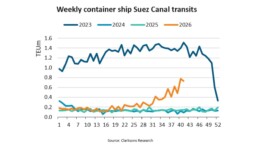
BIMCO Shipping Number of the Week
Suez Canal container ship transits exceed 50% of pre-disruption levels "During the first two weeks of October, weekly container ship capacity…
Subscribe to our newsletter!
if you dont want to swim alone in the ocean of news, sign up for the newsletter, and you will receive daily all the important news of world shipping!
