British Ports Association – Green Maritime Fund Critical to Emissions Reductions
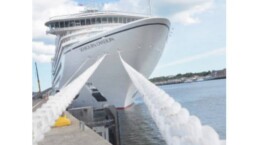

- New research finds that no ports in the world have installed cold ironing (shore to ship electricity) without public funding or subsidy
- Green maritime fund needed in UK to support emissions reductions, including support for shore power where it is viable
- BPA willing to discuss viability of a zero-emission standard with wider maritime industry as a way to drive demand and certainty for green investment
The British Ports Association has published new research examining the barriers to shore power in UK ports, setting out three proposals to support the industry to meet ambitious emissions reductions targets.
Shore power, also known as cold ironing, is the provision of shore-based electricity to ships at berth, allowing them to turn off their auxiliary engines. These auxiliary engines are used for crew and passenger accommodation and cargo operations (such as pumps or heating or cooling systems) and typically use a type of diesel. Shore connections either provide power from the grid or nearby generation sources. They are commonly fixed at one berth but mobile solutions (by barge) are also in operation.
There are currently no large scale shore power connections in UK ports, due to the prohibitively high capital costs associated with such projects. The price of electricity in the UK and a general lack of consistent demand also means that there is rarely a commercially viable business case for investing in shore power. Such systems, however, have the potential to significantly reduce emissions from ships at berth.
The report identifies three primary barriers and three proposed solutions:
Primary Barriers
- High capital costs, both within the port and associated with energy network upgrades
- High electricity prices make it difficult to compete with relatively cheap marine fuel
- A lack of consistent demand from shipping, although that may be starting to turn for some parts of some sectors
Proposals
- a Green Maritime Fund to support emissions reductions projects, including shore power
- The removal of taxes on electricity from shoreside power in line with that available for marine fuel
- Goal-based approach to increasing demand, such as a zero emission berth standard
Commenting on the report, Mark Simmonds, Head of Policy at the British Ports Association, said:
Shipping remains the most efficient way to move freight to, from, and around the UK. We recognise that whilst emissions from ports and ships are relatively small parts of the emissions puzzle, there is work to do to continue to bring them down.
Shore power is likely to play a role in reducing emissions from ships in ports in the future, but there are significant barriers to introducing it in UK ports. Government investment in green maritime to mirror investment in green vehicles is critical to helping the industry to continue to lower emissions.
We believe that a green maritime fund is needed to support decarbonisation in the ports and shipping sectors, but this alone will not overcome the challenges. We want to have a discussion about how a zero emission standard might help lower shipping emissions and bring greater certainty for ports and investors in low emission technology and infrastructure.
Research undertaken by Arkevista for the BPA found that the total power usage of vessels at berth in the UK was over 641 Gigawatt hours of energy in 2019 – roughly 0.5% of the UK’s total energy demand. Other findings include:
- Lack of demand: Whilst the number of vessels in the world fleet of 96,000 vessels with shore power is unclear, research suggests it is currently around 1500, with 809 of those container ships. Only 1.5% of ships on the order book currently will be ready to connect.
- High Electricity Costs: Electricity prices for big business users is over twice that (per kWh) than other countries where plugging in ships is common, making it difficult to compete with the cost of marine fuel
- Uncertain Energy Planning: Adding new capacity presents ports with punitive charges and risks ‘spiky’ demand, further inflating costs, whereas benefits accrue solely to port customers (i.e. ships). Just one shore connection could double the required electricity capacity needed by a port.
- Container and cruise ships look the most likely segments to be shore power ready in future, although these require the most electricity which presents technical problems. Some ferries and offshore service vessels (OSVs) are also be promising sectors
The research was supported with advice, expertise and experience from a number of BPA associate members, including Arkevista, Arup, Schneider Electric, TT Club, and UK Power Networks Services.
Mike Hughes, Schneider UK & Ireland Zone President, said:
We welcome the British Ports Association’s report examining the barriers to shore power connections in the UK. Research shows that by plugging into the power grid with 100 per cent renewable electricity and turning off their auxiliary diesel engines, ships at berth in the UK could reduce emissions equivalent to taking between 84,000 and 166,000 diesel buses, or 1.2 million diesel cars off our roads. As we look for ways to support a green recovery, shore-to-ship solutions powered by green energy represent an easy win. We would encourage the government to implement the report recommendations without delay and help ensure we can continue to enjoy the environmental benefits we are currently experiencing whilst supporting the economic recovery.



Related News.

Navigating the Multi-Orbit Era: In Conversation with Intellian’s Jon Harrison at SMM 2026
At SMM 2026 in Hamburg, the rapid evolution of maritime satellite communications took centre stage. Across the exhibition halls, discussions among…

Cyprus ports need joint energy and investment strategy, shipping agents chief says
Cyprus needs a coordinated strategy for shipping, energy and environmental protection to support port investment and modernisation, Cyprus shipping…

MASO Public Affairs introduces MASO Regulatory Intelligence
A new subscription service helping businesses understand what is changing and what it means for them MASO Public Affairs introduces MASO Regulatory…

Anglo-Eastern helps turn CMBTECH’s ammonia ambition into an operational reality
From early feasibility study and risk-based design to newbuilding supervision, crew readiness and technical management, Anglo-Eastern drew on its…

Escalation of attacks threatens to derail recovery in Middle East oil exports
World oil demand is forecast to fall by 2.5 mb/d y-o-y in 4Q26 and 2.6 mb/d on average in 2026. As the Iran war manifests itself through restricted…

New study finds shipping pays twice its share to EU ETS earmarked revenues should triple to help build market for sustainable fuels and technologies
Shipping is responsible for around 10% of EU ETS emissions but pays almost 20% of the ETS bill. Unlike other sectors, it has never received free…

MSARC strengthens maritime mass rescue readiness through training and national live exercise off Dakar, Senegal
Joint MSARC–FHAS programme combines three days of SAR training with a national multi-agency live exercise The Maritime Search and Rescue Council ,…

Sogese report deliveries are still being delayed as container freight rates fluctuate
FOR IMPORTERS Spot rates into the Mediterranean are back at January levels, Far East to Europe reliability sits at pandemic lows, and nearly…

Glencore begins trading on Australian Securities Exchange
Glencore has begun trading on the Australian Securities Exchange under the ASX code GLC. Gary Nagle, Glencore’s CEO, said it was an exciting day for…

BIMCO Shipping Number of the Week
Suez Canal container ship transits exceed 50% of pre-disruption levels "During the first two weeks of October, weekly container ship capacity…
Subscribe to our newsletter!
if you dont want to swim alone in the ocean of news, sign up for the newsletter, and you will receive daily all the important news of world shipping!
