IG Sanctions Response To The US Global Maritime Advisory
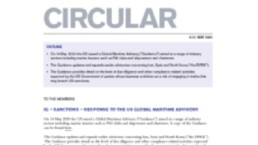

• On 14 May 2020 the US issued a Global Maritime Advisory (“Guidance”) aimed at a range of industry sectors including marine insurers such as P&I clubs and shipowners and charterers.
• The Guidance updates and expands earlier advisories concerning Iran, Syria and North Korea (“the DPRK”).
• The Guidance provides detail on the level of due diligence and other compliance related activities expected by the US Government of parties whose business activities run a risk of engaging in trades that may breach US sanctions.
IG SANCTIONS RESPONSE TO THE US GLOBAL MARITIME ADVISORY
On 14 May 2020 the US issued a Global Maritime Advisory (“Guidance”) aimed at a range of industry sectors including marine insurers such as P&I clubs and shipowners and charterers. A copy of the Guidance can be found here.
The Guidance updates and expands earlier advisories concerning Iran, Syria and North Korea (“the DPRK”).
The Guidance provides detail on the level of due diligence and other compliance related activities expected by the US Government of parties whose business activities run a risk of engaging in trades that may breach US sanctions. It applies specifically to the sanctions’ regimes surrounding Iran, Syria and the DPRK and provides information relevant to both US and non-US companies.
The Guidance covers the following sectors of the maritime industry:
• Marine Insurance
• Flag Registry Managers
• Port State Control Authorities
• Shipping Industry Associations
• CommodityTraders, Suppliers and Brokers
• Financial Institutions
• Shipowners,Operators and Charterers
• Classification Societies
• Vessel Captains
• Crewing Companies
The significance of the document lies in the fact that it represents an attempt by the US Government to set out the standards by which the marine industries will be judged if they are linked to sanctions breaking. In the past the US has been critical of the role played by the maritime industries in providing goods and services to countries that are the subject of sanctions. In several well publicised actions it has acted against companies where it considered that compliance practices have been inadequate or deliberate sanctions breaking was involved.The impact of such measures can have profound implications for a company and in extreme circumstances can prevent it from continuing to do business.
To the extent that the Guidance clarifies US expectations of what it considers to be good compliance practice in the maritime industry it should be welcomed. Equally it is important to recognise that the sectors of the maritime industry targeted by the Guidance are often subject to complex domestic and international regulation that may impose conflicting requirements on a party.The resolution of such conflicts in areas such as competition law, data protection laws and international conventions such as The International Convention for Safety of Life at Sea (“SOLAS”) are not addressed by the Guidance.The Guidance may also give rise to difficulties associated with the termination of legally binding commitments based on a suspicion of unlawful activity. By way of example, caution should be exercised before a shipowner or club voluntarily discloses information to third party institutions or organisations, private or public, unless directed to do so by a proper authority in the jurisdiction in which business interests are regulated. For a club based in the UK, for example, the club’s regulator or sanctions enforcement agency may direct it to disclose information that it holds on an entered vessel according to the rules stipulated by the club’s supervisory body, other proper authority or sanctions enforcement agency. A club voluntarily reporting to commercial databases, for example,may lead to a breach of relevant data protection or competition law.
Of particular note is the focus on the use – or misuse – of a vessel’s AIS equipment.All those engaged in the maritime industry can now be in no doubt as to the importance of monitoring such transmissions for abnormal or suspicious activity including switching off the equipment in circumstances not permitted by SOLAS. All clubs in the International Group now monitor the AIS transmissions of all entered vessels in High Risk Areas and have recently issued a circulardedicated to AIS and vessel monitoring.
The Guidance sets out the US Government’s expectation that shipowners will be well placed to assess and make sense of the AIS history of ships operated or owned by counterparties. It suggests the continuous monitoring of ships,“including ships leased to third parties, and ensure that the AIS is continuously operated consistent with SOLAS and not manipulated. Parties could also consider using LRIT in addition to AIS and receiving LRIT signals every 3 hours”. Long Range Identification andTracking (LRIT) is a closed system available to and for use by Flag States.Data available from LRIT is generally not available to private parties and for this reason alone compliance with the Guidance will be problematic.
The Guidance further suggests that counterparties should assess the AIS history of all new clients and “refuse to conduct business with vessels that have a history of AIS manipulation not consistent with SOLAS.” Together, these requirements may place Members in an onerous position. Ships’AIS transmission is often lost in high density areas or where satellites fail to receive positioning data when it is in transit or in port. Members are therefore advised to obtain independent advice and/or consult a reputable AIS monitoring service provider before disengaging from existing contracts or declining new ventures.
The Guidance also places heavy emphasis on the need to perform proper know your customer (KYC) and know your customer’s customer (KYCC) procedures.The way in which many commodities are traded renders this a complex area which will be a concern to many of those involved.
As mentioned above the consequences of not complying with US primary and secondary sanctions legislation can be severe.To the extent that the US has sought to provide guidance to the maritime industries as to the standard against which those industries will be judged, it should be welcomed.However,many will find some of the requirements difficult to comply with for both practical reasons and because in certain circumstances it runs contrary to existing legal obligations.
All clubs in the International Group have issued a similarly worded circular.
Source: UK P&I



Related News.

Navigating the Multi-Orbit Era: In Conversation with Intellian’s Jon Harrison at SMM 2026
At SMM 2026 in Hamburg, the rapid evolution of maritime satellite communications took centre stage. Across the exhibition halls, discussions among…
Cyprus ports need joint energy and investment strategy, shipping agents chief says
Cyprus needs a coordinated strategy for shipping, energy and environmental protection to support port investment and modernisation, Cyprus shipping…

MASO Public Affairs introduces MASO Regulatory Intelligence
A new subscription service helping businesses understand what is changing and what it means for them MASO Public Affairs introduces MASO Regulatory…
Anglo-Eastern helps turn CMBTECH’s ammonia ambition into an operational reality
From early feasibility study and risk-based design to newbuilding supervision, crew readiness and technical management, Anglo-Eastern drew on its…

Escalation of attacks threatens to derail recovery in Middle East oil exports
World oil demand is forecast to fall by 2.5 mb/d y-o-y in 4Q26 and 2.6 mb/d on average in 2026. As the Iran war manifests itself through restricted…
New study finds shipping pays twice its share to EU ETS earmarked revenues should triple to help build market for sustainable fuels and technologies
Shipping is responsible for around 10% of EU ETS emissions but pays almost 20% of the ETS bill. Unlike other sectors, it has never received free…

MSARC strengthens maritime mass rescue readiness through training and national live exercise off Dakar, Senegal
Joint MSARC–FHAS programme combines three days of SAR training with a national multi-agency live exercise The Maritime Search and Rescue Council ,…

Sogese report deliveries are still being delayed as container freight rates fluctuate
FOR IMPORTERS Spot rates into the Mediterranean are back at January levels, Far East to Europe reliability sits at pandemic lows, and nearly…

Glencore begins trading on Australian Securities Exchange
Glencore has begun trading on the Australian Securities Exchange under the ASX code GLC. Gary Nagle, Glencore’s CEO, said it was an exciting day for…
BIMCO Shipping Number of the Week
Suez Canal container ship transits exceed 50% of pre-disruption levels "During the first two weeks of October, weekly container ship capacity…
Subscribe to our newsletter!
if you dont want to swim alone in the ocean of news, sign up for the newsletter, and you will receive daily all the important news of world shipping!
