ClassNK grants world-first AiP to Imabari Shipbuilding for their concept design of a 180,000 DWT LPG dual fuelled bulk carrier
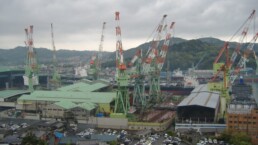

Leading Classification Society ClassNK granted an Approval in Principle (AiP) to Imabari Shipbuilding Co., Ltd. for their concept design of a 180,000 DWT LPG dual fuelled bulk carrier developed in cooperation with Mitsubishi Shipbuilding Co., Ltd. The AiP was granted to the concept design based on the Society’s Guidelines for Ships Using Low-Flashpoint Fuels(*1) and its Rule Part GF (regulation for ships using low-flashpoint fuels) incorporating “International Code of Safety for Ships using Gases or other Low-flashpoint Fuels (IGF Code), the current IMO Res. MSC.391(95) and the MSC.458(101) revision planned for release in 2024. This was the first LPG dual fuelled bulk carrier in the world to be granted an AiP.
The main features of the design announced by Imabari Shipbuilding are as follows:
“As one of the merits of this design, it eliminates the necessity for special consideration of boil off gas with this design handling LPG at room temperature and high pressure, which makes the ship’s operation easier. In addition, the ship has been designed with extensive consideration towards cost competitiveness by eliminating to use low-temperature materials such as stainless steel and cryogenic insulation. LPG tank is planned/designed to be installed in the aft area of the bridge and with round-trip distance capacity between Japan and Australia. And, as for supplying LPG to the ship, nowadays, LPG supply bases and infrastructure facilities are globally more developed and improved, which makes the ship’s operation more flexible. This is another motivation to create this design.”
(*1) Alternative fuels besides LNG (Methanol/Ethanol/LPG) have lower flashpoints compared to traditional fuels, therefore particular attention needs to be given to ensuring adequate safety precautions when using low-flashpoint fuels in order to decrease the potential risk of fire and explosions that may arise as a result of fuel leakage onboard the ship. International safety requirements for low-flashpoint fuels have been discussed at IMO and as a result, the International Code of Safety for Ships using Gases or other Low-flashpoint Fuels (IGF Code) has been adopted and enforced. The current code however, does not address specific regulations for alternative fuels other than LNG. Accordingly, in 2019 ClassNK released guidelines that outline safety requirements for other viable alternative fuels besides LNG, based on the latest technology and regulation trends in order to promote the design of alternative fueled ships.



Related News.

Navigating the Multi-Orbit Era: In Conversation with Intellian’s Jon Harrison at SMM 2026
At SMM 2026 in Hamburg, the rapid evolution of maritime satellite communications took centre stage. Across the exhibition halls, discussions among…

Cyprus ports need joint energy and investment strategy, shipping agents chief says
Cyprus needs a coordinated strategy for shipping, energy and environmental protection to support port investment and modernisation, Cyprus shipping…

MASO Public Affairs introduces MASO Regulatory Intelligence
A new subscription service helping businesses understand what is changing and what it means for them MASO Public Affairs introduces MASO Regulatory…

Anglo-Eastern helps turn CMBTECH’s ammonia ambition into an operational reality
From early feasibility study and risk-based design to newbuilding supervision, crew readiness and technical management, Anglo-Eastern drew on its…

Escalation of attacks threatens to derail recovery in Middle East oil exports
World oil demand is forecast to fall by 2.5 mb/d y-o-y in 4Q26 and 2.6 mb/d on average in 2026. As the Iran war manifests itself through restricted…

New study finds shipping pays twice its share to EU ETS earmarked revenues should triple to help build market for sustainable fuels and technologies
Shipping is responsible for around 10% of EU ETS emissions but pays almost 20% of the ETS bill. Unlike other sectors, it has never received free…

MSARC strengthens maritime mass rescue readiness through training and national live exercise off Dakar, Senegal
Joint MSARC–FHAS programme combines three days of SAR training with a national multi-agency live exercise The Maritime Search and Rescue Council ,…

Sogese report deliveries are still being delayed as container freight rates fluctuate
FOR IMPORTERS Spot rates into the Mediterranean are back at January levels, Far East to Europe reliability sits at pandemic lows, and nearly…

Glencore begins trading on Australian Securities Exchange
Glencore has begun trading on the Australian Securities Exchange under the ASX code GLC. Gary Nagle, Glencore’s CEO, said it was an exciting day for…

BIMCO Shipping Number of the Week
Suez Canal container ship transits exceed 50% of pre-disruption levels "During the first two weeks of October, weekly container ship capacity…
Subscribe to our newsletter!
if you dont want to swim alone in the ocean of news, sign up for the newsletter, and you will receive daily all the important news of world shipping!
