European responses to Covid-19 accelerate the electricity system transition by a decade, according to Wärtsilä analysis

Coal based power generation has fallen by over a quarter (25.5%) across the European Union (EU) and United Kingdom (UK) in the first three months of 2020, compared to 2019, as a result of the response to Covid-19, with renewable energy reaching a 43% share, according to new analysis by the technology group Wärtsilä.
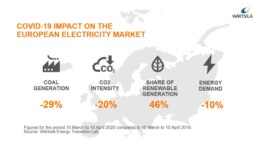
The impact is even more stark in the last month, with coal generation collapsing by almost one third (29%) between 10 March and 10 April compared to the same period in 2019, making up only 12% of total EU and UK generation. By contrast, renewables delivered almost half (46%) of generation – an increase of 8% compared to 2019.
In total, demand for electricity across the continent is down by one tenth (10%) due to measures taken to combat Covid-19, to its lowest level since the Second World War. The result is an unprecedented fall in carbon emissions from the power sector, with emission intensity falling by almost 20% (19.5%) compared to the same 10 March to 10 April period last year.
The analysis comes from the Wärtsilä Energy Transition Lab, a new free-to-use data platform developed by Wärtsilä to help the industry, policy makers and the public understand the impact of Covid-19 on European electricity markets and analyse what this means for the future design and operation of its energy systems. The goal is to help accelerate the transition to 100% renewables.
Björn Ullbro, Vice President for Europe & Africa at Wärtsilä Energy Business, said: “The impact of the Covid-19 crisis on European energy systems is extraordinary. We are seeing levels of renewable electricity that some people believed would cause systems to collapse, yet they haven’t – in fact they are coping well. The question is, what does this mean for the future?”
“What we can see today is how our energy systems cope with much more renewable power – knowledge that will be invaluable to accelerate the energy transition. We are making this new platform freely available to support the energy industry to adapt and use the momentum this tragic crisis has created to deliver a better, cleaner energy system, faster.”
The figures mark a dramatic shift in Europe’s energy mix – one that was not anticipated to occur until the end of the decade. The impact of the Covid-19 crisis has effectively accelerated the energy transition in the short-term, providing a unique opportunity to see how energy systems function with far higher levels of renewables.
Ullbro added: “Electricity demand across Europe has fallen due to the lockdown measures applied by governments to stop the spread of the coronavirus. However, total renewable generation has remained at pre-crisis levels with low electricity prices, combined with renewables-friendly policy measures, squeezing out fossil fuel power generation, especially coal. This sets the scene for the next decade of the energy transition.”
These Europe-wide impacts are mirrored at a national level, for example:
- In the UK, renewables now have a 43% share of generation (up 10% on the same 10 March to 10 April period in 2019) with coal power down 35% and gas down 24%.
- Germany has seen the share of renewables reach 60% (up 12%) and coal generation fall 44%, resulting in a fall in the carbon intensity of its electricity of over 30%.
- Spain currently has 49% renewables with coal power down by 41%.
- Italy has seen the steepest fall in demand, down 21% so far.
An industry first, the Wärtsilä Energy Transition Lab has been specifically developed as an open-data platform for the energy industry to understand the impact of Covid-19 and help accelerate the energy transition. The tool provides detailed data on electricity generation, demand and pricing for all 27 EU countries and the UK, combining Entso-E data in a single, easy to use platform. It will also allow users to model how systems could operate in future with higher renewables, helping pinpoint problem areas and highlight where to focus policy and investment.
The Wärtsilä Energy Transition Lab can be accessed from 10am EET on 17 April 2020 at: www.wartsila.com/energy/transition-lab



Related News.

Navigating the Multi-Orbit Era: In Conversation with Intellian’s Jon Harrison at SMM 2026
At SMM 2026 in Hamburg, the rapid evolution of maritime satellite communications took centre stage. Across the exhibition halls, discussions among…

Cyprus ports need joint energy and investment strategy, shipping agents chief says
Cyprus needs a coordinated strategy for shipping, energy and environmental protection to support port investment and modernisation, Cyprus shipping…

MASO Public Affairs introduces MASO Regulatory Intelligence
A new subscription service helping businesses understand what is changing and what it means for them MASO Public Affairs introduces MASO Regulatory…

Anglo-Eastern helps turn CMBTECH’s ammonia ambition into an operational reality
From early feasibility study and risk-based design to newbuilding supervision, crew readiness and technical management, Anglo-Eastern drew on its…

Escalation of attacks threatens to derail recovery in Middle East oil exports
World oil demand is forecast to fall by 2.5 mb/d y-o-y in 4Q26 and 2.6 mb/d on average in 2026. As the Iran war manifests itself through restricted…

New study finds shipping pays twice its share to EU ETS earmarked revenues should triple to help build market for sustainable fuels and technologies
Shipping is responsible for around 10% of EU ETS emissions but pays almost 20% of the ETS bill. Unlike other sectors, it has never received free…

MSARC strengthens maritime mass rescue readiness through training and national live exercise off Dakar, Senegal
Joint MSARC–FHAS programme combines three days of SAR training with a national multi-agency live exercise The Maritime Search and Rescue Council ,…

Sogese report deliveries are still being delayed as container freight rates fluctuate
FOR IMPORTERS Spot rates into the Mediterranean are back at January levels, Far East to Europe reliability sits at pandemic lows, and nearly…

Glencore begins trading on Australian Securities Exchange
Glencore has begun trading on the Australian Securities Exchange under the ASX code GLC. Gary Nagle, Glencore’s CEO, said it was an exciting day for…

BIMCO Shipping Number of the Week
Suez Canal container ship transits exceed 50% of pre-disruption levels "During the first two weeks of October, weekly container ship capacity…
Subscribe to our newsletter!
if you dont want to swim alone in the ocean of news, sign up for the newsletter, and you will receive daily all the important news of world shipping!
