IATA and ICS: Governments must facilitate ship crew changes


The International Air Transport Association (IATA) and the International Chamber of Shipping (ICS) are jointly calling on governments to take urgent measures to facilitate crew change flights for seafarers.
Due to the COVID-19 restrictions, seafarers are having to extend their service onboard ships after many months at sea, unable to be replaced following long tours of duty or return home.
Shipping is vital to the maintenance of global supply chains, but the current situation is unsustainable for the safety and wellbeing of ships’ crews and the safe operation of maritime trade.
Each month about 100,000 merchant seafarers need to be changed over from the ships on which they operate to ensure compliance with international maritime regulations protecting safety, health and welfare.
As a result of government-imposed travel restrictions due to COVID-19, flights to repatriate or position marine personnel are unavailable. Immigration and health screening protocols are also hampering the ability of merchant ships to conduct vitally necessary crew changes. IATA and ICS are working together to come forward with safe and pragmatic solutions that governments can implement to facilitate crew changes at certain airports.
“Seafarers are unsung heroes who everyday throughout this COVID-19 crisis are going above and beyond the call of duty to ensure that countries are kept supplied with the goods they need. We are working with the airlines to come forward with solutions. We now need governments to support our seafarers and facilitate safe passage for them to get home to loved ones and be replaced by crew members ready to keep supply chains open,” said ICS Secretary General, Guy Platten.
“Airlines have been required to cut passenger services in the fight to stop the spread of COVID-19. But if governments identify airports that seafarers can use for crew changes and make appropriate adjustments to current health and immigration protocols, airlines can help keep global logistics moving,” said Alexandre de Juniac, IATA Director General and CEO.
Designated Airports
ICS and IATA are calling on all governments to designate a specific and limited number of crew change airports for the safe movement and repatriation of crew. This would achieve critical mass for the resumption of crew change flights to these airports, keeping global supply chains open.
Priority airports should include those close to major shipping lanes which also have direct air connections to principal seafarer countries of residence, such as China, India and the Philippines as well as destinations in western and eastern Europe.
Facilitating Movement of International Transport Personnel
Aviation and shipping companies face common challenges in carrying out crew changes while complying with immigration and quarantine restrictions introduced by most governments around the world.
As authorities continue to battle COVID-19, international transport personnel operating aircraft and ships, or transiting international borders for duty, are often affected by national restrictions designed for passengers and non-essential personnel. When applied to crew not interacting with local communities, these restrictions unnecessarily jeopardize the ability of airlines and shipping companies to keep global supply chains operating.
IATA and ICS are working with their global regulators – the International Civil Aviation Organization (ICAO) and the International Maritime Organization (IMO) – on recommendations to governments for standardized procedures and protocols for positioning crews whilst preventing the further spread of COVID-19.
Keeping Global Supply Chains Operating
The aviation and maritime transport industries are the lifeblood of the global economy, moving the world’s goods and products which are necessary to allow society to continue to function efficiently throughout the COVID-19 crisis.
• By volume, some 90% of global trade is delivered by ship, including food, energy, raw materials and manufactured products.
• Airlines carry, in addition to passengers, some 35% of global trade by value, including critical medicines and medical supplies.
G20 governments, at their recent emergency meetings, committed to “minimize disruptions to trade and global supply chains” and identified the need to prioritize keeping air and sea logistics networks open and functioning efficiently.
Shipping companies and airlines are cooperating to meet this priority by ensuring that reliable operations continue throughout the pandemic. However, these networks will grind to a halt if replacement crews are unavailable for duty. Governments must take urgent action now to avoid further damage to the battered global economy.



Related News.

Navigating the Multi-Orbit Era: In Conversation with Intellian’s Jon Harrison at SMM 2026
At SMM 2026 in Hamburg, the rapid evolution of maritime satellite communications took centre stage. Across the exhibition halls, discussions among…
Cyprus ports need joint energy and investment strategy, shipping agents chief says
Cyprus needs a coordinated strategy for shipping, energy and environmental protection to support port investment and modernisation, Cyprus shipping…

MASO Public Affairs introduces MASO Regulatory Intelligence
A new subscription service helping businesses understand what is changing and what it means for them MASO Public Affairs introduces MASO Regulatory…
Anglo-Eastern helps turn CMBTECH’s ammonia ambition into an operational reality
From early feasibility study and risk-based design to newbuilding supervision, crew readiness and technical management, Anglo-Eastern drew on its…

Escalation of attacks threatens to derail recovery in Middle East oil exports
World oil demand is forecast to fall by 2.5 mb/d y-o-y in 4Q26 and 2.6 mb/d on average in 2026. As the Iran war manifests itself through restricted…

New study finds shipping pays twice its share to EU ETS earmarked revenues should triple to help build market for sustainable fuels and technologies
Shipping is responsible for around 10% of EU ETS emissions but pays almost 20% of the ETS bill. Unlike other sectors, it has never received free…

MSARC strengthens maritime mass rescue readiness through training and national live exercise off Dakar, Senegal
Joint MSARC–FHAS programme combines three days of SAR training with a national multi-agency live exercise The Maritime Search and Rescue Council ,…

Sogese report deliveries are still being delayed as container freight rates fluctuate
FOR IMPORTERS Spot rates into the Mediterranean are back at January levels, Far East to Europe reliability sits at pandemic lows, and nearly…

Glencore begins trading on Australian Securities Exchange
Glencore has begun trading on the Australian Securities Exchange under the ASX code GLC. Gary Nagle, Glencore’s CEO, said it was an exciting day for…
BIMCO Shipping Number of the Week
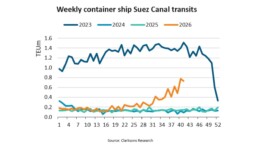
Suez Canal container ship transits exceed 50% of pre-disruption levels "During the first two weeks of October, weekly container ship capacity…
Subscribe to our newsletter!
if you dont want to swim alone in the ocean of news, sign up for the newsletter, and you will receive daily all the important news of world shipping!
