Port of Gothenburg – Coronavirus could accelerate digitalisation in the shipping industry
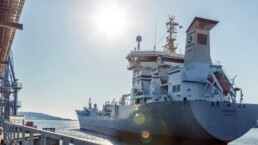

When physical contact between members of the crew on board ship and workers at the quayside needs to be kept to a minimum, new routines are required – and quickly. At the Port of Gothenburg there are clear indications of how the Corona pandemic could accelerate digitalisation in what is an otherwise conservative shipping industry.
Johan Östlund, chief officer on board the vessel Ternvag, and his crew have just berthed. Energy products are being loaded for onward export to Finland. New times, new challenges. Widespread reluctance in many countries to allow crews to go ashore is matched by the reluctance among ships’ crews to receive visitors on board.
“We are in a vulnerable position and we are limiting on-board access to key individuals, such as pilots and service technicians. Fortunately, we can deal with most things using computer systems and email exchange even if it takes a little longer,” said Johan Östlund.
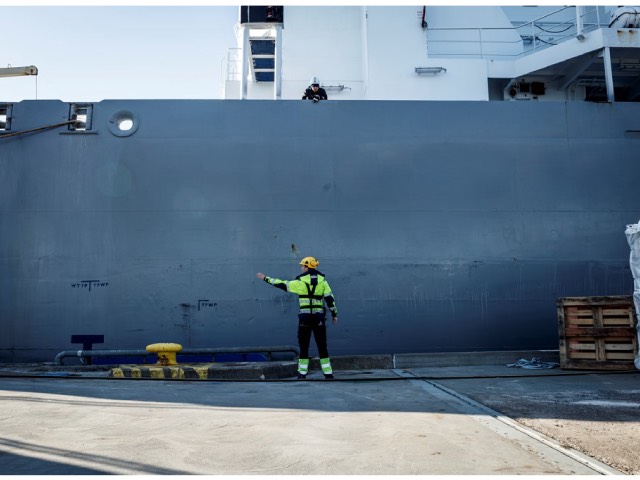
As a result of the Corona outbreak, the majority of ports throughout the world have been forced to re-examine their routines. Greater use of digital tools has been part of the solution in an effort to maintain an efficient workflow. At the same time, it takes slightly longer at the quayside when the new routines are being introduced. Even though a great deal of the work takes place remotely during the approach, once the vessel is at the quayside a whole range of physical interactions are normally required between the crew and the dockworkers. This could involve everything from inspecting the quality of the cargo to going through permits, safety checklists, and notices of readiness before loading or discharging.
At the quayside, Dan-Erik Andersson, Chief Operating Officer at the Energy Port in Gothenburg, is ready and waiting. His remit is to ensure the visit by Ternvag proceeds efficiently and safely.
“Loading and discharge are traditionally based on human contact. It’s quick and the entire system has been refined over the years. Changing the whole structure so quickly may result in a loss of time and momentum. However, by introducing new routines and new systems, and ensuring more tasks are carried out simultaneously rather than consecutively, we can probably become more efficient in the long run,” said Dan-Erik Andersson.
Johan Östlund agrees with his assessment: “There’s obviously quite a lot of development potential for the future. It’s in everyone’s interests if calls by vessels are quick, efficient and safe.”
Digitalisation a top priority at the Port of Gothenburg
Increased automation and digitalisation is a top priority at the Port of Gothenburg. The majority of the initiatives that have already been introduced have proved to be particularly constructive during the Corona pandemic. The digital system Permesso, which was introduced in 2019, has resulted in a significant reduction in administration and face-to-face contact when issuing work permits to contractors. The automatic gates for trucks introduced by APM Terminals at the Container Terminal are another example of a more efficient operating procedure, reducing the need for physical interaction.
Malin Collin, Deputy CEO at the Gothenburg Port Authority, is responsible for the digitalisation process. She states that extensive digital changes at the port will be introduced within the near future and could make a substantial difference.

According to Malin Collin, it is largely a question of improving efficiency and visualising freight flows and traffic movements to and from the port. “This is one of the most critical issues and we have dedicated resources to finding a solution. We are currently examining how artificial intelligence can make use of historical data to predict events and speed up the decision-making process. We can improve planning through data-driven decisions, identifying trends, and predicting events. By doing so we can create a platform for more efficient freight flows and transport movements on land and at sea.”
She states that enhanced digitalisation will benefit everyone. Nevertheless, if it is to produce the desired outcome, more people in the transport chain need to link into common systems and share information with each other.
“My impression is that the level of acceptance is rising, particularly now we are faced with the Corona crisis. But someone needs to take the initiative, act as a driving force, and offer effective alternatives that more people want to adopt. At the Gothenburg Port Authority, we are only too willing to lead the way and that’s why we are devoting so much time and resources to digital development.”



Related News.

Navigating the Multi-Orbit Era: In Conversation with Intellian’s Jon Harrison at SMM 2026
At SMM 2026 in Hamburg, the rapid evolution of maritime satellite communications took centre stage. Across the exhibition halls, discussions among…

Cyprus ports need joint energy and investment strategy, shipping agents chief says
Cyprus needs a coordinated strategy for shipping, energy and environmental protection to support port investment and modernisation, Cyprus shipping…

MASO Public Affairs introduces MASO Regulatory Intelligence
A new subscription service helping businesses understand what is changing and what it means for them MASO Public Affairs introduces MASO Regulatory…

Anglo-Eastern helps turn CMBTECH’s ammonia ambition into an operational reality
From early feasibility study and risk-based design to newbuilding supervision, crew readiness and technical management, Anglo-Eastern drew on its…

Escalation of attacks threatens to derail recovery in Middle East oil exports
World oil demand is forecast to fall by 2.5 mb/d y-o-y in 4Q26 and 2.6 mb/d on average in 2026. As the Iran war manifests itself through restricted…

New study finds shipping pays twice its share to EU ETS earmarked revenues should triple to help build market for sustainable fuels and technologies
Shipping is responsible for around 10% of EU ETS emissions but pays almost 20% of the ETS bill. Unlike other sectors, it has never received free…

MSARC strengthens maritime mass rescue readiness through training and national live exercise off Dakar, Senegal
Joint MSARC–FHAS programme combines three days of SAR training with a national multi-agency live exercise The Maritime Search and Rescue Council ,…

Sogese report deliveries are still being delayed as container freight rates fluctuate
FOR IMPORTERS Spot rates into the Mediterranean are back at January levels, Far East to Europe reliability sits at pandemic lows, and nearly…

Glencore begins trading on Australian Securities Exchange
Glencore has begun trading on the Australian Securities Exchange under the ASX code GLC. Gary Nagle, Glencore’s CEO, said it was an exciting day for…

BIMCO Shipping Number of the Week
Suez Canal container ship transits exceed 50% of pre-disruption levels "During the first two weeks of October, weekly container ship capacity…
Subscribe to our newsletter!
if you dont want to swim alone in the ocean of news, sign up for the newsletter, and you will receive daily all the important news of world shipping!
