Northern Lights show the way to seaborne CCS solutions
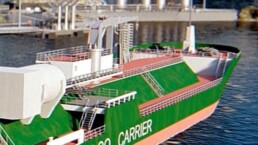

Recent high-level reports have tagged carbon capture and storage (CCS) as critical for achieving the UN’s global emissions reduction goals, with the maritime transport of CO2 emerging as an essential link in the decarbonization chain. The efficient transport of CO2 by ship could open up new industrial markets for the plentiful but sometimes problematic by-product.
These are two primary motivators behind the Northern Lights project, part of the Norwegian initiative to achieve full-scale CCS. The project encompasses the capture of CO2 from cement production and a waste-to-energy plant in the Oslofjord region and the shipping of liquid CO2 from these sites to an onshore terminal on the Norwegian west coast. From there, the liquefied CO2 will be transported by pipeline to a subsea storage location in the North Sea for permanent storage.
“Since pipelines cannot always provide the total solution for transporting CO2, we need to learn how to make CO2 shipping work,” says Frank Ollerhead, Ship Transport Lead in the Northern Lights project. “The aim of this initiative is to provide viable and necessary solutions for the sea transport of CO2.”
Viable vessels for CCS
Northern Lights is a joint cooperation project between Equinor, Shell and Total, while DNV GL has provided technical support.
“The Northern Lights ships are relatively small, and the schedule is tight,” says Ollerhead. “For this reason we decided to use proven technology rather than rely on R&D for our solutions. Most of the technology is already there. Now we are fitting it together in a practical solution.”
The project is looking to design vessels as close as possible to EEDI phase 3, Ollerhead says. “We want the ships to be as green as possible, but we are not developing new green technology for ships.” He reports that both LNG and dual fuel are being considered as fuel options, with batteries added for manoeuvring up to 45 minutes. “These are basically standard ships with new containment tanks, and batteries added on. The resulting reduction in CO2 emissions may seem small, but the introduction of batteries to improve efficiency is nonetheless a timely feature.”

Devising economic solutions
Introducing a high-pressure, low-temperature containment system into standard designs has kept costs down, improving the economics of vessel-based solutions compared with pipelines, says Magnus Lindgren, Senior Principal Surveyor, Ship Type Expert Gas Carriers at DNV GL Maritime.
“Standard size is a prerequisite for a ship to be economical, but the tanks in this case are designed for very high pressure. This requires high-strength materials.” The process with the project partners has focused on approving tank materials using a design compatible with standard ships, Lindgren reports. When using high-strength material in the tanks, the fatigue properties may become critical. The design team has taken these properties into account to maintain the defined safety levels in the codes.
The decision to incorporate a single large-diameter type C cylinder cargo tank in the Northern Lights project improved the economics of the liquefied CO2 carrier design, Lindgren notes, adding that the tank design provides relatively high-volume efficiency when applied on ships typically used for LPG transportation.
“The tank containment system is new, but the vessel is still based on proven ship design,” says Ollerhead. “We have selected a design solution that will be economical. It is somewhat outside the standard, which is traditionally a cost driver, but the ships will still have good economy.” With funding from the project partners, DNV GL concluded the pre-class evaluation of innovative type C containment tanks for liquefied CO2 for the Northern Lights project in October 2019.

Key modifications in tank design to adapt for CO2
In order to liquefy carbon dioxide, which sublimes directly between gaseous and solid states (dry ice) at atmospheric pressures, the temperature must be kept to around −50°C, with a pressure of 7 bar, in line with LPG containment systems. The CO2 containment system approved by DNV GL reduces refrigeration requirements by achieving an operation design temperature in the range of −30°C. This required the type C tank to withstand higher pressures of 19 bar.
The combination of high-density cargo, high design pressures and a large tank diameter required innovative solutions to meet the strength requirements for cargo tanks. Design modifications included reinforcing the type C tank design at various locations, but also softening the design at locations where larger deflections have been utilized to reduce the dynamic stresses in the tank.
The vessels have been designed to withstand pressure accumulation during laden voyages and the corrosive effects of liquid CO2. The chosen design reconciles the competing demands of economical tank manufacturing while meeting the safety requirements for the tank by replacing standard low-temperature steel for pressure vessels with a higher-quality steel product.
Robust solutions assure safety
The tank solution was designed to accommodate the physical characteristics of liquid CO2 in the loading and discharge phases. Particular care was taken to control pressure drops, which can provoke dry ice formation, with the possibility of abrasive effects on cargo pumps. The tank was also designed to resist variations in tank pressure experienced between laden and ballast voyages, in addition to the acceleration loads of liquids when fully loaded.
Design and material selection employed high tensile strength properties to withstand higher extreme loading and ensure resistance to cracking. “Documenting the safety of the tank design was a key criterion before the design could be awarded pre-class approval. This required exhaustive tests to ensure that the materials could meet the safety requirements against developing fatigue cracks,” Lindgren reports.
The design was concluded to be able to withstand dynamic loading without exceeding the stress levels that would allow fatigue cracks to propagate. Equinor received the GASA statement confirming design approval from DNV GL in November 2019.
Northern Lights: Part of a bigger CCS picture
Industrial-scale CCS has been defined as an integral part of the solution to reach the COP21 1.5°C target. “In addition to helping meet the UN goals, the greater effect of using ships to move CO2 is to allow stakeholders to deal with companies outside the energy chain,” Ollerhead maintains.
“CO2 is already being used in other industrial applications, and in a transportation context it is similar to the liquid gas trade. The tank technology has been used in food industry ships. We are simply applying thicker tanks and lower temperatures.”
Jump-starting the CO2 trade using ships is a high-value proposition in the Northern Lights project, Frank Ollerhead confirms. “For example, the potential for carbon-neutral cement production will drive investment decisions. With the solutions being developed in this project, shipowners should see potential new markets that will open the door to other industries. Overall the timing is good for introducing this technology.”
Source: DNVGL



Related News.
India joins ISF Verify, bringing trusted digital certification within reach of 30 per cent of the global seafarer workforce
Agreement with the world’s second-largest seafarer supply country marks a major milestone for global digital certification. The Directorate General…

OpenGate Capital to acquire Maersk Training, the Global Safety Training and Gas-Safety Services Business of Maersk
OpenGate Capital, a global private equity firm, announced today that it has signed a definitive agreement to acquire Maersk Training and its…

Can AI Save the Planet? Planet Classroom examines AI’s Climate Impact, Energy Demands and Clean Energy Solutions
C. M. (Cathy) Rubin and The Nest Campus CEO Peter Gilmer explore AI's growing environmental footprint, billions in climate investment, and the…

Smart Port Market Size to be valued at USD 23.10 Billion by 2034; Increasing Volume of International Maritime Trade to Boost Market Development: Fortune Business Insights™
The global smart port market size was valued at USD 3.4 billion in 2025 and is expected to be worth USD 4.2 billion in 2026. The market is projected…
Closer cooperation with India can strengthen Danish shipping
Minister of Business and Competitiveness Martin Lidegaard is leading a Danish business delegation to India. Green shipping is among the…
IRClass Academy and PIP Makassar strengthen Executive Maritime Capability through IMPDP 2026
Indian Register of Shipping , through its professional training and development arm IRClass Academy, has further strengthened its engagement in…

MOL, Sharp, IOM Implement Solar Panel Donation Project
Move Will Enhance Living Conditions in Power-short Areas of Kenya Mitsui O.S.K. Lines, announced the donation of solar power panels to communities in…
Intermodal Report Week 44 2026
Pls find below the Intermodal Report - Week 44 2026 Intermodal Report Week 44 2026
Allied Weekly Market Review Week 44
Pls find below the Allied - Weekly Market Review - Week 44 ALLIED - Weekly Market Report- Week 44
Nor-Shipping partners with Marketing in Maritime to deliver Marketing & Communications day and awards in 2027
Nor-Shipping is partnering with Marketing in Maritime to deliver a dedicated Marketing & Communications Day and awards initiative at the 2027…
Subscribe to our newsletter!
if you dont want to swim alone in the ocean of news, sign up for the newsletter, and you will receive daily all the important news of world shipping!
