DNV GL study looks at challenges in scrubber operations


The Global Sulphur Cap is in force now and many owners have opted for Exhaust Gas Cleaning Systems (“SOx scrubbers”) to achieve compliance. DNV GL conducted a study to learn about owners’ experiences of installing and operating scrubbers. The insightful results can help the industry avoid some of the challenges.
 Dr Fabian Kock, Head of Environmental Certification, DNV GL – Maritime
Dr Fabian Kock joined DNV GL in 2009 after studying mechanical engineering in Hamburg, Sydney and Chennai and subsequently gaining experience in the field of engine development. In his current position as Head of Environmental Certification at DNV GL, his section is responsible for environmental certification of marine diesel engines, marine exhaust gas aftertreatment systems such as SCR catalysts and scrubbers, and certification of the energy efficiency of ships.
What is the current situation in the scrubber market? Will all scrubbers be installed in time to ensure compliance with IMO’s Global Sulphur Cap?
We know that there is currently a four- to five-month backlog of vessels that should have been retrofitted by the end of last year. The number of vessels that need to be retrofitted has accumulated so it will probably take until April or May to complete all scrubber installations.
What are the reasons for the backlog?
The reasons are manifold. Material shortages and limited yard capacity are the biggest issues. For example, there is only a limited number of manufacturers of GRE pipes in China where most scrubbers are installed. Designers and yards have a high workload of retrofit installations, and lack of staff has doubled the installation time at yards from 40 to 80 days. At the same time, class societies had to cope with a higher number of vessels needing to be surveyed during peak times. Therefore, DNV GL started to offer remote surveys for exhaust gas cleaning systems on sister ships.
What do owners need to know when their installation is delayed?
From 1 January 2020 vessels must run on very low-sulphur fuel oil (VLSFO) or with scrubbers. If a scrubber has not been installed in time, operators need to switch to VLSFO until a scrubber has been installed and approved. An even harder deadline is 1 March 2020: from this date on, even the carriage of high-sulphur fuel oil (HSFO) on vessels without scrubbers is prohibited. This means that operators of ships not equipped with scrubbers must remove all HSFO from board and clean the tanks. They will only be allowed to carry HSFO again and use it as fuel after installing a scrubber system.
What needs to be considered before installing a scrubber?
Planning is an important factor because it takes time. In the case of a newbuilding project, the fuel price is the crucial factor that decides whether to opt for a scrubber or VLSFO. At a price difference of about 200 USD per tonne of fuel, scrubber installation is attractive. But long-term precise price predictions are very difficult. Furthermore, choosing the right material and coatings to avoid corrosion of the piping is essential as well. GRE pipes with a diameter of up to one metre need supporting struts to avoid damage when litres of heavy wash water flushes through them.
Based on the recently published operational experience study, what are the main challenges with scrubbers during operations?
Leakage and corrosion of SOx scrubber overboard pipes have been reported. To account for that risk, DNV GL has updated its rules and requires annual thickness measurements on various overboard pipes and spool piece designs. Sensor failures are also a big concern, and adhering to planned maintenance intervals is of utmost importance. When a sensor fails, the control system can get the wrong data and cause an incorrect or unnecessary operational response. Misleading sensor data can also falsely suggest that emissions are within limits and only when the emissions are checked by an authority will this be detected. In that case, the operator may get a penalty in the form of a high fine; in some ports the responsible officer might even be arrested. Some EU and Chinese ports have fitted sensors at the quayside, and on some occasions, PSC officers equipped with a handheld sensor have boarded to check emissions. Drones are also used in some areas to measure vessel emissions.
What can vessel operators do to avoid or overcome these challenges?
Adherence to the planned maintenance intervals and concluding a service agreement with the sensor manufacturer helps a lot. Keeping spare parts on board is also vital to avoid prolonged scrubber outages. Furthermore, a preliminary test of the control system can help avoid failure during operation as well as costly repairs or reinstallations. DNV GL already offers hardware-in-the-loop testing for these control systems at the workshop to check how the control system behaves in various situations and extreme conditions, such as very low or high temperatures, which can be simulated during these tests as well.
Source: DNV GL (https://www.dnvgl.com/expert-story/maritime-impact/DNV-GL-study-looks-at-challenges-in-scrubber-operations.html)



Related News.

Navigating the Multi-Orbit Era: In Conversation with Intellian’s Jon Harrison at SMM 2026
At SMM 2026 in Hamburg, the rapid evolution of maritime satellite communications took centre stage. Across the exhibition halls, discussions among…
Cyprus ports need joint energy and investment strategy, shipping agents chief says
Cyprus needs a coordinated strategy for shipping, energy and environmental protection to support port investment and modernisation, Cyprus shipping…

MASO Public Affairs introduces MASO Regulatory Intelligence
A new subscription service helping businesses understand what is changing and what it means for them MASO Public Affairs introduces MASO Regulatory…
Anglo-Eastern helps turn CMBTECH’s ammonia ambition into an operational reality
From early feasibility study and risk-based design to newbuilding supervision, crew readiness and technical management, Anglo-Eastern drew on its…

Escalation of attacks threatens to derail recovery in Middle East oil exports
World oil demand is forecast to fall by 2.5 mb/d y-o-y in 4Q26 and 2.6 mb/d on average in 2026. As the Iran war manifests itself through restricted…
New study finds shipping pays twice its share to EU ETS earmarked revenues should triple to help build market for sustainable fuels and technologies
Shipping is responsible for around 10% of EU ETS emissions but pays almost 20% of the ETS bill. Unlike other sectors, it has never received free…

MSARC strengthens maritime mass rescue readiness through training and national live exercise off Dakar, Senegal
Joint MSARC–FHAS programme combines three days of SAR training with a national multi-agency live exercise The Maritime Search and Rescue Council ,…
Sogese report deliveries are still being delayed as container freight rates fluctuate
FOR IMPORTERS Spot rates into the Mediterranean are back at January levels, Far East to Europe reliability sits at pandemic lows, and nearly…

Glencore begins trading on Australian Securities Exchange
Glencore has begun trading on the Australian Securities Exchange under the ASX code GLC. Gary Nagle, Glencore’s CEO, said it was an exciting day for…
BIMCO Shipping Number of the Week
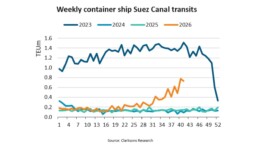
Suez Canal container ship transits exceed 50% of pre-disruption levels "During the first two weeks of October, weekly container ship capacity…
Subscribe to our newsletter!
if you dont want to swim alone in the ocean of news, sign up for the newsletter, and you will receive daily all the important news of world shipping!
