The climate implications of using LNG as a marine fuel


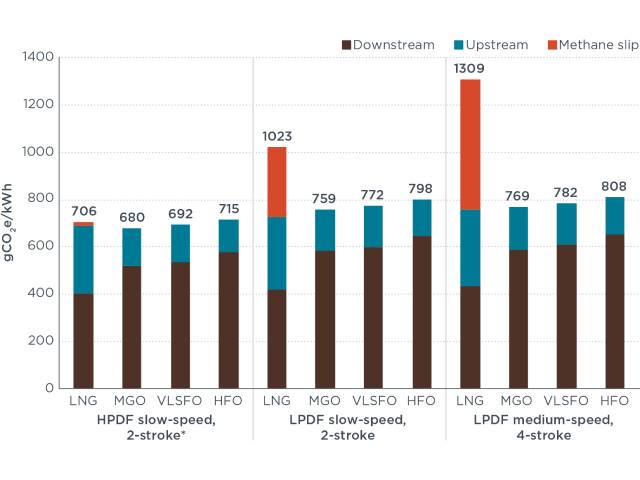
More and more ships, including container ships and cruise ships, are being built to run on liquefied natural gas (LNG), which emits approximately 25% less carbon dioxide (CO2) than conventional marine fuels in providing the same amount of propulsion power. However, LNG is mostly methane, a potent greenhouse gas (GHG) that traps 86 times more heat in the atmosphere than the same amount of CO2 over a 20-year time period. To better understand the full climate impacts of using LNG as a marine fuel, this study compares the life-cycle GHG emissions from LNG, including upstream emissions from leakage during extraction, processing, and transport and downstream emissions from combustion and unburned methane, to those of heavy fuel oil, very low sulfur fuel oil, and marine gas oil (MGO).
The authors use a representative life-cycle emission factor as well as the 100-year and 20-year global warming potentials (GWPs) for methane included in the Intergovernmental Panel on Climate Change’s Fifth Assessment Report. The 20-year GWP better reflects the need to reduce GHGs quickly, in order to meet the International Maritime Organization’s (IMO) climate goals, and the results show that when combined with a trend toward higher leakage, there is no climate benefit from using LNG, regardless of the engine technology.
Additionally, as illustrated in the figure below, the most popular LNG marine engine—low-pressure dual fuel (LPDF), medium-speed, four-stroke—is also the leakiest. Using LNG, this technology emitted 70% to 82% more life-cycle GHGs than MGO. The IMO has signaled that it will regulate GHGs under its initial GHG strategy and continued investment in LNG infrastructure on ships and on shore risks making it harder to transition to zero-emission vessels in the future. Investments should instead be focused on technologies that reduce total life-cycle GHG emissions, including energy-saving technologies, wind-assisted propulsion, zero-emission fuels, batteries, and fuel cells.
Download the full report here: https://theicct.org/sites/default/files/publications/Climate_implications_LNG_marinefuel_01282020.pdf
Source: International Council on Clean transportation



Related News.

Highly successful conclusion of the 2nd CSN Northern European Crewing Conference in Hamburg: Crewing 5.0 in Focus
We are delighted to report the highly successful conclusion of the 2nd CSN Northern European Crewing Conference, which took place on the 22nd of…
Dualog launches secure messaging for ship and shore
Dualog has launched Dualog Chat, a secure messaging service built for shipping. The first service in Workspace by Dualog, Chat gives crews and shore…
India and the Widening Tanker Freight Squeeze
This week’s Tanker Market Monitor tracks India’s return to Iraqi supply as Gulf oil movements recover amid persistent shipping risk. Yanbu is…
Star Bulk announces strategic partnership with Hermes World Maritime
Star Bulk Carriers Corp. (the "Company" or "Star Bulk") (Nasdaq & Euronext Athens: SBLK), today announced that it has entered into a strategic…

Thai Cave Rescue Diver Chris Jewell to Bring Lessons in Risk and Safety to IMCA Global Summit
The International Marine Contractors Association (IMCA) will launch its new strategy to 2030 as hundreds of offshore leaders and technical…

Port call optimisation pilot projects reveal significant emissions savings potential
Commercial ships spend between 4% and 6% of their operating year waiting outside ports. That idle time is one of the clearest inefficiencies in…

Port Houston celebrates Historic Project 11 Milestone
Houston Ship Channel expansion strengthens safety, efficiency, and regional prosperity Port Houston joined federal, state, and local elected…

Global VLCC Spot Earnings rise to $805,000/Day
Clarksons Research, the data and analytics arm of the Clarksons Group, continue to track and monitor shipping activity and markets impacted by the…

IMO adopts frameworks to assess marine geoengineering research activities
New guidance will help governments evaluate marine geoengineering research proposals to ensure they are safe for the environment. The…

BIMCO adopts addendum to support investments in retrofit projects
The shipping industry is working to improve fuel efficiency and ship performance to address decarbonisation requirements, new regulations and rising…
Subscribe to our newsletter!
if you dont want to swim alone in the ocean of news, sign up for the newsletter, and you will receive daily all the important news of world shipping!
