Gard – Are you snap-safe?
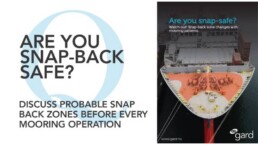

Use of worn mooring lines, overtightening of the brakes, or sudden movements of the ship are some of the main reasons for ropes straining beyond their breaking limits and parting. Parting of tensioned mooring lines has been associated with some of the worst human injuries, and loss of life registered in Gard’s claims portfolio.
The victims are usually the crew handling the line, the winch operator and/or the supervising officer. A parting line has the potential to flex the whole distance from the place where it parts to the place where it is attached. A typical example can be found in this investigation report by the Swedish Accident Investigation Branch.
During the pre-mooring tool box talks, crew members should discuss not only the hazards of snap-back but also potential snap-back zones. Depending on the mooring pattern, the configuration of these unsafe areas can change. It is therefore not recommended to mark these zones on decks as it may give the seafarer standing outside the painted zones a false sense of security. Code of Safe Working Practices (2015 edition, Amendment 4) recommends that “a bird’s eye view of the mooring deck arrangement is produced to identify danger areas” and that “the whole mooring deck may be considered a danger zone.” Crew members are also recommended to look out for each other and if a fellow crew member is standing in a potentially unsafe area, then they should be warned.
Further information
Case study: Mooring operations
Loss Prevention poster: Are you snap-safe?
Source: Gard http://www.gard.no/web/updates/content/29017131/are-you-snap-safe



Related News.

Navigating the Multi-Orbit Era: In Conversation with Intellian’s Jon Harrison at SMM 2026
At SMM 2026 in Hamburg, the rapid evolution of maritime satellite communications took centre stage. Across the exhibition halls, discussions among…
Cyprus ports need joint energy and investment strategy, shipping agents chief says
Cyprus needs a coordinated strategy for shipping, energy and environmental protection to support port investment and modernisation, Cyprus shipping…

MASO Public Affairs introduces MASO Regulatory Intelligence
A new subscription service helping businesses understand what is changing and what it means for them MASO Public Affairs introduces MASO Regulatory…
Anglo-Eastern helps turn CMBTECH’s ammonia ambition into an operational reality
From early feasibility study and risk-based design to newbuilding supervision, crew readiness and technical management, Anglo-Eastern drew on its…

Escalation of attacks threatens to derail recovery in Middle East oil exports
World oil demand is forecast to fall by 2.5 mb/d y-o-y in 4Q26 and 2.6 mb/d on average in 2026. As the Iran war manifests itself through restricted…
New study finds shipping pays twice its share to EU ETS earmarked revenues should triple to help build market for sustainable fuels and technologies
Shipping is responsible for around 10% of EU ETS emissions but pays almost 20% of the ETS bill. Unlike other sectors, it has never received free…
MSARC strengthens maritime mass rescue readiness through training and national live exercise off Dakar, Senegal
Joint MSARC–FHAS programme combines three days of SAR training with a national multi-agency live exercise The Maritime Search and Rescue Council ,…

Sogese report deliveries are still being delayed as container freight rates fluctuate
FOR IMPORTERS Spot rates into the Mediterranean are back at January levels, Far East to Europe reliability sits at pandemic lows, and nearly…

Glencore begins trading on Australian Securities Exchange
Glencore has begun trading on the Australian Securities Exchange under the ASX code GLC. Gary Nagle, Glencore’s CEO, said it was an exciting day for…
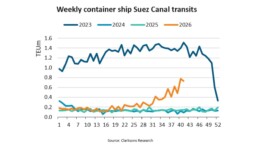
BIMCO Shipping Number of the Week
Suez Canal container ship transits exceed 50% of pre-disruption levels "During the first two weeks of October, weekly container ship capacity…
Subscribe to our newsletter!
if you dont want to swim alone in the ocean of news, sign up for the newsletter, and you will receive daily all the important news of world shipping!
