Panama Canal to adopt measures to ensure water availability & route’s reliability
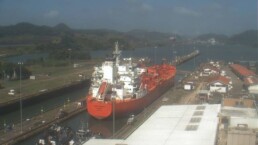
Following an extended period of low rainfall, the waterway will implement changes to sustain water levels and minimize impacts on customers.
Due to changing rainfall patterns and historic low water levels at Gatun Lake, the main source of water for the waterway, the Panama Canal announced today that it will implement a series of new measures beginning February 15 to sustain an operational level of water and provide reliability to customers while it implements a long-term solution to water.
Despite the use of extensive water-conservation measures, this past year’s rainfall was 20 percent below the historic average and the fifth driest year in 70 years. It follows several years of lower than average rainfall coupled by a 10 percent increase in water evaporation levels due to a 0.5-1.5 degree Celsius rise in temperature.
Without fee and operational changes, the Canal’s water levels are projected to drop to levels that would affect the Neopanamax and Panamax Locks. These new measures are intended to better provide reliability in water levels and therefore transit schedules.
The measures include the following components:
Freshwater Surcharge
- A new freshwater fee will be applied to all vessels over 125 feet in length overall (LOA) that transit through the Panama Canal, and will include the following components: A fixed fee of $10,000 per transit and a variable fee ranging from a minimum of 1 percent to a maximum of 10 percent of the vessel’s toll will be applied depending on Gatun Lake levels at the time of transit (i.e. if the lake has a higher level, the percentage will be lower and vice versa).
Adjustments to the Booking System
- The Panama Canal will adjust the number of daily reservation slots available to 27, replicating the total offered during lane outages. The waterway will also require that each vessel pays its booking fee in full no later than 48 hours depending on the booking period.
- Regulars (up to 90.99 feet in beam): 6 slots
- “Supers” (up to 107 feet in beam): 13 slots
- Neopanamax: 8 slots (unchanged)
- One slot for supers and one slot for regular vessels will be awarded through the auction process three days before transits. Nonetheless, the Canal will continue to provide additional capacity when possible, serving vessels on a first-come, first-serve basis.
Vessel Visit Creation Fee (ETA Handling Fee)
- A handling service fee will be applied to all visits for transit at the time they are created in the system. The processing fee will be applied as follows:
- For vessels 91 feet in beam and over: $5,000.
- For vessels over 125 feet LOA, but less than 91 feet in beam: $1,500.
- The fee will be deducted from the vessel’s tolls invoice once the vessel begins transit. If the vessel cancels the visit and does not transit, the Vessel Visit Creation Fee will not be refunded. All visits created prior to February 15, 2020 will be honored and will not be required to pay this fee.
Together, the new measures will allow the Panama Canal to better anticipate the number and type of ships transiting the waterway, and therefore allocate water resources accordingly.
In order to plan accordingly, customers will be provided with real-time data on current and projected levels of Gatun Lake, available maximum drafts, and number and types of transits when requesting transits or making reservations. The official lake levels will be published daily, as well as forecasted for the following 2 months.
The decision to adopt such measures was taken following an evaluation of the impact of innovative techniques already instituted to save water used in the Canal’s operations. For example, the Panama Canal has been implementing cross-filling lockages, a technique that sends water between the two lanes at the Panamax Locks during transits and saves an amount of water equivalent to that used in six lockages each day. Other ongoing water-saving measures adopted at the Panama Canal include:
- Suspension of power generation at the Gatun Hydroelectric Plant
- Elimination of hydraulic assistance at the Panamax Locks
- Tandem lockages, which involves two ships transiting at the same time, when vessel size allows
- Use of water-saving basins at the Neopanamax Locks
In addition to these measures, the Panama Canal will expand its investment program to include projects focused on addressing the sustainability of the water supply in the medium and long-term. The Panama Canal will continue to dedicate a portion of its income to analyzing and identifying solutions to the problem of water availability in the watershed.



Related News.

Navigating the Multi-Orbit Era: In Conversation with Intellian’s Jon Harrison at SMM 2026
At SMM 2026 in Hamburg, the rapid evolution of maritime satellite communications took centre stage. Across the exhibition halls, discussions among…
Cyprus ports need joint energy and investment strategy, shipping agents chief says
Cyprus needs a coordinated strategy for shipping, energy and environmental protection to support port investment and modernisation, Cyprus shipping…

MASO Public Affairs introduces MASO Regulatory Intelligence
A new subscription service helping businesses understand what is changing and what it means for them MASO Public Affairs introduces MASO Regulatory…
Anglo-Eastern helps turn CMBTECH’s ammonia ambition into an operational reality
From early feasibility study and risk-based design to newbuilding supervision, crew readiness and technical management, Anglo-Eastern drew on its…

Escalation of attacks threatens to derail recovery in Middle East oil exports
World oil demand is forecast to fall by 2.5 mb/d y-o-y in 4Q26 and 2.6 mb/d on average in 2026. As the Iran war manifests itself through restricted…
New study finds shipping pays twice its share to EU ETS earmarked revenues should triple to help build market for sustainable fuels and technologies
Shipping is responsible for around 10% of EU ETS emissions but pays almost 20% of the ETS bill. Unlike other sectors, it has never received free…
MSARC strengthens maritime mass rescue readiness through training and national live exercise off Dakar, Senegal
Joint MSARC–FHAS programme combines three days of SAR training with a national multi-agency live exercise The Maritime Search and Rescue Council ,…
Sogese report deliveries are still being delayed as container freight rates fluctuate
FOR IMPORTERS Spot rates into the Mediterranean are back at January levels, Far East to Europe reliability sits at pandemic lows, and nearly…

Glencore begins trading on Australian Securities Exchange
Glencore has begun trading on the Australian Securities Exchange under the ASX code GLC. Gary Nagle, Glencore’s CEO, said it was an exciting day for…
BIMCO Shipping Number of the Week
Suez Canal container ship transits exceed 50% of pre-disruption levels "During the first two weeks of October, weekly container ship capacity…
Subscribe to our newsletter!
if you dont want to swim alone in the ocean of news, sign up for the newsletter, and you will receive daily all the important news of world shipping!
