Adoption of fully automated shipping will take decades, not years


The UK is the second least supportive nation in their attitude towards the development of unmanned vessels, according to our study across six territories (United Kingdom, United States, Australia, China, Singapore and Hong Kong), and the least supportive of autonomous vehicles more generally.

Our recently published report polled over 6,000 people as well as gaining insights from key industry leaders in the transport and insurance sectors.
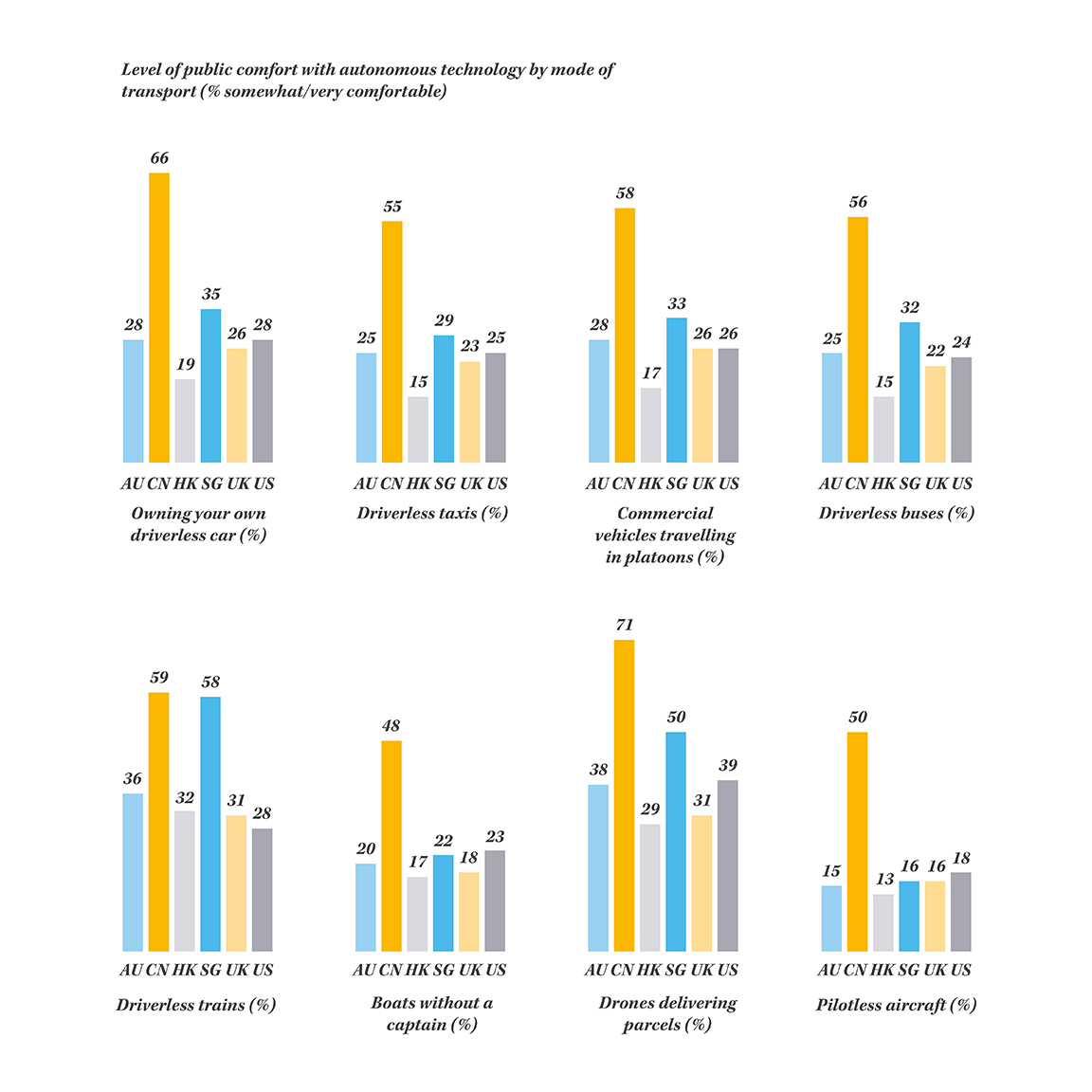
Fewer than one fifth of UK respondents said that they were comfortable with the idea of autonomous vessels (18%). This places the UK as the second least supportive of autonomous ships out of the six regions surveyed, behind only Hong Kong. In China, percentage support was more than double the UK, with 48% of respondents feeling at least somewhat comfortable.
The pattern is reflected in people’s broader opinions towards autonomous vehicles: 48% in the UK support partially autonomous vehicles, and only 28% support full autonomy: the lowest overall levels of support across all regions surveyed.
The main reason for their concern is safety (67%), with respondents specifically placing trust in human judgement over computers (63%).
“If we are to achieve the public trust necessary, solutions need to also be provided around the storage, usage and sharing of the masses of data which will be collected by the next generation of autonomous vessels”
Following discussions with maritime market practitioners, we have identified some of the key benefits and challenges presented by autonomous adoption. The exacting regulatory standards imposed on ships by the International Maritime Organisation (IMO) and the Flag State, where ships are registered, will pose a challenge around connectivity between ships and shore, particularly for the original equipment manufacturers (OEMs).
Autonomy at sea is an opportunity to help international shipping meet environmental concerns and regulations. The IMO’s anti-pollution measures and energy efficiency standards can be met through step-change in ship design with growing use of data-driven autonomous and connected vehicle technology.
Autonomous vehicle technology can also help the gathering of additional data on engine performance, enabling ship owners to identify parts that may need repairing or replacing before they fail. This helps reduce time in dry-docks while improving performance and safety levels.
One of the key concerns around automation in the maritime sector is the impact on employment: the shipping sector faces an existential challenge in the form of an ageing workforce with younger generations showing less interest to spend months away from home at sea. Incorporating autonomous technology in ship construction can help to reduce the potential for skills shortages in the future. Furthermore, the ability for technology to replace labour could provide major cost savings. We are then likely to see a new type of ‘sailor’ who will be remotely working and able to go home after their shift.
The market also raises a number of key practical considerations: bad weather conditions and navigation into port may require manual control, while enabling high-speed internet connection while at sea to control and monitor vessels is costly and difficult, potentially taking decades to implement.
Ultimately, achieving automation of vessels at sea will improve public confidence in the technology, with a greater effort from global automotive OEMs and technology firms to accommodate for the growing demand and develop cost-effective, safe technology.
Kennedys partner, Michael Biltoo, said: “The UK public clearly has strong reservations about the adoption of autonomous vehicles. The challenges that face the maritime sector are particular and exacting: from multi-national regulatory frameworks to barriers of data transfer while off-shore, achieving the consensus necessary to facilitate global fleets of automated ships will be crucial in achieving marine autonomy.
“However, the benefits are clear and, ultimately, crucial: if shipping is to achieve the ever-tightening environmental standards set by a range of regulatory bodies, a far more data-driven approach to maritime logistics is absolutely necessary. Furthermore, the opportunity to reduce time in dry-dock repairs offers a clear long-term financial incentive to market participants. Greater automation in the sector is inevitable: there now needs to be a clear call-to-action on governments to create modern legal frameworks providing appropriate protocols on the behaviours of vehicle technology.
“If we are to achieve the public trust necessary, solutions need to also be provided around the storage, usage and sharing of the masses of data which will be collected by the next generation of autonomous vessels. This will require a collaborative approach across government, vessel manufacturers, software developers, insurers, law enforcement and consumer groups.”
In a recent independent and wide-ranging industry report that ranked insurance law firms across a variety of areas on their London Market work, we were ranked as the most used insurance law firm for marine, energy property and casualty/non marine liability, as well as ranking highest for service satisfaction levels and for the number of leading lawyers, named in the report’s research, that are known for outstanding service. The Gracechurch London Market Insurance Law Report also revealed that we lead the market for usage in both the UK and Latin America, and for our innovative use of technology.



Related News.

Hong Kong Global Maritime Trade Summit to return for third edition
The International Chamber of Shipping, in collaboration with the Transport and Logistics Bureau of the Government of Hong Kong and the Hong Kong…

Appetite for US crude oil exports climbs despite high freight
South Korea tops US crude destinations at 568,600 b/d VLCC rates to Asia double, closing arbitrage window European refining margins…

Shipping stocks Rally as Hormuz Traffic plunges 75%
Ship traffic through the Strait of Hormuz — a critical chokepoint handling about 20% of global crude oil and liquefied natural gas shipments — has…

Diana Shipping announces Time Charter Contract for m/v G P Zafirakis with Classic Maritime
Diana Shipping, a global shipping company specializing in the ownership and bareboat charter-in of dry bulk vessels, announced that, through a…
New IMO ESP Code framework for Remote Inspection Techniques
The International Maritime Organisation, through Resolution MSC.584(111) , has adopted amendments to the International Code on the Enhanced…

ABS opens Offshore & Marine Support Center in Bergen
ABS has expanded its capabilities in the Norwegian maritime market with the opening of a cutting-edge support center in Bergen, bringing advanced…

MOL holds giant step memorial ceremony and beach cleanup at Kashima Coast
Memorial and Reflection 20 Years After the Accident: Learning from the Past to Foster an Even Stronger Safety Culture Mitsui O.S.K. Lines, announced…

KEZAD-based Arabian Gulf Steel Industries achieves lowest verified Carbon Footprint for Rebar
CARES UK verified Environmental Product Declaration confirms 139 kg CO₂e per tonne for rebar produced at AGSI’s KEZAD Abu Dhabi facility Arabian…

Indian Register of Shipping announces launch of first fleet support ship INS Surya
Indian Register of Shipping continues to strengthen its role in supporting the Indian Navy and India’s naval shipbuilding capabilities through the…

VLCCs Climbing the Record Charts
LR2 The TC1 75kt MEG/Japan index decreased by only a single point this week to WS928. The corresponding Baltic round-trip TCE fell by $2,000 to…
Subscribe to our newsletter!
if you dont want to swim alone in the ocean of news, sign up for the newsletter, and you will receive daily all the important news of world shipping!
