IMO2020 and Bunkers: JVs turning challenges into opportunities


The implementation on 1 January 2020 of the global sulphur cap on marine fuels is expected to give rise to potential opportunities and risks in relation to issues such as the availability of marine fuels, the quality of marine fuels, increased cost and availability of credit, and price volatility. In response to these issues, the Marine team at Clyde & Co is seeing an increased prevalence of joint ventures in the marine industry between ship owners and commodity traders, driven by a desire to utilise economies of scale, pool resources, and improve competitiveness.
We have also seen an increase in joint ventures established in the marine industry and bunker market to enable knowledge sharing between entities, both to enable one partner to enter a new geographical market as well as to enable a partner to expand its skills and experience in a market sector through a joint venture with an established supplier.
Whilst there are clear benefits to joint ventures, it is important to be cognisant of and protect against the risks when entering into such an arrangement. Building a successful joint venture arrangement requires clear agreement at the outset on the venture’s objectives.
Key considerations include:
1. Location
Consideration as to where to incorporate the joint venture company and which law should govern the transaction documents may be required. Given the international nature of the marine industry, decisions will be driven by matters such as each party’s tax considerations, their own countries of incorporation/operations and the location of the joint venture’s assets.
2. Control and Restrictions
How will the joint venture be managed on a day to day basis? Will the directors be prevented from undertaking certain activities without consent of both shareholders? There is a delicate balance to be struck between protecting shareholders through approval provisions whilst ensuring that the joint venture company operates efficiently without expending too much shareholder management time. Often forgotten too is the culture/management style of the joint venture company which needs to be carefully considered in order to ensure smooth integration and co-operation. Will the joint venture company be restricted from any activities? For example, the parties may wish to prevent the joint venture from directly competing in any way with its shareholders.
3. Contribution of Assets
What will each party bring to the table? Will this be tangible assets, cash, or otherwise? If one party’s contribution is knowledge/experience, how can this be valued? Are there any implications of one party transferring knowledge or assets to the joint venture (for example, IP, or tax implications)?
4. Financing
How will the joint venture company be financed? If, as is common, in addition to each party’s equity investment, third party debt is also required, consideration will need to be given to how security will be provided. This will generally be limited to the vessels themselves. If one or both parties are also to provide debt, discussions around how to protect that financing will be required, particularly where third party debt is also provided, which will generally have priority.
5. Confidentiality
Joint venture partners will be required to share confidential information with each other in forming the joint venture. Each may discuss matters such as their financing arrangements, accounting positions and assets among other things. It is important to consider how to protect this confidentiality.
6. Profits
Key to the extraction of profits is the mechanism for how the joint venture company decides how and when any distributions will be paid. This requires discussion at the outset and a specified dividend procedure.
7. Exit/Buyout
How and when will either party be permitted to sell its shares in the joint venture company? Will there be circumstances where either party will be forced to sell its shares in the joint venture company? Can one party buy out another company in certain circumstances and should the other party have a right of first refusal? Will a contributing party be entitled to have its contributed assets returned to it? Consideration of future scenarios should be given at the outset so as to account for the various exit routes with detailed exit and buyout procedures in the joint venture agreement.
Joint ventures provide clear benefits but require careful consideration of the various commercial and legal aspects to ensure that the agreements reflect each party’s requirements and will last the course.
Source: Clyde & Co LLP – Victoria Green, James Kennedy and Adam Kaye (https://www.clydeco.com/insight/article/imo2020-and-bunkers)



Related News.

Navigating the Multi-Orbit Era: In Conversation with Intellian’s Jon Harrison at SMM 2026
At SMM 2026 in Hamburg, the rapid evolution of maritime satellite communications took centre stage. Across the exhibition halls, discussions among…
Cyprus ports need joint energy and investment strategy, shipping agents chief says
Cyprus needs a coordinated strategy for shipping, energy and environmental protection to support port investment and modernisation, Cyprus shipping…

MASO Public Affairs introduces MASO Regulatory Intelligence
A new subscription service helping businesses understand what is changing and what it means for them MASO Public Affairs introduces MASO Regulatory…
Anglo-Eastern helps turn CMBTECH’s ammonia ambition into an operational reality
From early feasibility study and risk-based design to newbuilding supervision, crew readiness and technical management, Anglo-Eastern drew on its…

Escalation of attacks threatens to derail recovery in Middle East oil exports
World oil demand is forecast to fall by 2.5 mb/d y-o-y in 4Q26 and 2.6 mb/d on average in 2026. As the Iran war manifests itself through restricted…

New study finds shipping pays twice its share to EU ETS earmarked revenues should triple to help build market for sustainable fuels and technologies
Shipping is responsible for around 10% of EU ETS emissions but pays almost 20% of the ETS bill. Unlike other sectors, it has never received free…

MSARC strengthens maritime mass rescue readiness through training and national live exercise off Dakar, Senegal
Joint MSARC–FHAS programme combines three days of SAR training with a national multi-agency live exercise The Maritime Search and Rescue Council ,…
Sogese report deliveries are still being delayed as container freight rates fluctuate
FOR IMPORTERS Spot rates into the Mediterranean are back at January levels, Far East to Europe reliability sits at pandemic lows, and nearly…

Glencore begins trading on Australian Securities Exchange
Glencore has begun trading on the Australian Securities Exchange under the ASX code GLC. Gary Nagle, Glencore’s CEO, said it was an exciting day for…
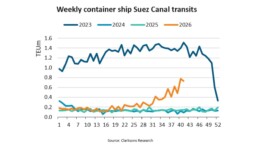
BIMCO Shipping Number of the Week
Suez Canal container ship transits exceed 50% of pre-disruption levels "During the first two weeks of October, weekly container ship capacity…
Subscribe to our newsletter!
if you dont want to swim alone in the ocean of news, sign up for the newsletter, and you will receive daily all the important news of world shipping!
