The USV Procurement Paradox Why buying faster is not enough
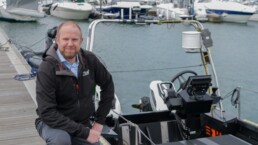

By Chris Shepherd, Chief Commercial Officer at RAD
Defence procurement is changing. Navies increasingly expect uncrewed systems to be delivered in weeks rather than years, driven by the rapid evolution of technology and lessons from modern conflict. Yet while the demand for rapid delivery is growing, the willingness to commit to large inventories of equipment that may become obsolete before they are deployed remains understandably limited.
This creates a fundamental paradox. Defence customers want access to operational capability at wartime speed, but without the cost or risk of maintaining wartime stockpiles. Instead, much of that responsibility falls to industry, which is expected to invest in manufacturing capacity, maintain supply chains and deliver equipment at pace, often with little certainty of future orders.
Uncrewed systems have moved from niche assets used for dull, dirty and dangerous tasks to a mainstay of military capability. But unlike traditional naval equipment, the technology underpinning these systems can evolve dramatically in a matter of months. Buying large quantities of ammunition that expires every six months would quickly lose its appeal, and the same logic helps explain why volume procurement of uncrewed systems has yet to materialise across most navies outside active conflict zones.
The early calls during the war in Ukraine for the MOD to stockpile drones illustrate the problem. Systems considered effective only a few years ago may now be suited to little more than basic training, as the threat environment and the technology needed to counter it have evolved.
The challenge is therefore no longer simply how to accelerate procurement, but how to create an industrial model capable of delivering rapidly evolving technology at scale, without either government or industry bearing the unsustainable cost of equipment sitting idle.
Three pressure points
The first is cash flow. Delivering at pace requires investment in manufacturing capacity or the holding of inventory. Without predictable orders, that inventory can sit idle for months while technology moves on. Few companies can justify this level of speculative investment without substantial external backing, the cost of which ultimately finds its way back to defence customers and taxpayers.
The second is bespoke design. Most users have a specific operational requirement, meaning solutions must be adaptable to different demands for payload capacity, range, speed and budget. Each modification also carries safety and regulatory implications, potentially requiring changes to the vessel’s safety case and reassessment against applicable standards, including the Workboat Code.
The third is supply chain resilience. Rapid procurement depends on the wider supply chain being ready to respond, yet long-lead items such as propulsion systems and PTZ cameras evolve quickly and are often specified for particular missions. Holding stock of every configuration is therefore impractical. Manufacturers committing to speculative fleets also face growing supply chain security risks, including the potential for disruption by hostile state actors.
Stocking the capability rather than the fleet
A more sustainable answer is to prepare platforms rather than stockpile complete systems. The automotive sector has long worked this way, holding a baseline vehicle that is configured to a customer’s specification only once an order is placed. A modular USV follows the same principle, with a common base vessel fitted out for a specific mission profile once the requirement is known.
Fit For Not With, or FFNW, is the engineering approach that makes this possible. A building constructed with pipework in place for air conditioning, but without the units installed, can be fitted with HVAC only if it is ultimately used in a hot climate. The same logic applies to autonomy, with cable runs and connection plates built into the vessel from the outset while cameras, communications and the autonomy software stack are installed at the point of need, ensuring they reflect the latest technology and the customer’s actual requirements.
This is the approach behind RAD’s AXON system. Its modular architecture allows integration with different subsystems as customer requirements evolve, enabling propulsion, sensors and communications links to change without substantial rewriting of the autonomy stack or the need to hold separate interface units for every engine and steering system.
It also enables established boatbuilders to bring USVs to market while retaining their naval architecture expertise, proven manufacturing processes and existing support infrastructure. By combining this established capability with rapidly evolving autonomy technology, customers benefit from both innovation and the confidence of a mature, resilient supply chain capable of delivering and supporting vessels throughout their operational lives.
Design for distributed manufacture and shadow factories
Design for distributed manufacture extends well beyond efficient boatbuilding. Applied properly, it enables manufacturers to maintain steady commercial production while retaining the ability to scale output rapidly across a network of qualified facilities when operational demand increases. Without this preparation, achieving a significant increase in production can take months or years.
Commercial boatbuilders, which already have vessels moving through production and established manufacturing infrastructure, are well placed to act as shadow factories for uncrewed capability. Standardised designs, common components and shared manufacturing processes would allow production to be distributed across multiple facilities, providing resilience and the ability to surge without maintaining large inventories of completed vessels.
Testing is part of the same equation. Customers increasingly ask for systems in weeks, whereas traditional development and assurance processes can take months or years. Where core configurations have been tested and assured in advance, subsequent modifications can be assessed against an established baseline, potentially reducing the scope, cost and duration of additional assurance activities.
In an Urgent Capability Requirement (UCR) or Urgent Operational Requirement (UOR) situation, a customer may also accept a more proportionate, risk-based approach to assurance, where permitted by the applicable regulatory framework. This can further accelerate delivery while avoiding unnecessary duplication of testing.
Why this matters operationally
A force that cannot iterate faster than its adversary risks seeing its systems countered and their effectiveness eroded. The ability to adapt and deliver new capability must therefore become a central consideration in procurement, rather than simply the performance of equipment at the point of purchase.
Recent rapid procurement programmes have demonstrated that industry can respond at pace when suitable equipment is already in production. However, this inevitably favours existing designs and available manufacturing capacity, potentially limiting the customer’s ability to select the most appropriate capability.
Procurement rules in many established militaries were developed around traditional equipment acquisition and must evolve to reward industrial readiness and adaptability, rather than simply immediate availability. This requires a different relationship between defence customers and industry, one that recognises the value of maintaining production capability even when there is no immediate requirement to manufacture complete systems.
A modular and dual-use future
Over the next three to five years, autonomy is likely to become mainstream on conventional craft, with FFNW and optionally crewed vessels increasingly becoming the norm. There is little logic in procuring a new vessel without considering its future autonomous capability when the cost of designing for conversion represents only a fraction of the overall investment.
This also opens the door to dual use, with vessels designed for defence applications capable of being re-roled for logistics, survey or other commercial operations, spreading costs across a wider customer base.
The USV market will inevitably mature and consolidate. Success will depend not simply on technological innovation, but on the ability to manufacture at scale, maintain reliable supply chains and provide credible through-life support. Established boatbuilders and technology companies that embrace modularity and collaboration will be well placed to meet this challenge.
Ultimately, the procurement paradox cannot be solved by buying equipment faster. Defence must move towards procuring industrial readiness as well as operational capability, ensuring that manufacturing capacity, proven platforms and adaptable technology are available when needed, without committing to large inventories of systems that may become obsolete before they are deployed.
The measure of future naval readiness may not be how many uncrewed vessels a navy has in storage, but how quickly it can manufacture, configure and deploy the capability it needs



Related News.
Intelligent Skies, Secure Seas: Navigating Connectivity, Cyber Resilience, and AI Liability at the 5th CSN Greece ICT Conference
The 5th CSN Greece ICT Conference, held on 19th November 2026 at the Ploes Floating Venue in Paleo Faliro, Athens, successfully convened maritime…

EU moves to ban tankers insured in Russia, repair services at Russian refineries
EU targets Russian-insured tankers, refineries Von der Leyen announces 22nd sanctions package All 27 member states must approve new…
IMO tackling fraudulent registries together
Strong national systems and international information sharing are crucial to tackling fraudulent registries and fraudulent ship registration…
Open letter on freedom of navigation and the protection of seafarers
Dear High Representative Kallas, Dear Foreign Affairs Ministers, European Shipowners | ECSA, BIMCO, the Cruise Lines International Association…

Davies Turner warns of Rising Asia-UK Container Disruption and European Port Congestion
Davies Turner, one of the UK’s largest independent freight forwarding and logistics companies, says that disruption to container shipments from Asia…

Disruptions still dominate tanker market outlook
"This year, tanker markets have been affected by disruption to transits through the Strait of Hormuz, the Houthi blockade of Saudi Arabian Red Sea…
Panama’s President called on to match COP31 Heroism with action at shipping climate talks
As a series of crucial meetings tasked with cutting greenhouse gas emissions from global shipping takes place this week and next, environmental NGOs…

Trafigura appoints Helio Cumbi as Executive Director, Mozambique
Trafigura has appointed Helio Cumbi as Executive Director, Mozambique, and Business Development Lead for East and Southern Africa Oil. Helio is a…

“K” LINE holds FY2026 Global Dry Bulk Meeting
Kawasaki Kisen Kaisha, announces that it held a global meeting for its dry bulk business at the company’s head office on November 9 and 10. The…
MOL launches ‘AQuA’ safety and quality improvement initiative
Standardizing Group-wide Safety and Quality Assessment Criteria to Enhance Vessel Safety and Quality Mitsui O.S.K. Lines, announced the launch of…
Subscribe to our newsletter!
if you dont want to swim alone in the ocean of news, sign up for the newsletter, and you will receive daily all the important news of world shipping!
