Russian Vessels Have Shifted From Europe’s Cables to Its Energy Grid
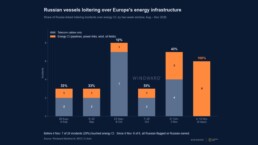

Windward’s MIOC tracks vessels loitering over European subsea and offshore infrastructure. Between late August and mid-November, Russia-linked loitering events in that record shifted decisively toward energy. Through September and October, energy appeared roughly once every two weeks. In the nine days to November 12, it was every loitering event. Telecom-only Russian events dropped to zero.
The reversal is sharp. In the window to October 6, seven of eight Russia-linked loitering events were telecom-only. Five weeks later, none were.
The turn came in the October 21 to November 3 window, when three of seven events were energy, two of them over the BBL interconnector and one over Norpipe.
The Vessels Changed Alongside the Targets
Earlier loitering over energy infrastructure mostly involved third-party flagged vessels trading with Russia. Ships at Poland’s B8 platform, on the FLAGS and Alwyn-Frigg systems, and on BBL.
All six vessels in the November window were Russian-flagged or Russian-owned. Two tugs, three small cargo ships, and one vessel under U.S. sanctions for Russian Ministry of Defence logistics work. Through September
That is a different population. Not shadow fleet tankers under flags of convenience, but small Russian tonnage operating openly under its own flag or ownership.
The Target Set Widened Across Six National Zones
The six sites span most of Europe’s offshore energy categories.
Two gas trunklines carrying Norwegian supply to the UK and onward to Kårstø. A 1.4 GW HVDC interconnector running between the UK and Denmark. A Dutch gas trunkline alongside a UK to Germany interconnector currently being laid. A planned Danish wind farm. Three planned wind farms off Galicia. And an Azerbaijani offshore oil complex in the Caspian Sea.
Six national zones, four infrastructure types.
Three of the Six Sites Are Not Built Yet
The interconnector under construction, the Danish wind farm, and the Galician wind farms are all unbuilt or incomplete.
That timing matters in two ways.
Seabed data is most useful to collect before cable and pipeline routes are fixed and laid, when survey work attracts the least attention and the eventual route is still being determined.
The second is what is happening on the surface. A site under active investigation has survey vessels working it, and that work is observable. Equipment, methods, vessel types, where crews concentrate, and how long each stage takes are all visible to anyone positioned nearby. A sanctioned Russian-flagged tanker that loitered five hours inside a planned Dutch wind farm under active site investigation, then moved onto the NOGAT trunkline, is positioned for both. Collection on the seabed and observation of the survey work itself.
Loitering over infrastructure that does not exist yet is harder to explain as incidental than loitering over infrastructure that does.
Four Vessels Shared a Route and a Behavior
Four of the six were sailing from the Black Sea to Murmansk or St. Petersburg.
In each case, the vessel was the only one to slow at its site. No port call, no meeting with another vessel, no change of declared destination. It slowed, held, and continued.
The route explains why small Russian vessels are in the North Sea. It does not explain why they slow over energy infrastructure on the way through.
Weather and Trade Do Not Account for It
The alternative explanations fail on the same point.
Weather would affect every vessel in the area. In each of these cases, the Russian-linked vessel was the only one to slow. Commercial logic would produce a port call, a meeting, or a destination change. None occurred.
What remains is a vessel reducing speed over a specific asset, alone, and resuming.
Winter Narrows Europe’s Margin
The timing coincides with the tightest European gas position in over a decade.
EU storage stood at 74.6% full on November 1, against 82.9% a year earlier, and the IEA has warned it could fall below 10% by the end of March.
Thin storage shifts load onto Norwegian pipeline gas and onto interconnectors, which are precisely the assets appearing in this record. On November 5, RUSI described UK offshore energy infrastructure as very vulnerable, especially where supply comes from offshore sources.
Every Baltic Incident Came in This Season, After a Russian Port Call
The seasonal pattern is established.
A gas pipeline and two telecom cables were severed in October 2023. A power cable and four telecom cables were severed on December 25, 2024, after which Finland charged the captain and two officers. A data cable was damaged on December 31, 2025.
All three occurred in winter. All three involved a vessel that had recently departed a Russian port.
Russian Mapping of European Energy Assets Is Documented
This is not a new assessment.
Dutch military intelligence has reported Russia mapping North Sea wind parks and energy networks. Norway’s PST expects continued mapping of the Norwegian coast using civilian vessels. In April, the UK and Norway disclosed a submarine survey of North Atlantic cables and pipelines. The UK Ministry of Defence has identified Russia as a long-term threat to offshore energy assets.
What is new is the shift in emphasis from telecom to energy, and the use of Russian-flagged small tonnage rather than third-flag or shadow fleet vessels.
What This Shows, and What It Does Not
These counts are events that Windward recorded rather than a census. The detection criteria have not changed since August, so the trend is comparable across windows, but the record reflects what the desk reported rather than everything that occurred.
AIS shows presence, not interference. No damage has been reported at any of these sites.
Windward assesses that Russian collection against European critical infrastructure is shifting toward energy assets ahead of winter, conducted with Russian-flagged small tonnage on the Black Sea to northern Russia route rather than only through shadow fleet tankers.
Written by Maya Romi, Senior Content Manager, Windward; analysis by Gilad Karo, Maritime Analyst, MIOC.



Related News.

Greece has the most to lose from delays in shipping’s green transition, new analysis finds
UCL and WWF Greece report finds the IMO Net-Zero Framework offers Greek ship owners the clarity they need, and the best protection against a…

Snow Land joins Cool Carriers as the world’s first reefer with a gate rudder, a new chapter for sustainable and efficient reefer shipping
Cool Carriers, the world’s largest operator of specialised reefer vessels, took delivery of Snow Land from Kitanihon Shipbuilding in Japan on 12…

IBIA launches Marine Energy Outlook Survey as Annual Convention in New York
IBIA - The International Bunker Industry Association officially launched its Marine Energy Outlook Survey during the IBIA Annual Convention in New…

Why did ITF staff vote to strike again?
Staff at the International Transport Workers’ Federation (ITF) headquarters in London have voted to give their union a strike mandate. According to…

Nearly half of maritime crew tickets booked a week ahead are cancelled
Two new C Teleport reports show when maritime and aircrew teams book crew flights, how often they cancel, and what late booking costs, with a…

Kpler completes $1.5bn+ Sixth Street investment and continues accelerating growth
Investment backs Kpler's bold ambition to shape the future of global trade intelligence. Kpler, a leading provider of global physical trade…

How SAL and DNV are strengthening heavy-lift shipping
From classification and newbuilding support to operational tools and advisory expertise, SAL and DNV have been collaborating for decades. The…

PSA Singapore breaks ground on Tuas Port Phase Two to strengthen Global Trade Connectivity
PSA Singapore marked the groundbreaking of Tuas Port Phase Two, a significant step in the development of the world’s largest fully automated…

 …

BIFA welcomes UK–EU trade progress and calls for clarity on implementation
The British International Freight Association (BIFA) has welcomed progress made at today's UK–EU Summit in Brussels, highlighting the potential…
Subscribe to our newsletter!
if you dont want to swim alone in the ocean of news, sign up for the newsletter, and you will receive daily all the important news of world shipping!
