Emissions driven to lowest levels in Port of Long Beach’s busiest year

Strategic investments in zero-emissions equipment, greater use of shore power and more frequent visits by cleaner ships have driven the Port of Long Beach’s emissions per container to an all-time low, even as the global trade hub moved record-breaking cargo volumes, according to an annual emissions report.
The comprehensive 2025 emissions inventory, available here, found across-the-board reductions in port-related air pollution emissions compared to the prior year, proving that economic growth and environmental stewardship can thrive together. Key single-year reductions include diesel particulate matter down by 7%, nitrogen oxides 9%, sulfur dioxides 9% and greenhouse gases by 6%.
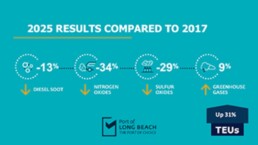
The report also documented consistent progress since the 2017 Clean Air Action Plan update was adopted in partnership with the neighboring Port of Los Angeles. Since that year, diesel particulates have decreased 13%, nitrogen oxides 34% and sulfur oxides 29%. While greenhouse gases increased 9%, it occurred against the backdrop of a staggering 31% increase in container throughput during the period.
“These findings confirm one of our foundational principles – that it’s possible to serve as a vibrant and strong jobs engine for the nation while protecting the environment,” said Long Beach Harbor Commission President Steven Neal. “We are incredibly proud of our achievements and will continue our unwavering commitment to cutting emissions for our community.”
“It’s been said the best way to predict the future is to create it,” said Port of Long Beach CEO Dr. Noel Hacegaba. “In our case, we are laser-focused on building the Port of the Future – a safe, resilient and zero-emissions port. Our latest inventory shows us we’re on the right track, and although there’s more to do, it’s worth celebrating what we’ve accomplished so far together with our partners.”
Last year was the Port of Long Beach’s busiest on record, with terminals handling nearly 9.9 million twenty-foot equivalent units. It was also the 20th anniversary of the adoption of the Port’s pioneering Green Port Policy, an aggressive, comprehensive and coordinated approach to reduce the negative impacts of port operations.
This year marks the 20th anniversary of the Clean Air Action Plan. Since 2005, diesel soot has decreased 91%, nitrogen oxides 70%, sulfur oxides 98% and greenhouse gases 9%, while container throughput increased 47%.
Other highlights of the 2025 inventory:
- The percentage of 2014 or newer model year trucks has reached its highest level yet at 95%; additionally, 2% of the drayage fleet were zero-emissions models.
- Use of shore power and emissions-control barges increased by 11% for ships at berth.
- 21% of vessel calls had Tier III engines, the cleanest available.
- 21% of cargo-handling equipment was zero-emissions models.
To accelerate the transition toward a carbon-free future, in the next year, the Port is launching a slate of new initiatives, including a truck utilization incentive program aimed at increasing usage of zero-emissions trucks, an enhanced zero-emissions truck voucher program, an update of the Green Ship Incentive Program to encourage cleaner ships to visit and continued work on a zero-emissions infrastructure plan to boost deployments of zero-emissions cargo handling equipment, harbor craft and locomotives.



Related News.
Neptune Group welcomes NIKOS TRAVLOS to Piraeus, honouring its founder and expanding its strategic Genesis Project
Melina Travlos:"We honour our history and our roots, and we create our future while keeping our values unchanged." The arrival of the Greek-flagged…

Maritime Passport and The Bahamas Maritime Authority progress collaboration on electronic seafarer documentation
Maritime Passport reports that its collaboration with The Bahamas Maritime Authority (BMA) is entering its next phase, progressing the development…
Scott Vicknair Personal Injury Lawyers Shares Maritime Safety Information Following Vessel Incident Near the Port of New Orleans
Scott Vicknair Personal Injury Lawyers is sharing general safety information for passengers and maritime workers following reports that a river…

US ethanol readily available to fuel the world’s methanol- capable fleet
Study published by MEMA, a platform of the Global Centre for Green Fuels, finds ethanol can use existing methanol engines and bunkering…

Detecting Ship-to-Ship Activity in Real Time
When two vessels meet at sea, knowing about it matters Vessels operate close to one another every day, especially around ports, anchorages, and busy…
ATI secures Manila South Harbour concession renewal to 2063
Asian Terminals, DP World’s strategic partner in the Philippines, has secured a 25-year renewal of its concession to operate and develop Manila South…

Valenciaport brings together the port community at Ecofira to demonstrate its commitment to sustainability
The APV is taking part in the competition alongside 12 companies from the port community to raise awareness of the environmental initiatives being…
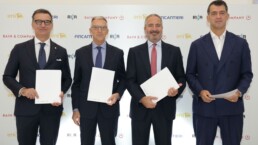
Eni, Fincantieri and RINA present the second edition of the Sustainable Maritime Transport Outlook
Eni, a global energy company, Fincantieri, a global leader in the construction of high-complexity ships, and RINA, the global inspection,…

Cargill’s Jan-Willem van den Dijssel takes over NAMEPA Chairmanship
The North American Marine Environment Protection Association (NAMEPA) announces the election of Jan-Willem van den Dijssel, Americas Lead at Cargill…

Nor-Shipping 2027 thought leader Ståle Hansen, CEO, Skuld
Collectively stronger In a seemingly fragmenting world, the need to work together to solve collective challenges has never been greater. Here, Ståle…
Subscribe to our newsletter!
if you dont want to swim alone in the ocean of news, sign up for the newsletter, and you will receive daily all the important news of world shipping!
