Atlantic Tanker earnings fall faster than Gulf Earnings

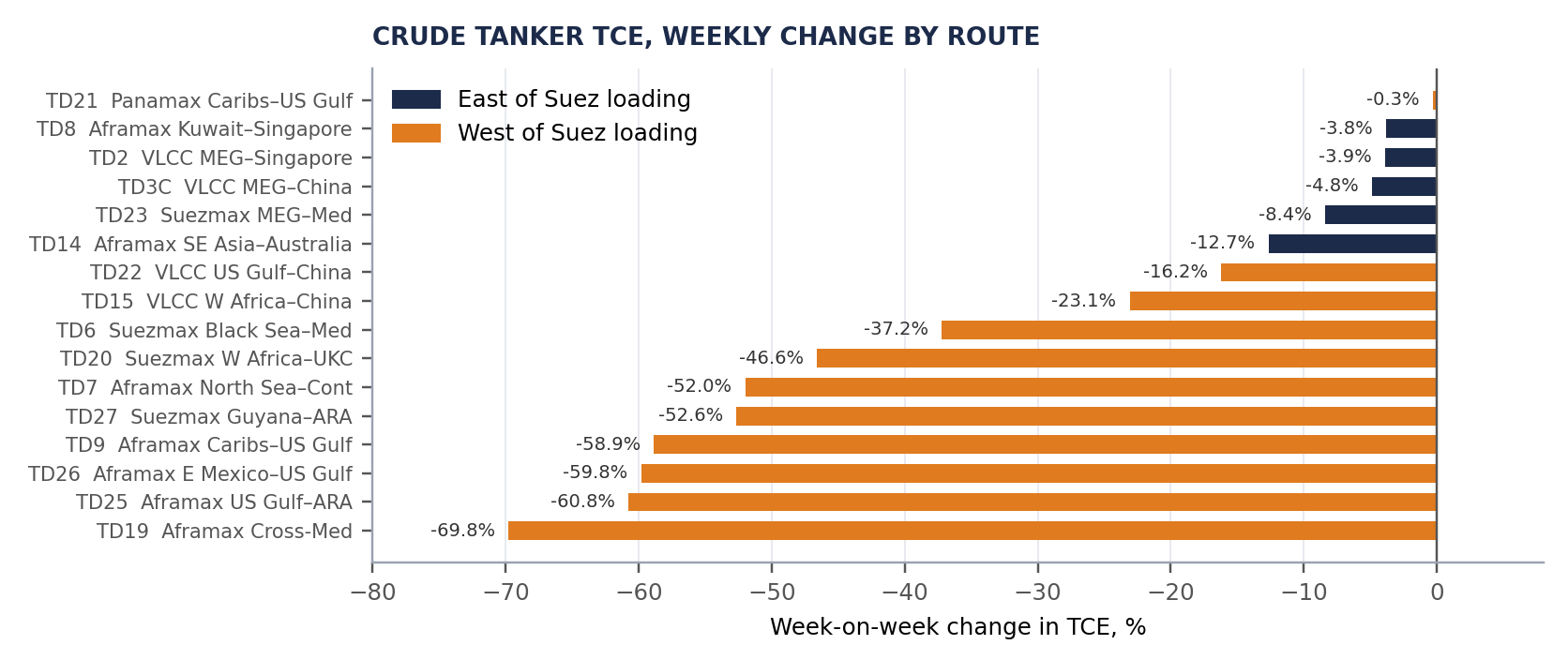
The TD3C/TD22 earnings ratio rose from 2.73 on 30 October to 3.10 on 6 November, as US Gulf–China VLCC earnings fell 16.2% to around $415,000/day, against a 4.8% decline on Middle East Gulf–China to $1.29 million/day. All 16 dirty tanker benchmarks fell over the week, with the steepest declines in the Atlantic and Mediterranean. Several Suezmax and Aframax routes lost 50% or more of their earnings, while Middle East Gulf VLCC losses remained below 5%.
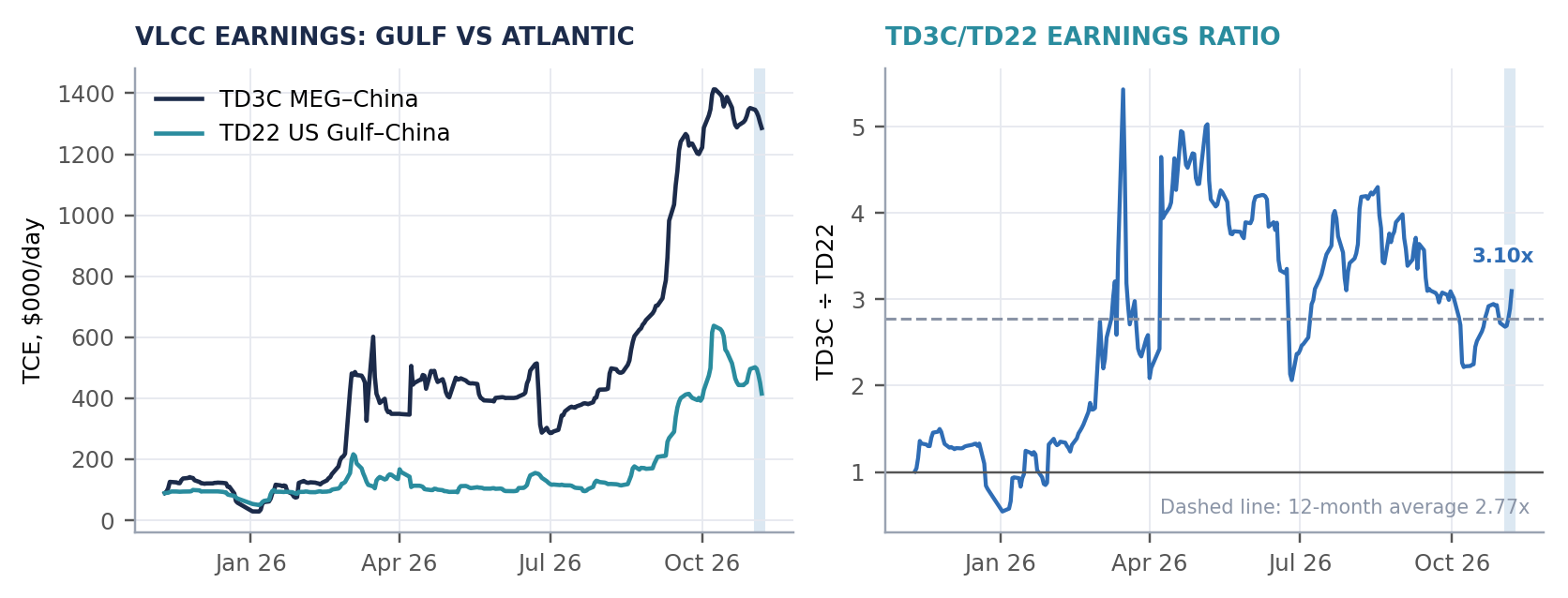
Both TD3C (Middle East Gulf–China) and TD22 (US Gulf–China) reached their October earnings peaks on 8 October, although the subsequent correction has been considerably sharper on the Atlantic route. By 6 November, TD22 earnings had fallen 34.9% from their October high, compared with a 9.0% decline on TD3C. The sharper fall in Atlantic earnings pushed the TD3C/TD22 ratio to 3.10 at the end of the week, its highest level since 18 September and above its 12-month average of 2.77.

Freight: Atlantic Crude Routes Lead the Decline
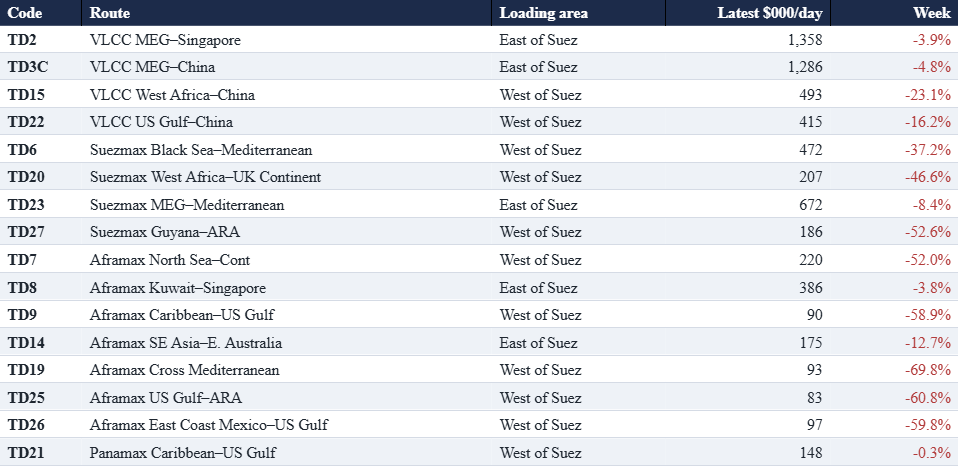
The ten largest percentage declines in the dirty basket were all on routes loading West of Suez, as classified in Chart 2 and the table below. Suezmax West Africa–UK Continent (TD20) fell 46.6%, Guyana–ARA (TD27) 52.6%, and Black Sea–Mediterranean (TD6) 37.2%, while MEG–Mediterranean (TD23) fell 8.4% and remained 3.2 times TD20. Among Aframaxes, Cross-Mediterranean (TD19) fell 69.8% and US Gulf–ARA (TD25) fell 60.8%, against 3.8% on Kuwait–Singapore (TD8). All 16 routes remain above their year-earlier and three-month reference levels.
Spot Rate Summary: dirty TCE, VLCC, Suezmax, Aframax and Panamax
Supply: Westbound Ballasters Rise as the Fleet Stays East
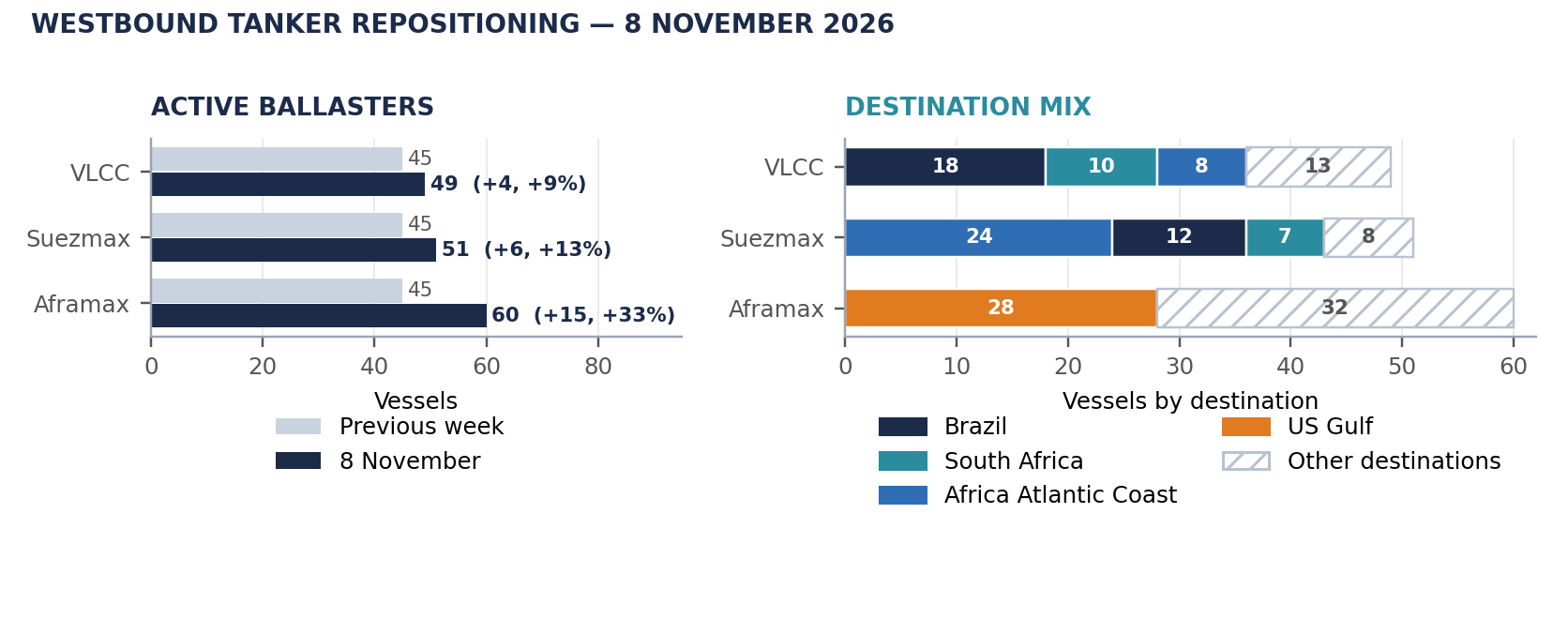
Signal Maritime recorded 49 active westbound VLCC ballasters on 8 November, compared with 45 a week earlier. Of these, 43 originated in the Far East. Brazil was the leading destination with 18 vessels, followed by South Africa with 10 and the African Atlantic Coast with eight. The count remains below the late-October peak of 52, and monthly East-to-West ballast movements fell from 73 in September to 50 in October.
Westbound positioning rose faster in the smaller crude segments. Suezmax ballasters increased to 51 from 45 a week earlier, with 24 heading for the Africa Atlantic Coast. Aframax ballasters rose to 60 on 7 November from 45 on 31 October, with 28 heading for the US Gulf. Arrival dates, onward employment and regional cargo demand will determine how much of this tonnage becomes available for fixing.
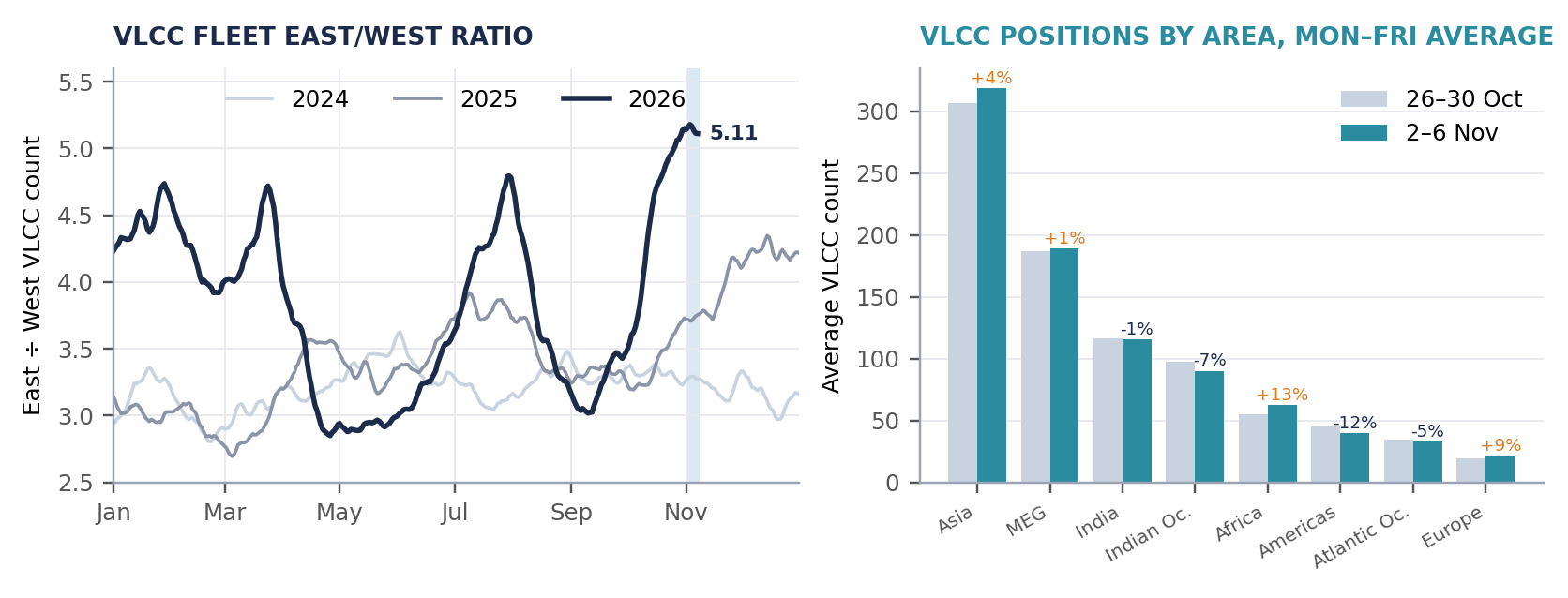
The increase in westbound ballasters contrasts with the continued concentration of VLCC tonnage east of Suez. The East/West fleet ratio stood at 5.11 on 7 November, close to its 2026 high of 5.18, compared with 3.75 in 2025 and 3.27 in 2024. Regionally, VLCC positions increased by 13.0% around Africa and 9.2% in Europe, while the Americas recorded a 12.3% decline. The Middle East Gulf count was broadly unchanged at 189 vessels. These figures capture the geographical distribution of VLCCs across all employment states, rather than the number of vessels immediately available for new employment.
Flows and Transport Costs
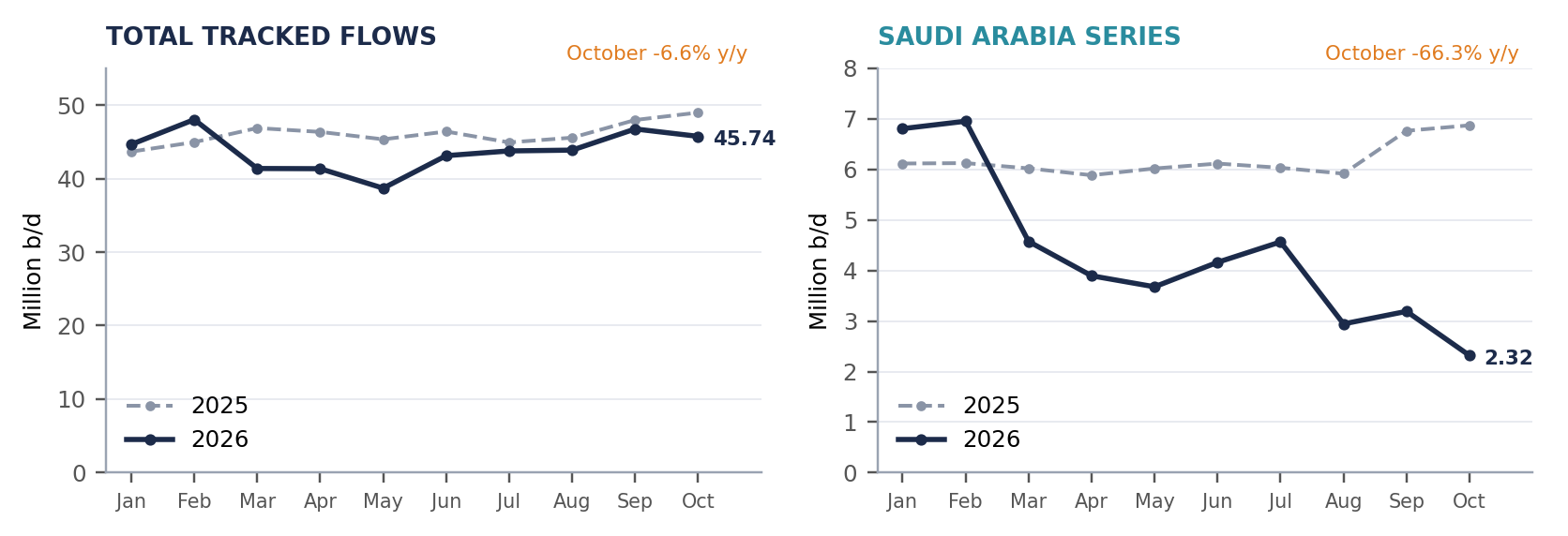
Signal Ocean tracked crude flows from all origins averaged 45.7 million b/d in October, down 6.6% year on year but well above May’s low. Tracked flows attributed to Saudi Arabia averaged 2.32 million b/d, down 66.3% year on year and below every earlier month of 2026. These are tracked and attributed flows, not a definitive measure of physical Saudi crude exports: the comparison does not establish how much of the decline reflects lower physical exports or changes in the attribution of ship-to-ship cargoes.
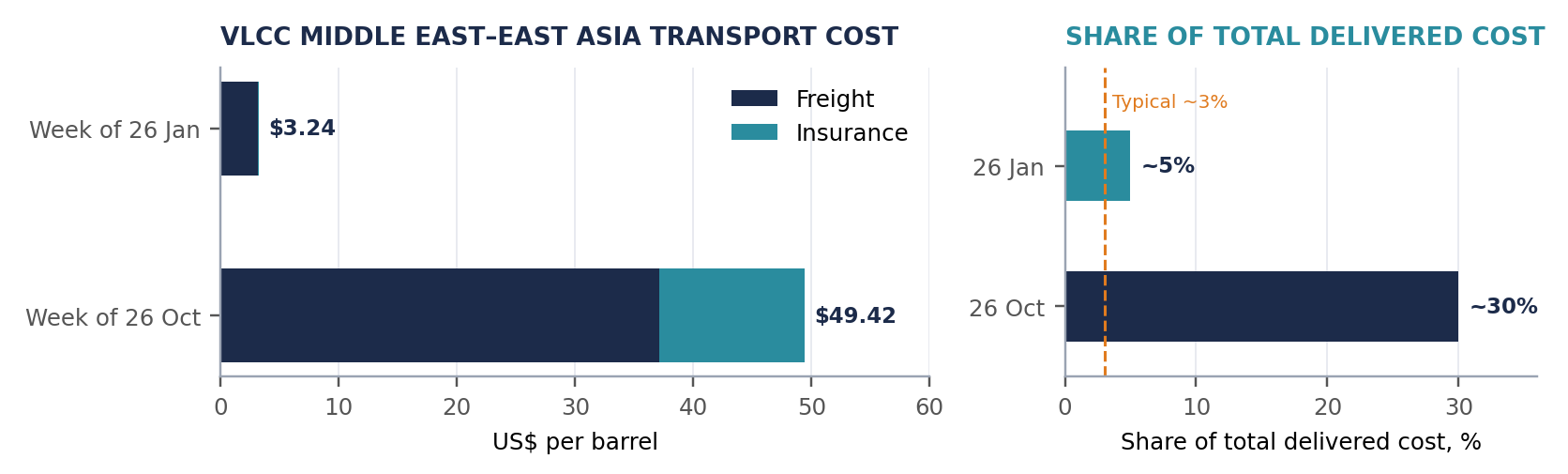
OPEC estimates that Middle East–East Asia VLCC freight rose from $3.18/bbl in the week of 26 January to $37.13/bbl in the week of 26 October, and insurance from $0.06/bbl to $12.29/bbl. On OPEC’s basis, freight and insurance combined accounted for about 30% of the total delivered cost of a barrel of crude on this route, against about 5% in January. These are OPEC estimates of the cost borne by cargo, not tanker TCE earnings.
Hormuz Freight Watch: Macro Risks
Conditions around the Strait of Hormuz remained uncertain in early November. Diplomatic contacts continued without a confirmed agreement, and security incidents involving commercial vessels were reported in and around the strait during the week. For shipping, the practical effects are on owners’ willingness to accept Gulf employment, war-risk insurance terms and voyage times, none of which can be assumed to normalise on a fixed timetable. Oil prices fell sharply after the US midterm elections amid hopes of de-escalation, while TD22 declined 16.3% between 3 and 6 November; the freight data do not isolate the effect of the election from other market changes.
Transport costs remain elevated, with freight and insurance at about 30% of total delivered cost on Middle East–East Asia VLCC voyages on OPEC’s estimates. Seven OPEC+ producers maintained their December production targets on 1 November, leaving planned supply levels unchanged ahead of their next meeting on 29 November. Potential changes to tanker availability and export capacity remain unconfirmed: the approval process outlined on 19 October for acquiring and refurbishing sanctioned tankers has yet to result in confirmed additions to mainstream chartering capacity, while comments attributed to Saudi Arabia’s energy minister on 12 October indicated that converting a gas pipeline could add about 1.2 million b/d of crude capacity towards the Red Sea within seven to eight weeks; completion has not been confirmed, and Yanbu loading capacity remains a constraint.
Market Takeaways
The tanker freight outlook remains difficult to assess, with geopolitical developments continuing to influence market expectations and vessel employment. Fresh reports of a possible agreement concerning the Strait of Hormuz on 9 November have renewed attention on the prospects for de-escalation, although no agreement or corresponding improvement in shipping conditions has been confirmed.
In the Atlantic, the timing of ballast arrivals and fresh cargo enquiry will be important in determining the supply balance for upcoming loadings. The Middle East Gulf presents a different picture, where security concerns, insurance costs and owners’ willingness to trade continue to influence vessel availability. An increase in vessel transits would not, on its own, establish that normal chartering conditions have been restored. With these differences persisting, the timing and scale of any freight adjustment remain uncertain.
Source: Signal Group



Related News.

1 Week left for the 5th CSN Greece ICT Conference, Athens 19th November 2026 “Intelligent Skies, Secure Seas: The AI Impact on ICT” – Register Now
“Intelligent Skies, Secure Seas: The AI Impact on ICT” Register here Date: 19 November 2026 Time: 09:00-15:00 Venue: PLOES Floating Venue The…

IMO Secretary-General calls on States to enforce maritime rules in the Strait of Hormuz
Secretary-General urges concrete measures to ensure compliance with international maritime regulations The Secretary-General of the International…

The future of shipping takes centre stage at Imperial College Alumni Association of Greece Event in Piraeus
Energy transition, digital transformation, artificial intelligence and the development of the next generation of maritime leaders at the heart of…

Wallem Group appoints Apostolos Poulovassilis to lead Greek expansion
Hong Kong-based Wallem Group announces the appointment of Apostolos Poulovassilis as General Manager, Ship Management, Greece, effective November…

Shipping cannot manage risk without managing the human impact
Shipping invests considerable time and resources in protecting vessels, cargo and commercial interests, yet the impact of risk on the people working…
ASA urges unified Global Rules as Hong Kong Convention enters second year in force
The 30th Interim Meeting of the ASA Ship Recycling Committee (SRC) was held online on 22 October 2026. The SRC members are firmly committed to…
Ahead of MEPC85, IMarEST members highlight barriers to net-zero delivery
Ahead of MEPC85, the Institute of Marine Engineering, Science and Technology (IMarEST) says its members now identify delivery, infrastructure, and…
Somali piracy resurgence: understanding the risk to commercial shipping
A hijacking off Somalia can have consequences far beyond the vessel seized. Captured ships can become motherships, extending pirates’ reach offshore…
JAXPORT awarded $40 million federal grant to modernise Blount Island berth
JAXPORT has been awarded a $40 million grant through the U.S. Maritime Administration’s Port Infrastructure Development Program to modernize Berth 32…

xclusiv S&P Report 9th November 2026
Pls find below the[xclusiv] S&P Report 9th November 2026 [xclusiv] 2026_11_09
Subscribe to our newsletter!
if you dont want to swim alone in the ocean of news, sign up for the newsletter, and you will receive daily all the important news of world shipping!
