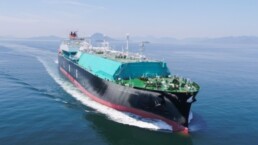

With Democrats securing victories in the U.S. midterm elections, analysts have raised concerns that the order outlook for liquefied natural gas carriers — a key revenue source for South Korea’s shipbuilding industry — could weaken. Stricter licensing and permitting procedures for LNG export terminals in the United States could delay new projects and, in turn, vessel orders.
Kang Kyung-tae, a researcher at Korea Investment & Securities, assessed the potential impact of the U.S. midterm election results on South Korea’s shipbuilding industry in a report on Nov. 6. He identified three key factors: delays in LNG carrier orders, changes in opportunities to secure U.S. naval shipbuilding contracts, and growing demand for on-site power generation at data centers.
The biggest concern is a potential contraction in the LNG carrier order pipeline. As of the end of September, LNG projects worldwide targeting operations by 2032 represented a combined annual capacity of 478 million metric tons. U.S. projects accounted for 255 million metric tons, or 53.2% of the total. The United States represents the largest share of the LNG carrier order pipeline for South Korean shipbuilders, making vessel orders particularly sensitive to changes in project schedules there.
If greater Democratic influence leads to stricter environmental impact assessments and permitting requirements, project construction could be pushed back. In particular, delays in permitting and commercialization schedules for LNG export terminal projects along the U.S. Gulf Coast could also defer related vessel orders.
Such changes could directly weaken the sales outlook for LNG carriers scheduled for delivery from 2029 onward. Shipbuilders may face pressure to lower newbuild prices to maintain adequate order backlogs. Market concerns over potential weakness in vessel prices are also seen as a key factor behind the recent correction in South Korean shipbuilding stocks.
The impact on U.S. naval shipbuilding opportunities is expected to be broadly neutral. A Democratic victory has reduced the likelihood of legislative changes that would allow U.S. naval vessels to be built overseas. However, opportunities for South Korean shipbuilders through their investments in U.S.-based shipyards remain. Kang noted that contracts for U.S. naval vessels awarded to Korean-owned shipyards could serve as a form of compensation for investments made under MASGA, or Making American Shipbuilding Great Again. The process is already underway, as illustrated by Hanwha Philly Shipyard’s selection to build a Medium Landing Ship for the U.S. Navy and Marine Corps.
The value of South Korea’s maritime defense business could be reassessed as new contract opportunities emerge. Key developments include overseas design evaluations for next-generation frigates, additional orders for Medium Landing Ships, and the selection of a design concept for next-generation combat support ships.
Meanwhile, growing demand for on-site power generation at U.S. data centers is seen as a positive factor for South Korean shipbuilders. This is partly due to bills introduced in the U.S. Congress that seek to make large electricity consumers bear the costs of expanding the power grid.
A bill introduced in the House of Representatives in June recommended that large consumers with peak demand of at least 100 megawatts bear the full cost of grid expansion. A separate bill introduced in the Senate in September proposed lowering the threshold to 20 megawatts and making cost-sharing mandatory.
As grid connection costs rise, data center operators may find it more attractive to install their own power generation facilities rather than wait for grid connections. Kang said the incentive could grow further if operators are also required to provide financial guarantees for grid expansion costs. This could benefit companies with relevant equipment manufacturing capabilities, including HD Hyundai Heavy Industries. In particular, Kang expects orders that could help support utilization at the company’s new facilities from 2029 onward. Floating data centers powered by on-site generation were also cited as a potential new business opportunity for the shipbuilding industry.
Kang said the uncertainty surrounding the midterm elections had been resolved and that the recent share price correction had improved the sector’s valuation appeal. He maintained his Overweight rating on the shipbuilding sector and reiterated HD Hyundai Heavy Industries as his top pick.
Source:Business Korea



Related News.

IMO Council backs second term for Secretary-General Arsenio Dominguez
Decision to extend the Secretary-General’s mandate for another four years is subject to approval by the IMO Assembly in 2027. The IMO Council has…

Wärtsilä to donate EUR 200 000 to Aalto University to support world-class engine technology research and expertise
Technology group Wärtsilä donates EUR 200,000 to Aalto University in Finland to support teaching and research of combustion engine technology. The…
Shin Yang Trading and Nippon Paint Marine Malaysia partner to strengthen coatings supply in East Malaysia
Shin Yang Trading a premier industrial supply and logistics subsidiary of the Shin Yang Group of Companies, has finalised a distribution partnership…

Can Marine Systems named an authorised reseller of Amazon Leo
Amazon Leo to expand Can Marine’s managed maritime connectivity offering through the Canopus™ Platform Can Marine Systems Pte Ltd announced it has…

Shipbroker’s document delay leads to US$24,000 demurrage settlement, ITIC warns
A shipbroker contributed US$24,000 towards a settlement of a demurrage dispute after delays in forwarding key documents complicated a claim between…

How China became a leader in green shipping corridors
A recent report from the Global Maritime Forum reveals that China has quickly become a global leader in green shipping corridors, with nearly…

LR and MAWANI sign agreement to support the development of Saudi Arabia’s maritime and ports sector
Collaboration will explore opportunities spanning safety, sustainability, digitalisation, institutional capability and professional development…

Jamaica launches IMO Council bid with call for inclusive maritime leadership
The Jamaica has launched its campaign for re-election to Category C of the International Maritime Organization Council for the 2028-2029 biennium,…
IMO Council urges stronger protection of seafarers amid threats to global shipping
Council condemns attacks on merchant shipping in the Red Sea and Black Sea, mourns loss of 25th seafarer since onset of Strait of Hormuz conflict,…
New Leaders take charge of two Port of Long Beach Divisions
Promoted directors named to head Survey, Maintenance divisions Focused on transforming itself into the Port of the Future™, the Port of Long Beach…
Subscribe to our newsletter!
if you dont want to swim alone in the ocean of news, sign up for the newsletter, and you will receive daily all the important news of world shipping!
