Tubarão Gains, Ponta da Madeira Retreats Brazil’s Iron Ore Freight Outlook


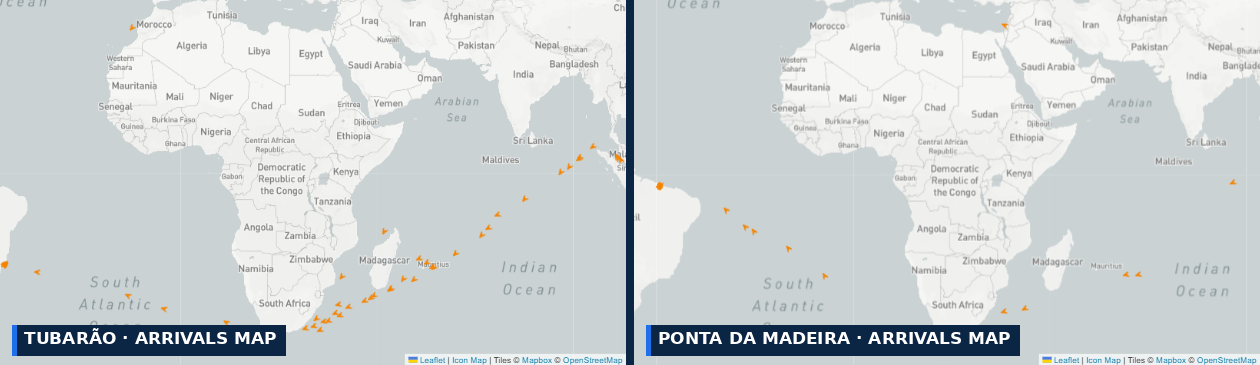
SPOTLIGHT | TUBARÃO, PONTA DA MADEIRA & PRODUCTION CUTS
Brazil’s Iron Ore: Tubarão Gains, Northern Supply WeakensBrazil’s Iron Ore: Tubarão Gains, Northern Supply Weakens

Brazilian iron ore exports have diverged across major loading systems in 2026. Tubarão has recorded stronger China-bound shipments, while Ponta da Madeira (PDM) has declined amid weaker output at Vale’s Northern System. The difference matters for freight, but cargo growth alone does not establish additional spot Capesize demand: vessel size, contractual coverage and the timing of Atlantic ballast arrivals determine how much export activity reaches the C3 market.
Brazilian terminals | China-bound export divergence
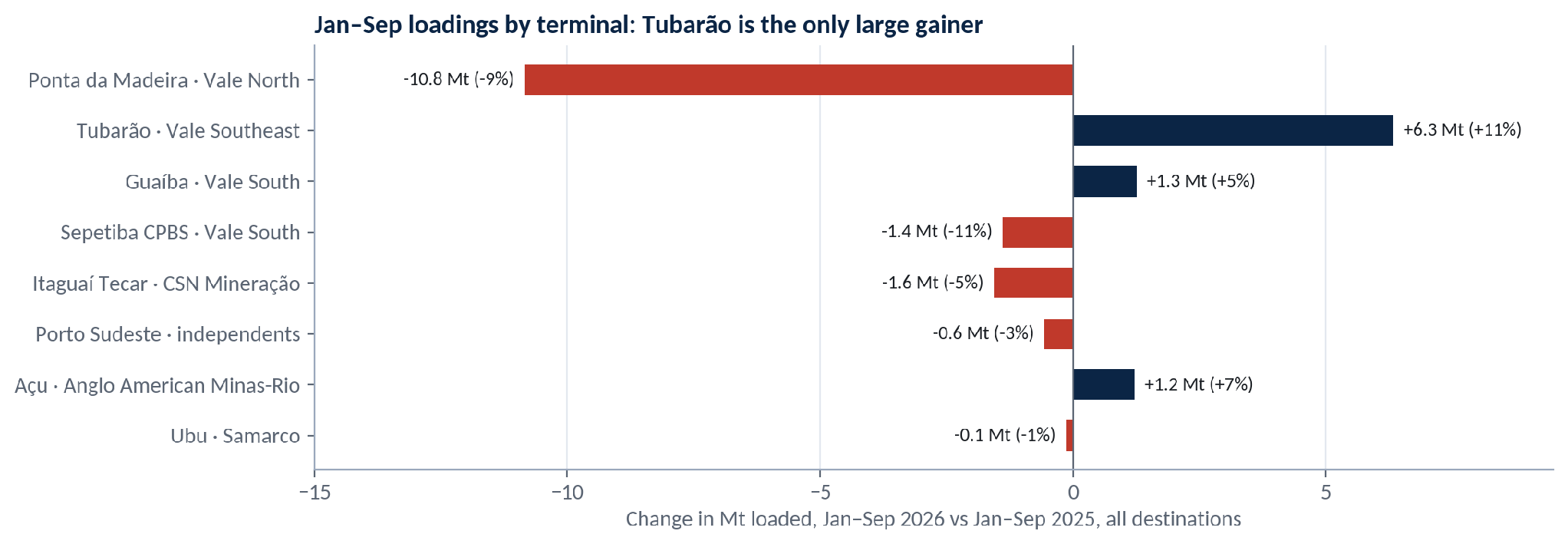
Tubarão’s estimated China-bound shipments increased by 6.59 Mt to 40.07 Mt in January–September 2026, up 20% year on year. Ponta da Madeira moved in the opposite direction, losing 9.90 Mt to 78.80 Mt (−11%). Guaíba recorded a more modest increase of 4% to 24.23 Mt, while the wider Itaguaí area declined 6% to 36.07 Mt. The contrast indicates that Brazil’s China trade is not strengthening evenly across its export corridors.

Across all destinations, Tubarão’s iron ore loadings increased by approximately 6.3 Mt (+11%) year on year during January–September 2026, while Ponta da Madeira declined by 10.8 Mt (−9%). Figure 1 highlights the contrasting export performance of Vale’s Southeastern and Northern Systems, with Tubarão recording stronger loading activity amid weaker volumes at Ponta da Madeira.
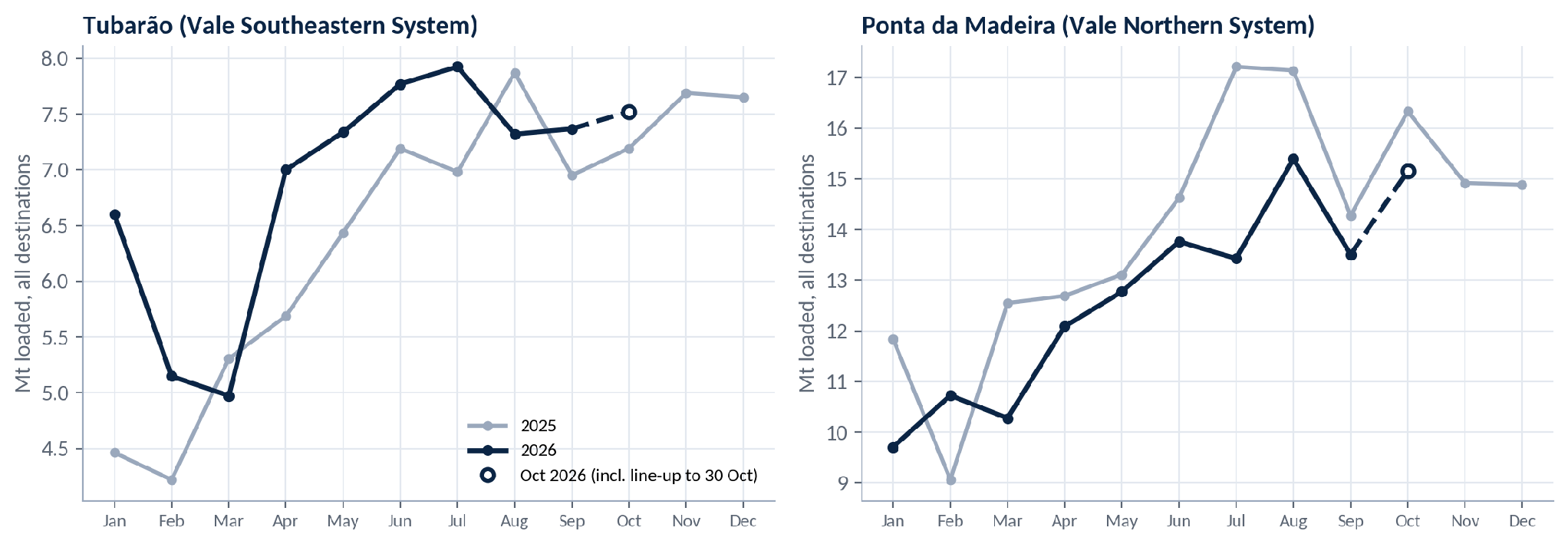
Monthly loadings | Tubarão steadier, PDM recovering from September
Figure 2 presents monthly iron ore loadings to all export destinations, with October volumes remaining indicative. Tubarão recorded a rebound in loading activity during 2026, with volumes strengthening from the lower levels seen earlier in the year and remaining firm through the third quarter. September loadings reached approximately 7.4 Mt, with October indications rising slightly to 7.5 Mt. Ponta da Madeira followed a more variable monthly pattern, despite its weaker cumulative export performance year on year. Its October loading indications increased to approximately 15.2 Mt from 13.5 Mt in September (+13%).
Ponta da Madeira’s performance also reflects developments within Vale’s Northern System. According to Vale’s third-quarter results, Northern System iron ore production declined by 6.9 Mt year on year to 42.8 Mt, largely reflecting reduced run-of-mine availability at Serra Norte, while stronger Serra Sul output provided a partial offset. Vale nevertheless maintained its full-year production guidance of 335–345 Mt, expecting operational improvements during the final quarter. These developments provide important context for PDM’s export performance, although production volumes and seaborne loadings do not necessarily move in parallel.
The improvement in loading activity was also reflected across Brazilian iron ore export ports, where estimated volumes reached 28.4 Mt during 1–25 October, up 5.8% from the corresponding September period but 2.3% below the same period in 2025. The month-on-month increase points to firmer shipment activity, although the year-on-year decline indicates that the recovery remains uneven across Brazil’s export terminals.
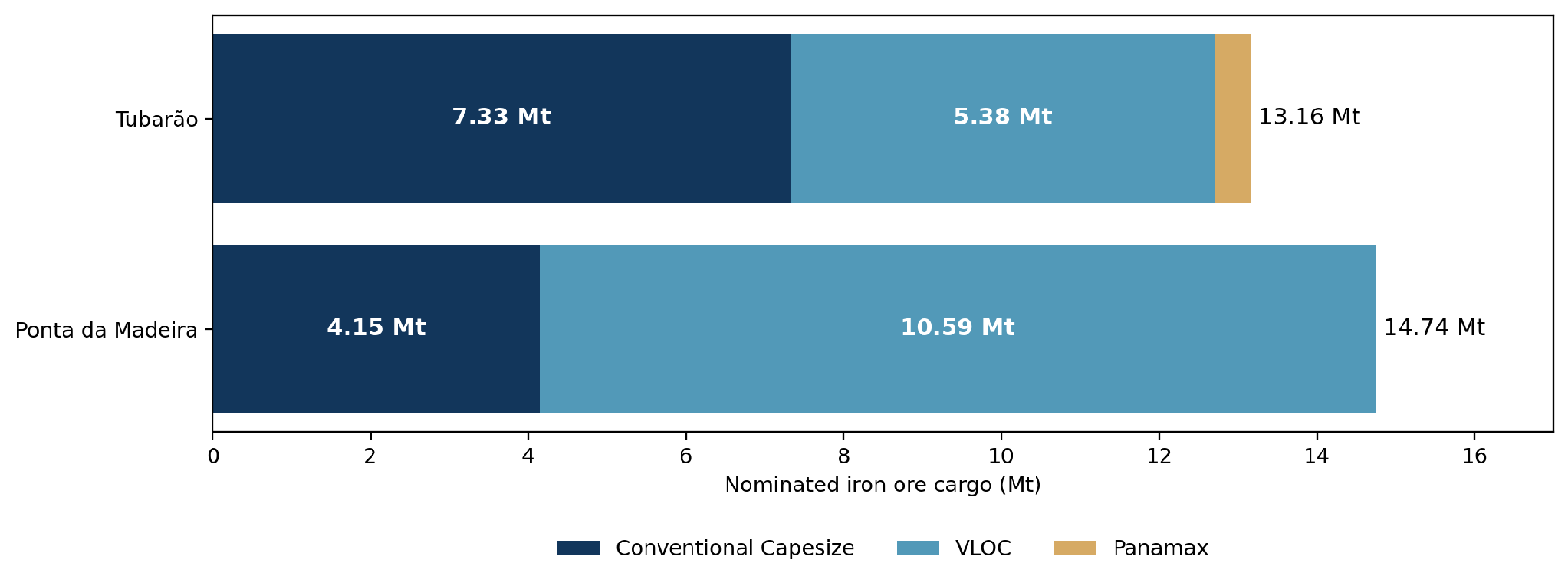
Port Insights | Tubarão Leads in Conventional Capesize Nominations
The 28 October Port Insights data show contrasting iron ore loading programmes at Tubarão and Ponta da Madeira. Tubarão recorded 67 nominated loading calls representing 13.16 Mt, compared with 57 calls and 14.74 Mt at Ponta da Madeira. Conventional Capesizes accounted for 44 calls (7.33 Mt) at Tubarão, compared with 24 calls (4.15 Mt) at PDM. In contrast, PDM’s programme was dominated by 33 VLOC nominations representing 10.59 Mt, against 16 VLOC calls (5.38 Mt) at Tubarão. Despite PDM’s larger nominated cargo volume, Tubarão recorded 20 more conventional Capesize calls, highlighting the different vessel requirements at the two terminals.
The November departure schedules reinforce this difference. Tubarão recorded approximately 10.7 Mt of nominated departures, including 38 conventional Capesize calls (6.32 Mt) and 12 VLOC calls (3.96 Mt). At Ponta da Madeira, November nominations reached approximately 11.3 Mt, comprising 25 VLOC calls (7.91 Mt) and 20 conventional Capesize calls (3.40 Mt). The higher VLOC concentration at PDM contrasts with Tubarão’s stronger conventional Capesize representation, an important distinction when assessing potential vessel employment on Brazil’s long-haul iron ore routes.
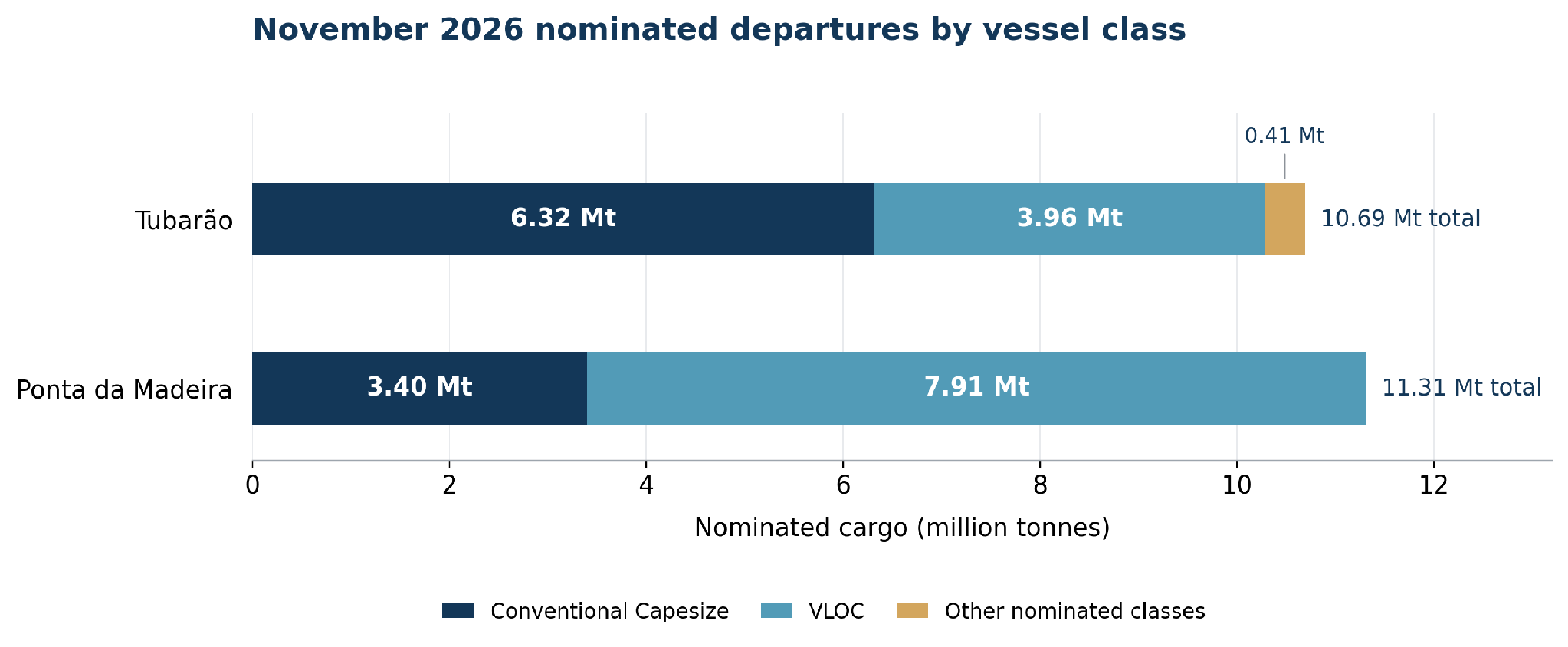
Cargo composition provides further context. At Tubarão, iron ore pellets accounted for 51 nominated calls and approximately 7.78 Mt, or 59% of indicated tonnage. At Ponta da Madeira, iron ore fines dominated the loading programme, with VLOCs representing approximately 72% of nominated cargo tonnage. The contrasting cargo and vessel profiles highlight how differences in export activity between the two ports translate into different fleet requirements. The nominated programmes provide a forward view of potential loading activity, while actual Capesize employment will depend on the execution of scheduled departures and the availability of vessels positioning towards Brazil.
Production outlook | Supply constraints
Brazil’s iron ore production outlook remains uneven. Vale reported 88.4 Mt in the third quarter, down 6% year on year, with lower ore availability at Serra Norte partly offset by stronger Serra Sul performance. Both operations belong to the Northern System, providing operational context for weaker exports through Ponta da Madeira. Vale nevertheless maintained its annual guidance of 335–345 Mt. The extent to which production translates into export availability will depend on inventories, logistics and the execution of loading programmes.
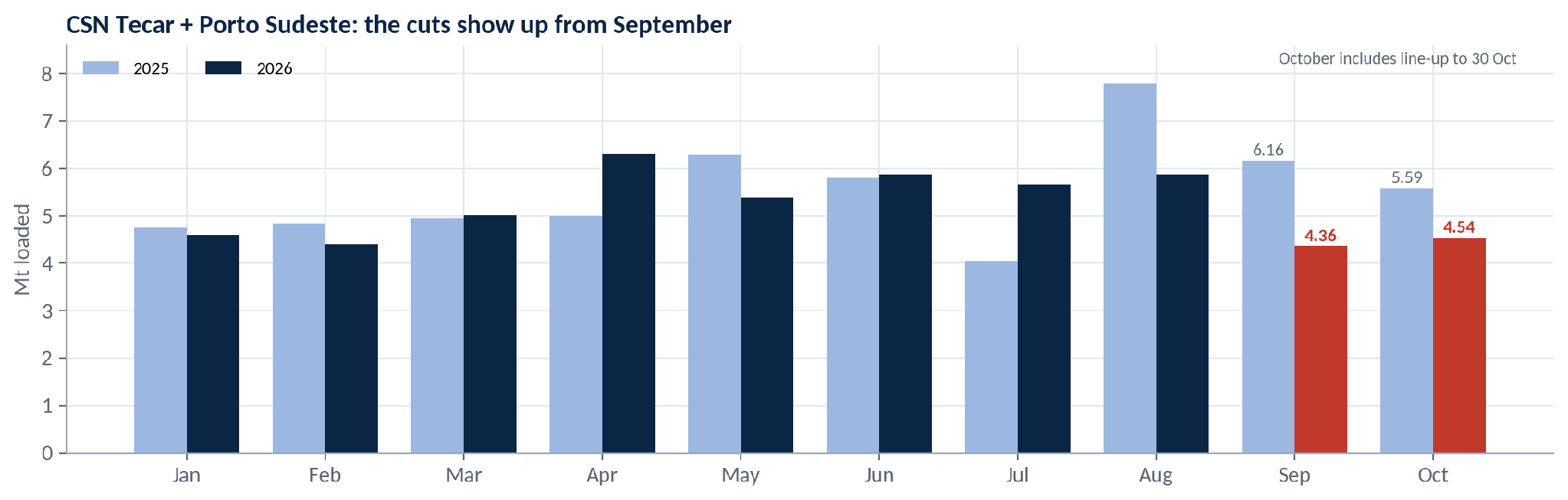
Supply pressure is more evident among smaller producers. CSN Mineração reduced its production-plus-purchases guidance to 39–41 Mt from 45–47 Mt, while several independent miners announced suspensions or output adjustments. These developments coincide with weaker terminal activity: combined September–October loadings at Tecar and Porto Sudeste fell to 8.90 Mt from 11.75 Mt a year earlier, a reduction of 2.85 Mt. The decline highlights a weaker source of conventional Capesize cargo demand alongside the larger nominated programmes at Vale’s ports.
Anglo American reported Minas-Rio production of 6.3 Mt in the third quarter, up 24% year on year. Samarco reported production of 4.3 Mt, up 4%. However, sales declined 5% to 3.9 Mt. Separately, Signal Ocean Platform’s Dry Bulk Flows records show that Açu’s China-bound shipments increased to 9.18 Mt in January–September from 5.15 Mt a year earlier. Ubu shipped only 0.37 Mt to China over the same period, with South Korea, Egypt and the US among its main destinations. The stronger China-bound flow from Açu therefore has a more direct connection to Brazil–China vessel employment than Samarco’s production recovery.
For freight, lower shipments at Tecar and Porto Sudeste may constrain spot Capesize enquiry, while increased Açu–China volumes support long-haul employment. Sustained support for C3 will depend on scheduled cargoes materialising and conventional Capesize demand absorbing available Atlantic tonnage. Vale’s Northern System performance, independent producer restarts, Chinese buying and ballast arrivals remain the main indicators to watch.
Source:Signal Ocean



Related News.
Global study finds Cyprus ranks SEVENTH and set for $1.1 billion AI GDP boost
Cyprus beats India and New Zealand to come SEVENTH in major AI study – with potential €1.1 billion GDP boost and youth jobs opportunity Some 86% of…

Global shipping’s trillion dollar climate bill according to Zero Carbon Analytics
A new study by Zero Carbon Analytics finds that emissions from international shipping cost the global economy around USD 963 billion between 1990…

Keeping Children Safe Online at Sea Seafy® earns friendly WiFi Certification across 26 vessels
Seafy becomes Friendly WiFi’s first partner in the maritime sector, helping protect kids from harmful content online. Friendly WiFi is delighted…
ShipManager joins Star Information Systems to accelerate the maritime industry’s transition to cloud
CFARER, a DNV Company selects Star Information Systems as the longterm home for ShipManager and its cloud future Star Information Systems (Star)…

Seafarer experience must shape maritime technology, initial STEER Project report finds
New research finds technology can shift rather than remove risk as The Nautical Institute, with support from Lloyd’s Register Foundation, calls for…

New LR service targets cargo disruption when trade routes fail
New LR Advisory service helps ports, governments and logistics operators respond to disruption, protect critical cargo flows and strengthen trade…

DORIC WEEKLY INSIGHT 06 NOVEMBER 2026
Please find below the DORIC Market Insight for the week ending 06th November 2026. Weekly Report 06.11.2026
BIMCO Shipping Number of the Week
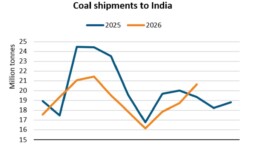
Coal shipments to India drop 7%, but limited recovery may lie ahead "Between January and October, coal shipments to India dropped 7% y/y due to the…

Hapag-Lloyd marks 20 years in South Africa and targets further growth
South Africa has become a cornerstone of Hapag-Lloyd's business in Africa Hapag-Lloyd surpasses 1 million TEU in Africa for the first time in its…
Subscribe to our newsletter!
if you dont want to swim alone in the ocean of news, sign up for the newsletter, and you will receive daily all the important news of world shipping!
