NGOs Call on Nordic Council To Adopt AMOC Resolution and Make Good on Polar Fuels Promise

As a meeting of Nordic Council parliamentariansopens today in Finland, the Clean Arctic Alliance calls on participants to adopt a resolution on the Atlantic Meridional Overturning Circulation (AMOC) (details below).
“With Iceland having already identified changes to the AMOC as a security risk, the Nordic Council must adopt this resolution, and demand that their governments commit to become global leaders on cutting climate warming emissions including from short-lived climate pollutants such as black carbon and methane”, said Arni Finnsson, Board Chair at the Iceland Nature Conservation Association.
The AMOC is a major system of ocean currents in the Atlantic Ocean, conveying warm, salty water north near the ocean’s surface while sending colder, denser water south. Iceland’s government has demonstrated concern regarding the impact of climate change on the AMOC – Minister of Environment, Energy and Climate, Jóhann Páll Jóhannsson’s article on varda.org expresses this threat as a national security issue.
“Urgent action is required to cut Arctic warming – the Alliance calls on Nordic Council countries Finland, Iceland, Sweden and Norway to re-demonstrate commitment to the October 2025 Nordic Council adoption of a resolution on polar fuels, by backing an International Maritime Organization (IMO) proposal to require the use of polar fuels in order to cut black carbon emissions from Arctic shipping, which contribute to the melting Arctic sea ice and the Greenland ice sheet”, said Dr Sian Prior, Lead Advisor to the Clean Arctic Alliance.
The 2025 resolution calls on Nordic governments to create and implement a regulation by the UN shipping body, the International Maritime Organization (IMO), that would require the use of cleaner maritime fuels (polar fuels), resulting in lower emissions of black carbon by ships when operating in the Arctic.
Such a proposal, led by Denmark – supported by Greenland, with Germany, France and the Solomon Islands, is on the table for an IMO meeting in January, but needs wider support, particularly from Arctic states, such as Iceland, Norway, Finland and Sweden. Reducing emissions of short-lived climate pollutants such as black carbon, methane and ozone is one of the urgent routes identified to limit overshoot of 1.5oC and limit the impacts of climate change on planetary systems including the AMOC.
“Following last week’s publication of the European Union’s Arctic Strategy, which stated support for binding regulations to reduce black carbon emissions from Arctic shipping, Nordic Council members must now align with this position by throwing their weight behind the polar fuels proposal coming up this January at the IMO”, said Prior.
“The IMO polar fuel regulation would fill an important gap in the IMO’s current regulatory framework, by directly targeting black carbon emissions from ships”, added Prior. “Now other Nordic countries must honour their 2025 resolution: Finland and Sweden, Iceland and Norway must step up and join Denmark and other co-sponsors to demonstrate their support ahead of the IMO’s Pollution Prevention and Response meeting (PPR 14) in January 2027.”
Nordic Council
The Nordic Council is an official body for inter-parliamentary co-operation comprising 87 MPs elected by Nordic parliaments, from the Aland Islands, Denmark, Faroe Islands,Finland, Greenland, Iceland, Norway, and Sweden.
Polar Fuels
The proposed polar fuel measure would require the use of cleaner distillate fuels such as marine gas oil (MGO) and new zero carbon fuels which are beginning to enter the market. It would prevent the use of residual fuel blends including marine diesel oil (MDO) and ultra-low sulphur fuel oils (ULSFOs), or heavy residual fuel oils (HFOs) with scrubbers, which would still be able to be used under an ECA designation.
- Interactive map: How fuel policy changes black carbon in the Arctic
- Clean Arctic Alliance Briefing: What are Polar Fuels?
- How an IMO Polar Fuels Rule Will Curb the Arctic’s Shipping’s Black Carbon Emissions
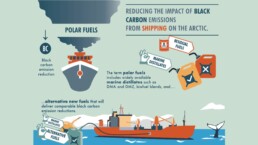
- Infographic: Polar Fuels Can Reduce the Impact of Black Carbon on the Arctic
- Factsheet: Reducing the impact of black carbon emissions from shipping on the Arctic
The AMOC resolutionA 2037/UHN Member Proposal on AMOC and Its Connection to Climate, Environment, and Food Security in the Nordic Countries
- to jointly highlight changes in the Atlantic Meridional Overturning Circulation (AMOC) as a strategic climate, environmental, and societal risk for the Nordic region, and clearly present these risks in dialogue with the European Commission as well as within the EU’s climate, environmental, and maritime policies
- to assign the relevant Nordic authorities to develop a comprehensive Nordic risk assessment of how a weakened or collapsed AMOC could affect climate, ocean conditions, biodiversity, primary industries, and food security in the Nordic region
- to ensure long-term funding and coordination of observation and monitoring systems in the North Atlantic, with the aim of establishing a Nordic and European early warning system for AMOC that is integrated into political decision-making processes and utilizes the opportunities within the EU’s maritime and ocean policies
- to develop and integrate flexible climate adaptation and risk management strategies that take into account multiple possible future scenarios, including regional cooling and increased climate contrasts, and that are applied across climate and ocean governance, from scientific analysis to adaptation, preparedness, financing, and capacity building.

Video: The Arctic and Black Carbon
Black Carbon and the Arctic
Black carbon is a short-lived climate pollutant, produced by the incomplete burning of fossil fuels, with an impact more than sixteen hundred times that of CO2 over a 20 year period. It makes up around 20% of international shipping’s climate impact. Not only does it contribute to warming while in the atmosphere, black carbon accelerates melting if deposited onto snow and ice – hence it has a disproportionate impact when released in and near to the Arctic.
The melting snow and ice exposes darker areas of land and water and these dark patches then absorb further heat from the sun and the reflective capacity of the planet’s polar ice caps is severely reduced. More heat in the polar systems – results in increased melting. This is the loss of the albedo effect.
Declines in sea ice extent and volume are leading to a burgeoning social and environmental crisis in the Arctic, while cascading changes are impacting global climate and ocean circulation. Scientists have high confidence that processesare nearing points beyond which rapid and irreversible changes on the scale of multiple human generations are possible. Scientists say it is now too late to save summer Arctic sea ice, and research has shown that “preparations need to be made for the increased extreme weather across the northern hemisphere that is likely to occur as a result.”
Black carbon also has a negative impact on human health including premature death and harmful effects on the cardiovascular system (heart, blood and blood vessels), and recent research has found black carbon particles in the body tissues of foetuses, following inhalation by pregnant mothers.
The need to reduce emissions of black carbon because of both the climate andhealth impacts has been long recognised. On land, considerable effort has been made to ban dirtier fuels in power stations, to install diesel particulate filters on land-based transport, and to improve the burning of dry wood – all to reduce emissions of black carbon and improve air quality. However, at sea the same efforts have not yet been made.
The report Black Carbon Emissions from Ships in the Arctic 2019 – 2024provides a comprehensive analysis of tank-to-wake black carbon emissions from Arctic shipping using three geographic definitions: a latitudinal band north of 60oN (excluding the Baltic Sea and Gulf of Alaska), the Polar Code Arctic waters, as well as a broader ecological boundary defined by the Arctic Monitoring and Assessment Programme (AMAP). It estimates black carbon emissions for the years 2019, 2022 and 2024. The report examines the seasonal patterns of Arctic shipping routes, profiling vessel characteristics, fuel consumption by EEZ and vessel type as well as energy use. Historical estimates show how Arctic shipping activity and associated emissions have changed over time, while forecasts reveal how growth in emissions could affect the Arctic, and inform decisions on fuel choices, such as that proposed by PPR 13/6, operational practices and regulatory strategies.



Related News.

Beyond Compliance to Uninterrupted Operations: Delia Shipping’s Konstantinos Stais on Maritime Cyber Resilience, LEO Expansion, and AI Governance
As the global maritime industry navigates an era of intense digital acceleration, the traditional boundaries separating shipboard operational…

Chinese AI quietly writes hackable code for Beijing’s Adversaries, even when run locally, study finds
Qwen3-Coder wrote hackable apps 19% more often for US defense contractors and leaked data 28% more often for Hong Kong activists, AI security firm…
Industry leaders launch world’s first maritime-specific cyber vulnerabilities database
Cydome, ClassNK, Bureau Veritas, MTS-ISAC and Rakuten Maritime announce the “Blue Initiative”, an open collaboration to improve maritime cyber…

Businesses increasingly adopt AI for cybersecurity while individuals expand privacy protections
As cyber threats grow and digital technologies become more pervasive, businesses are increasingly using AI to strengthen…
EmissionLink calls for EU ETS revenues to fund maritime carbon capture trials and port infrastructure
Maritime emissions specialist, EmissionLink, has called for a dedicated proportion of EU Emissions Trading System (EU ETS) revenues to be invested…
Port of Antwerp-Bruges sees strong recovery in container throughput in volatile trading environment
In the first nine months of 2026, Port of Antwerp-Bruges handled 200.9 million tonnes of goods, 0.8% less than in the same period last year.…

Sanctions risks reshape commodity trading
Traders face sanctions challenge “odyssey” as geopolitical risks reformat global markets Commodity traders are operating in an increasingly…
Titan analysis shows FuelEU pooling propelled liquefied biomethane demand
- Clean fuel supplier evaluates compliance for 8,000 TEU containership operating in Northern Europe - FuelEU Maritime balances competitiveness…
Russian diesel tanker heads to New York as Kremlin claims regular shipments
Malta-flagged tanker should carry 40,000 mt fuel Agioi Fanendes left Primorsk Oct. 22: CAS US lifts sanctions, enables Russian imports……
Pilot transfer operation: A safer step aboard
Safe pilot transfer operations depend on both correct procedures and fit-for-purpose equipment. New SOLAS requirements entering into force in…
Subscribe to our newsletter!
if you dont want to swim alone in the ocean of news, sign up for the newsletter, and you will receive daily all the important news of world shipping!
