SWITCH Maritime receives design basis agreement from US coast guard for 150-passenger hydrogen fuel cell-electric ferry
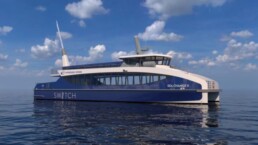

SWITCH Maritime , a leading developer of zero-emission vessels, secured a Design Basis Agreement with the United States Coast Guard for the SWITCH-150, a 150-passenger hydrogen fuel cell-electric ferry. The SWITCH-150 is a zero-emission vessel that is designed to align with the performance and operating specification that ferry operators have come to expect from diesel vessels, but the only vessel emissions are water vapor.
The SWITCH-150 is powered by an integrated hydrogen fuel cell-electric propulsion and hydrogen storage system that enables the vessel to perform high-frequency, high-intensity ferry operations like an existing diesel vessel. This means parallel service speeds, a daily bunkering schedule, and no need to increase dwell time or alter service to account for vessel charging. Further, the vessel requires no investment in costly and complicated shoreside charging infrastructure and power grid upgrades. Needing only mobile hydrogen refueling equipment, the SWITCH-150 can be seamlessly integrated into an ongoing ferry operation, rather than requiring scheduling changes or a system-wide reorientation, as would be required for a comparably specified battery-electric vessel. The SWITCH-150 was designed by global naval architecture firm, Incat Crowther.
The SWITCH-150 draws directly from the technical, regulatory, and operational framework set by Switch’s first vessel, the Sea Change. The Sea Change is the first hydrogen fuel cell-electric ferry in the United States, which began passenger service in July 2024. The Sea Change received its DBA from the USCG in 2020 and its Certificate of Inspection (COI) in 2024, which cleared the vessel for commercial operation. The Sea Change was the first hydrogen fuel cell-electric vessel to successfully move through USCG’s Alternative Design Basis Approval Process.
The USCG Subchapter T regulation – the set of rules and standards that governs the design, construction, and operation of passenger vessels with a capacity of 150-passengers or fewer – does not currently include guidance or regulation specifically tailored to hydrogen fuel cell-electric propulsion and hydrogen storage. To ensure that the SWITCH-150 design adhered to USCG standards, Switch and the vessel project team worked directly with USCG to build a regulatory framework that demonstrates sufficient equivalency in safety and risk mitigation. The International Maritime Organization (IMO) approved the Interim Guidelines for the Safety of Ships Using Hydrogen as Fuel in May 2026; these guidelines served as an important foundation for the DBA process for the SWITCH-150, adding more structure to the process while reducing time to approval.
Throughout the DBA process and the broader SWITCH-150 development process, Switch collaborated closely with Incat Crowther, which led vessel design and initial regulatory matrix development. The SWITCH-150 is the second vessel designed in partnership between Switch and Incat Crowther, after the Sea Change. In addition, Switch leveraged the critical contributions of a global team of expert partners, including hydrogen storage systems developer, Hexagon Purus; operational advisor, Hornblower Marine; hydrogen propulsion system design and safety specialist, LH2 Shipping; fuel cell system developer and manufacturer, PowerCell Group; and propulsion system integrator, SEAM.
The development of the SWITCH-150 has been supported by a $2 million grant from the New York State Energy Research and Development Authority (NYSERDA) to develop and demonstrate the first hydrogen-powered ferry in New York State. The grant was provided through NYSERDA’s Advanced Fuels and Thermal Energy Research Program, which aims to accelerate deployment of commercially ready clean hydrogen technologies that reduce greenhouse gases across sectors.
The first SWITCH-150 is intended to operate in New York City, based at the Brooklyn Navy Yard. The New York application would utilize clean hydrogen, ensuring lowest-possible “well-to-wake” emissions. While this would be the first deployment, the SWITCH-150’s propulsion system provides the performance, range, and flexibility to operate in a range of high-frequency commuter services throughout the United States.
“Signing the DBA with the Coast Guard is a critical milestone in advancing the development of the SWITCH-150. With the DBA in hand, Switch, our project team, and the USCG have a clear and defined framework that will inform vessel construction, commissioning, and ultimately operation,” said Francisco Planells, the Director of the Newbuild Program at Switch. “We are now one step closer to deploying commercial-scale hydrogen-fueled vessels that will help operators to futureproof and decarbonize their fleets without operational compromise.”
Source: Business Wire



Related News.
Columbia Group calls for greater focus on retaining women at sea as second She Beyond Conference takes place
Columbia Group has called on the maritime industry to create a future where women can thrive, progress and lead at sea, as it celebrated the second…
Neptune Group Welcomes “NIKOS TRAVLOS”
The new vessel proudly bears the name of Neptune's founder, who laid the foundation for the creation and enduring evolution of the Group. Her…

Wildcat Defense enters into exclusive agreement to acquire Fraser Shipyards
American family firm takes the next step in its strategy to rebuild U.S. shipbuilding and repair capacity, following its offer for Austal USA.…

Kawasaki signs strategic partnership MOU with Romania’s Transgaz for Onshore Hydrogen Gas Transport
Establishing a model for large-scale hydrogen supply and transport via pipelines Kawasaki Heavy Industries, announced at the Romania–Japan…

UK P&I Club and TT Club secure regulatory approval for Thomas Miller acquisition
The UK P&I Club and TT Club announce the successful completion of their joint acquisition of the Thomas Miller Holdings group, marking a major…
Valenciaport presents its Sandbox at PEIC’26 as a tool to bridge the gap between innovation and implementation
The opening session featured a discussion between Valenciaport President Mar Chao and Valenciaport Foundation Director Antonio Torregrosa. The…
Major investments strengthen Gothenburg RoRo Terminal
Expanded terminal areas, new rail connections and modernised quays are among the investments that have strengthened Gothenburg RoRo Terminal in…
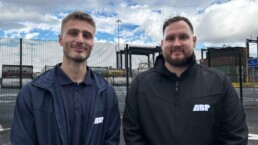
ABP appoints key roles in the Humber
Associated British Ports has made two key appointments at its container terminals strengthening its unitised operations at the ports of Immingham…

Xinhua Silk Road 2026 North Bund Forum unveils 20 shipping-related achievements
The 2026 North Bund Forum opened in Shanghai on October 20 with 20 key shipping-related achievements spanning international cooperation, green…
Ports encouraged to prepare now for advanced nuclear in maritime and clean energy
New joint Lloyd’s Register and British Ports Association paper sets out a practical readiness pathway for ports considering nuclear-powered vessels,…
Subscribe to our newsletter!
if you dont want to swim alone in the ocean of news, sign up for the newsletter, and you will receive daily all the important news of world shipping!
