eFuel Group and DACMA open Direct Air Capture Competence Center in the Port of Hamburg
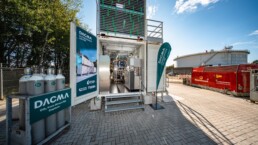

The new research and development centre at Hamburg Blue Hub combines the testing of modular CO₂ capture technologies with preparations for international applications. One focus is the collaboration with the Canadian project developer Deep Sky.
eFUEL GROUP and DACMA opened the DACMA Competence Center at Hamburg Blue Hub. Hamburg’s Senator for Economic Affairs, Dr Melanie Leonhard, joined company representatives for the official launch at the Hydrogen and Carbon Capture Technology World Expo. Keynote speakers included Evelyne Coulombe of the Canadian Embassy. Her visit underlined the importance of German-Canadian cooperation in the field of CO₂ capture.
Dr Melanie Leonhard, Senator for Economic Affairs, Labour and Innovation: “In Hamburg, we develop new technologies and bring them into industrial practice. The DACMA Competence Center creates new opportunities for this. Here, companies and researchers can work together to test how CO₂ from ambient air can be used as a raw material for industry. This also helps in the development of synthetic fuels, which will be needed in aviation and shipping in the future. With this expertise, we are strengthening Hamburg as a centre of innovation and industry and laying the foundations for new business models and industrial applications to emerge here.”
Direct Air Capture (DAC) refers to the capture of CO₂ from ambient air. The captured CO₂ can be used as a carbon source for synthetic fuels and other chemical products, or stored permanently underground. With permanent storage, the process can contribute to the net removal of CO₂ from the atmosphere, provided that emissions across the entire process chain are lower than the amount of CO₂ stored.
At the DACMA Competence Center, modular DAC plants are tested under real industrial conditions. The focus is on examining technical components and materials and analysing operating processes and energy and material flows. Together with international universities and research institutions, the aim is to develop approaches for technical optimisation.
German-Canadian cooperation on international DAC projects
DACMA and the Canadian project developer Deep Sky are working together on the further development and deployment of Direct Air Capture technology in Canada. The partnership includes a first DACMA plant with a planned capture capacity of 600 tonnes of CO₂ per year, as well as the joint development of a next generation of technology for larger plants. Deep Sky combines the capture of CO₂ from ambient air with its permanent geological storage.
For its future large-scale plants, Deep Sky has set a target of removing one million tonnes of CO₂ from the atmosphere each year. This scale is an expansion target, not a removal capacity that has already been achieved. What matters for the climate is how much CO₂ is permanently removed after deducting the emissions from construction, operation, transport and storage: a verified net removal of one million tonnes would take that amount of CO₂ out of the atmosphere every year. Unlike emissions avoidance, the process thus addresses CO₂ that is already in the atmosphere.
Evelyne Coulombe praised the partnership between DACMA and Deep Sky as a milestone in German-Canadian cooperation and a pioneering impetus for both countries’ shared commitment to decarbonisation. “Decarbonising industry is a challenge, but also an opportunity. Canada offers ideal conditions for climate-friendly production. Companies benefit from clean electricity, access to raw materials, CO₂ storage capacity and infrastructure, and a stable investment environment. To achieve the net-zero climate target, the removal of CO₂ from the air will become increasingly important. Canada has the infrastructure, the legal framework and the financing instruments to successfully decarbonise industrial production.”
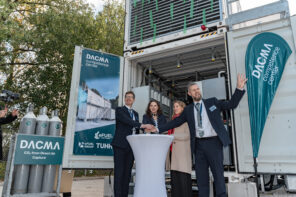
“At Deep Sky, we are focused on bringing the world’s best direct air capture technologies to industrial scale. Our collaboration with DACMA shows what is possible when companies work together across borders to develop and scale the technologies needed to build a global carbon removal industry. The Competence Center in Hamburg illustrates our shared approach: real-world deployment is the decisive step in understanding how the technologies perform under real conditions, and in building on that knowledge as we prepare to bring DACMA’s first plant to Deep Sky,” says Alex Petre, CEO of Deep Sky.
“For the further development of our plants, it is crucial to see how the technology performs in continuous operation. The DACMA Competence Center allows us to feed experience from testing straight back into development. This lets us base technical decisions on a broader data foundation,” says Alexander Backs, Co-CEO of DACMA GmbH.
“Direct Air Capture is a pragmatic and easily implemented addition for achieving climate targets, with a very significant impact. The DACMA Competence Center creates the conditions for further developing this proven technology and for testing the integration of CO₂ capture into downstream production processes. With the negative emissions generated by this technology, Hamburg could realistically achieve the targets of the Climate Referendum without jeopardising jobs in Hamburg’s industry,” explains Hanspeter Tiede, Managing Director of eFuel DAC GmbH. As part of eFUEL GROUP, the company specialises in stakes in projects and technologies for CO₂ capture from ambient air.
“To produce eFuels, eSAF and eMethanol, we need to bring together renewable energy, hydrogen and suitable carbon sources. That is why our focus is on integrating DAC into these production chains. Together with DACMA, we want to examine the interfaces between CO₂ supply and downstream processing,” says Lorenz Kiene, Managing Director of eFUEL GROUP.
PEGASUS: linking DAC and eMethanol production
In the PEGASUS project, DACMA, eFuel DAC GmbH and Hamburg University of Technology (TUHH) are investigating the integration of atmospheric CO₂ into an eMethanol process chain. Experimental work on the DAC technology is complemented by simulations that look at CO₂ capture, hydrogen from renewable sources and methanol synthesis together. The project analyses how energy, heat and material flows can be aligned and what effect this has on the efficiency and cost-effectiveness of the process chain.
The PEGASUS research project
The projects at the DACMA Competence Center also include PEGASUS, a collaboration between DACMA, eFuel DAC GmbH and Hamburg University of Technology (TUHH). The focus is on the experimental development of the DAC technology and on investigating its integration into an eMethanol process chain that uses atmospheric CO₂ as a carbon source. Accompanying process simulations examine the interplay of CO₂ capture, hydrogen from renewable sources and methanol synthesis. The aim is to identify ways of aligning energy, heat and material flows and thereby improving the efficiency and cost-effectiveness of the integrated process chain.



Related News.
ITF joins ISF Verify to help scale trusted digital seafarer certification worldwide
The International Transport Workers’ Federation has joined the ISF Verify project, to support the roll-out to the ITF’s seafarer network -…
Noatum CSM expands regional client base and managed fleet in first year of operations
Noatum CSM has expanded its managed fleet and secured new regional clients during its first year of operations, strengthening its position in the…
New Climate TRACE report quantifies the emissions impact of COP31 climate targets and identifies pathways with the greatest co-benefits
Clean power is a particular force multiplier of COP31 goals, with facility-level analysis showing that pairing smart 35% electrification with new…
INTERCARGO re-elects John A Xylas as Chair and welcomes two new Vice-Chairs
Members meet in Rome as INTERCARGO membership passes 500 INTERCARGO, the International Association of Dry Cargo Shipowners, has re-elected John A.…
IMO’s Marine Environment Protection Committee MEPC 85 to discuss shipping emissions, pollution and other ocean issues
The Marine Environment Protection Committee (MEPC) of the International Maritime Organization (IMO) will meet for its 85th session at IMO…
The Nautical Institute names winner and runners-up in global pilot transfer safety competition
Elliott Steinberg, a student at Wismar University of Applied Sciences in Germany, has won The Nautical Institute’s global student competition on…

Norway’s ‘green battery’ needs faster wind and grid build-out as power surplus narrows, says GlobalData
Norway’s reservoir hydropower makes it the flexible ‘green battery’ of northern Europe and a structural net electricity exporter. However, rising…
Saudi Red Sea Authority introduces ‘Invest with Guidance’ campaign for Maritime Tourism Investors
The Saudi Red Sea Authority has launched the “Invest with Guidance” campaign, which introduces investor guides. It consolidates licensing…

xclusiv S&P Report 16th November 2026
Pls find below the [xclusiv] S&P Report 16th November 2026 [xclusiv] 2026_11_16
Port of Long Beach recognised for outstanding communications
The Port of Long Beach earned four awards from the Los Angeles chapter of the Public Relations Society of America for outstanding communications…
Subscribe to our newsletter!
if you dont want to swim alone in the ocean of news, sign up for the newsletter, and you will receive daily all the important news of world shipping!
