Europe’s first Geostationary Sounder enters service to track Storms in Four Dimensions
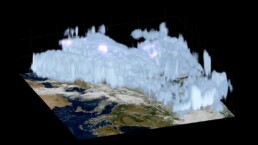

Data from Meteosat Third Generation’s Infrared Sounder are now operational, strengthening forecasts and severe weather warnings
Data from the Infrared Sounder on the first Meteosat Third Generation (MTG) Sounder spacecraft enter operational service today, as the satellite takes its new name, Meteosat-13. The sounder’s observations of temperature, humidity and trace gases down through the atmosphere will support earlier and more precise warnings of severe weather and support air quality forecasts across Europe, helping to protect lives, livelihoods and economies.
One of two instruments on Meteosat-13, launched on 1 July 2025, the Infrared Sounder is the first of its kind that Europe has placed in geostationary orbit. It is also a first for any global operational weather observation programme, reflecting Europe’s leadership in this field. Every 30 minutes its measurements can be used to detail how warm and humid the air is at different heights over Europe, and to track ozone, dust and volcanic ash.
“National weather services across EUMETSAT Member States can now use these data to detect signs of atmospheric instability even before clouds begin to form,” EUMETSAT Director-General Phil Evans said. “Together with the imaging and lightning sensors on our MTG imager satellites and their rapid revisiting time, they give a true four-dimensional view of the atmosphere, enabling forecasters to follow a storm over Europe from early instability through its growth up to full intensity lightning and precipitation, for the first time.
“Climate change is making extreme weather more frequent and intense, and these data will enhance short-range forecasts of flash floods, violent storms, hail and dangerous winds. Forecasters will see weather risks earlier and in more detail, so that citizens, first responders and civil authorities can act faster, and that saves lives. My sincere thanks go to our Member States and all the teams involved at EUMETSAT and partner organisations that made this achievement possible.”
A new view of Earth’s dynamic atmosphere
From around 36,000 kilometres above the equator, the Infrared Sounder works on the same principle as a thermal camera. The instrument measures nearly 2,000 infrared wavelengths, which carry signals at different heights and from different constituents of the atmosphere.
A new animation released today, built from real observations, combines these data with MTG imager data in a three-dimensional map of the atmosphere that changes through time – the fourth dimension, revealing storm clouds, lightning, winds and rainfall.
“The strength of the MTG system lies in how its two types of satellite (MTG-I and MTG-S) work together,” said Tony McNally, Head of Earth System Assimilation at the European Centre for Medium-Range Weather Forecasts. “Imagers bring spatial detail to track clouds, lightning and surface events like wildfires. The sounder adds more three-dimensional information on atmospheric temperature and humidity at different heights. This is a very powerful combination, and when used in our forecast models, allows us to provide more accurate predictions and better warnings of severe weather.”
Meteosat Third Generation is the most complex European Earth observation system for weather and climate ever built. In providing operational data, Meteosat-13 joins the imager Meteosat-12, while a second imager satellite, MTG-I2, is being commissioned and will scan Europe every 2.5 minutes.
Developed by EUMETSAT and ESA and built by European industry led by Thales Alenia Space, with OHB responsible for the sounder satellite, the system will be operated by EUMETSAT throughout its lifetime. A second instrument on board Meteosat-13 serves the European Union’s Copernicus Sentinel-4 air quality mission, which is expected to start delivering operational data in 2027.
Source: Business Wire



Related News.

Poland’s additional national requirements distort competition says Danish Shipping
Poland has introduced a national survey requirement for smaller foreign-flagged vessels operating in Polish waters. This creates significant…

Battery Vessels could help electrify most of Global Shipping Emissions
Battery-electric ships are economical only if the pack is cycled frequently, so they have been confined to short-sea, ferry and harbour vessels…

Mintra and Ledgid explore collaboration to connect Maritime digital identity, learning and workforce development
Mintra® and LEDGID are exploring opportunities to bring together complementary capabilities in digital learning, maritime training, professional…

World Shipping Council calls for global agreement on shipping emissions as industry investment surpasses $200 billion USD
The World Shipping Council (WSC) is calling on governments to agree on binding global greenhouse gas regulations for international shipping without…

What happened to the ITF whistleblower’s complaint?
In January 2026, a whistleblower complained that International Transport Workers’ Federation (ITF) General Secretary Stephen Cotton had manipulated…

Growing regulatory scrutiny puts seafarer wellbeing firmly on maritime safety agenda, VIKAND warns
Seafarer wellbeing is coming under greater regulatory scrutiny as international rules and guidance increasingly recognise crew health and welfare as…

Good Times Bad Times the Premium Stays with the Strait
In October, we wrote that if the transfer network off Oman kept pace, Gulf crude would carry China's refill and keep drawing tonnage east,…

Allied Weekly Market Review Week 47
Pls find below the Allied - Weekly Market Review - Week 47 ALLIED - Weekly Market Report- Week 47


Climate TRACE releases September 2026 Emissions Data
Climate TRACE reported that global greenhouse gas (GHG) emissions for the month of September 2026 totaled 4.7 billion tonnes CO₂e. This remains…
Subscribe to our newsletter!
if you dont want to swim alone in the ocean of news, sign up for the newsletter, and you will receive daily all the important news of world shipping!
