SEA.AI Maritime Machine Vision integrated on MARTAC unmanned surface vessels
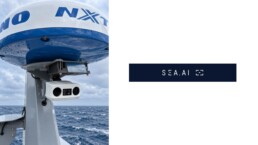

Purpose-built machine vision brings autonomous visual intelligence to MARTAC’s high-performance USV fleet, completing the sensor picture where conventional systems reach their limit.
SEA.AI, pioneer in maritime machine vision since 2018, announced the integration of its technology on MARTAC unmanned surface vessels. MARTAC, a Florida-based manufacturer of high-performance autonomous maritime platforms proven across thousands of hours of operational time on water, has selected SEA.AI’s system as part of its sensor integration architecture, adding autonomous visual intelligence to its fleet across ISR, security, and patrol mission profiles.
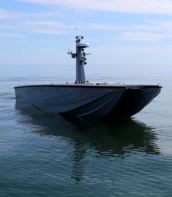
MARTAC’s fleet of scalable, battle-hardened autonomous USV platforms include the MANTAS™ T12, Devil Ray™ T18, Muskie™ M18, Devil Ray™ T24 and Devil Ray™ T38, providing a suite of mid-range USV solutions that combine unprecedented stability, speed and coverage to meet real-world mission demands
What Machine Vision Adds
Maritime domain awareness has a well-documented gap. Radar resolves position and radar cross-section. AIS is voluntary, routinely manipulated, and absent on any platform that chooses not to broadcast. These are known limitations. What has made them operationally consequential in today’s grey zone environment is the proliferation of threats that are specifically designed to exploit them: dark vessels, spoofed identities, and fast-attack assets indistinguishable from surrounding traffic until the moment of action.
Electro-optical and thermal sensors have always been part of the answer. The problem has not been the optics. It has been what happens after the image is captured. A conventional camera system on an autonomous platform produces a video feed. Without a human analyst watching that feed continuously, it produces nothing operationally useful at all.
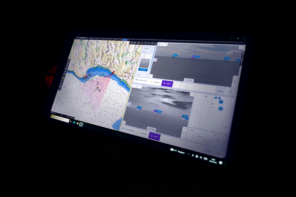
SEA.AI’s system resolves this. It is an electro-optical and thermal platform with AI inference operating at the sensor level, classifying contacts in real time without requiring human review of imagery. Vessel or object type, heading, and proximity are processed and output as actionable information, not raw footage. On an unmanned platform operating beyond visual range of its operators, that distinction is the difference between genuine situational awareness and a data stream nobody has time to interpret.
The operational context makes this concrete. In May 2026, MARTAC’s T38 Devil Ray completed a record 8-day fully autonomous mission off the coast of California, navigating multiple real surface contacts in open-ocean conditions, without crew or escort, at ranges exceeding 400 nautical miles from shore. A platform operating at that distance, in Sea State 5 conditions, cannot rely on a remote operator to review imagery. It needs to detect and understand its environment independently. That is precisely the capability SEA.AI brings.
“We built SEA.AI in 2018 around a conviction that the camera alone was never going to be enough at sea. The intelligence had to be in the system, not in a person watching a screen somewhere. That requirement has only become more urgent as autonomous platforms move from trials into operational deployment.”
Marcus Warrelmann, CEO, SEA.AI
“Operators have sensors, platforms, and more data than their teams can process. What we add to a MARTAC vessel is not another feed to monitor, it is a system that watches, understands, and reports. This partnership with MARTAC puts that capability where it matters: on proven platforms, in real missions.”
Diogo Arreda, Managing Director, SEA.AI Americas
“Our platforms are built to carry whatever sensors the mission requires, and we evaluate every integration on one basis: does it make the vessel more operationally capable? SEA.AI’s machine vision, that classifies contacts autonomously and in real time, is a direct solution for closing a real gap. That is why it is on our platforms.”
Jim Harvey, Chief Technology Officer, MARTAC



Related News.

Poland’s additional national requirements distort competition says Danish Shipping
Poland has introduced a national survey requirement for smaller foreign-flagged vessels operating in Polish waters. This creates significant…

Battery Vessels could help electrify most of Global Shipping Emissions
Battery-electric ships are economical only if the pack is cycled frequently, so they have been confined to short-sea, ferry and harbour vessels…

Mintra and Ledgid explore collaboration to connect Maritime digital identity, learning and workforce development
Mintra® and LEDGID are exploring opportunities to bring together complementary capabilities in digital learning, maritime training, professional…

World Shipping Council calls for global agreement on shipping emissions as industry investment surpasses $200 billion USD
The World Shipping Council (WSC) is calling on governments to agree on binding global greenhouse gas regulations for international shipping without…

What happened to the ITF whistleblower’s complaint?
In January 2026, a whistleblower complained that International Transport Workers’ Federation (ITF) General Secretary Stephen Cotton had manipulated…

Growing regulatory scrutiny puts seafarer wellbeing firmly on maritime safety agenda, VIKAND warns
Seafarer wellbeing is coming under greater regulatory scrutiny as international rules and guidance increasingly recognise crew health and welfare as…

Good Times Bad Times the Premium Stays with the Strait
In October, we wrote that if the transfer network off Oman kept pace, Gulf crude would carry China's refill and keep drawing tonnage east,…

Allied Weekly Market Review Week 47
Pls find below the Allied - Weekly Market Review - Week 47 ALLIED - Weekly Market Report- Week 47


Climate TRACE releases September 2026 Emissions Data
Climate TRACE reported that global greenhouse gas (GHG) emissions for the month of September 2026 totaled 4.7 billion tonnes CO₂e. This remains…
Subscribe to our newsletter!
if you dont want to swim alone in the ocean of news, sign up for the newsletter, and you will receive daily all the important news of world shipping!
