Cognitum One announces ruOS, the Enterprise Computer Platform for AI Agents
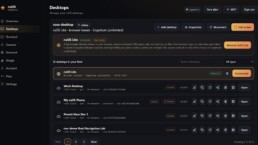

As Meta’s Muse and OpenAI’s dots bring AI agents with computers of their own into the mainstream, ruOS gives enterprises a multi-agent environment they own and control.
AI assistants are becoming persistent digital coworkers with computers of their own. Cognitum One™, Inc. today announced ruOS, the execution layer for enterprises and software providers building these experiences. ruOS provides managed workspaces, persistent task context, fleet coordination, and integration with enterprise infrastructure. Organizations connect their chosen models and assistant interfaces while defining where work runs and how access is controlled.
This month’s launches of Meta’s Muse and OpenAI’s dots have brought wide attention to agents that work on dedicated computers. Both are single-agent, cloud-hosted assistants: guest applications that connect to a person’s software and act on their behalf. ruOS is the host. It is a full agentic operating system that securely chains teams of specialized AI agents together, grounds their work in structured workflows and verified context, and gives technical teams full control over automated computer use without depending on closed, subscription-based big-tech ecosystems.
“Muse and dots have shown millions of people what an agent with its own computer can do. Enterprises now need to decide where that computer lives and who controls it,” said Reuven “rUv” Cohen, Founder and Chief AI Officer of Cognitum One. “ruOS is the host rather than the guest. It gives teams of specialized agents a real environment to work in and gives the enterprise control over what they can see, what they can do, and a record of whether the work was done right.”
ruOS extends an idea that transformed enterprise computing once before. Cognitum One founding advisor and investor Mark B. Templeton, former CEO of Citrix Systems, helped popularize remote desktops, giving workers secure access to centrally managed computers from anywhere. ruOS applies that model to AI agents, giving them managed, centrally governed computers of their own.
“At Citrix, we proved that a worker’s desktop didn’t have to sit under their desk. It could be delivered securely from a central place, governed by IT, and reached from anywhere, and that changed how the world works,” said Mark B. Templeton, founding advisor to Cognitum One and former CEO of Citrix Systems. “ruOS is a game changer in the same way. AI agents now need computers of their own, and enterprises need those computers to be secure, governed, and under their control. ruOS does for agents what remote desktops did for people, and I believe it will be just as foundational for the agentic era.”
What Sets ruOS Apart
- Architecture: ruOS is an agentic operating system, not a hosted agent app. It connects agents to applications, files, and terminals inside managed Linux workspaces, running locally or across virtual environments on infrastructure the customer controls. Built natively on the Model Context Protocol (MCP), it works with the models and assistant interfaces an organization chooses, ships as a standard .deb package, and supports restricted-network and air-gapped deployments where the required models and dependencies are available locally.
- Primary audience: ruOS is built for enterprises, developers, and software providers that need multi-agent orchestration, chained workflows, and custom automation, and for platform companies that want to embed governed agent workspaces in their own products.
- Agent coordination: Where consumer agents work alone, ruOS orchestrates many. The RuFlo framework chains specialized agents through structured pipelines that pass verified context from one step to the next, and RuVector keeps task context persistent so long-running work resumes where it left off.
- Control and safety: Agents operate within administrator-defined policy, which sets what they can do on their own, what requires human approval, and what is off limits. Actions are grounded in RuVector context rather than open-ended conversation, activity is recorded for review, and MetaHarness evaluates agent output, so teams know the work was done correctly before they rely on it.
Built to Complement Existing Infrastructure
ruOS works alongside the platforms enterprises already run and can be embedded by the companies that build them. A hybrid cloud computing and software company could use ruOS to offer customers governed agent workspaces that run as virtual machines and Kubernetes workloads on its platform. A networking company selling high-performance multilayer network switches and software could use ruOS to give agents network visibility for troubleshooting and recommendations, while its own management tools remain authoritative and production changes stay with human operators.
“Bring your assistant experience and your models and use ruOS to operate the computers behind them on infrastructure you control,” said D. Christopher Keil, Founding CEO of Cognitum One. “Consumer agents have made the category visible. ruOS makes it deployable inside the organizations that need it most.”
ruOS is available today. Enterprises and software providers can learn more at ruos.cognitum.one.
Source: Business Wire



Related News.

Greece has the most to lose from delays in shipping’s green transition, new analysis finds
UCL and WWF Greece report finds the IMO Net-Zero Framework offers Greek ship owners the clarity they need, and the best protection against a…

Snow Land joins Cool Carriers as the world’s first reefer with a gate rudder, a new chapter for sustainable and efficient reefer shipping
Cool Carriers, the world’s largest operator of specialised reefer vessels, took delivery of Snow Land from Kitanihon Shipbuilding in Japan on 12…

IBIA launches Marine Energy Outlook Survey as Annual Convention in New York
IBIA - The International Bunker Industry Association officially launched its Marine Energy Outlook Survey during the IBIA Annual Convention in New…

Why did ITF staff vote to strike again?
Staff at the International Transport Workers’ Federation (ITF) headquarters in London have voted to give their union a strike mandate. According to…

Nearly half of maritime crew tickets booked a week ahead are cancelled
Two new C Teleport reports show when maritime and aircrew teams book crew flights, how often they cancel, and what late booking costs, with a…

Kpler completes $1.5bn+ Sixth Street investment and continues accelerating growth
Investment backs Kpler's bold ambition to shape the future of global trade intelligence. Kpler, a leading provider of global physical trade…

How SAL and DNV are strengthening heavy-lift shipping
From classification and newbuilding support to operational tools and advisory expertise, SAL and DNV have been collaborating for decades. The…

PSA Singapore breaks ground on Tuas Port Phase Two to strengthen Global Trade Connectivity
PSA Singapore marked the groundbreaking of Tuas Port Phase Two, a significant step in the development of the world’s largest fully automated…

 …

BIFA welcomes UK–EU trade progress and calls for clarity on implementation
The British International Freight Association (BIFA) has welcomed progress made at today's UK–EU Summit in Brussels, highlighting the potential…
Subscribe to our newsletter!
if you dont want to swim alone in the ocean of news, sign up for the newsletter, and you will receive daily all the important news of world shipping!
