Envision Energy unveils EN-252/16.7 Offshore Wind Turbine to deliver high performance and reliability in high-wind environments
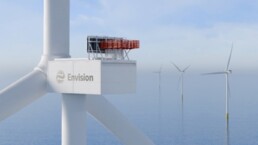

Envision Energy, a global leader in green technology, launched the EN-252/16.7, its next-generation offshore wind turbine developed for high-wind environments and tailored to the requirements of international offshore markets. With 16.7 MW rated power, a high-performance rotor and an integrated powertrain, the new turbine is designed to deliver higher energy production, greater reliability and increased project ROI.
The EN-252/16.7 builds on Envision’s proven Model Z platform and more than a decade of offshore wind development and operational experience. The Model Z platform has been in operation since 2023, providing a foundation of operating data and engineering experience for the next generation of offshore turbines. The international EN-252/16.7 is tailored with a Europe-specific high-performance rotor and is being developed through extensive component- and system-level validation. The turbine combines high-capacity generation with vertically integrated key component technologies, advanced safety and grid capabilities, and AI-powered lifecycle monitoring through Envision’s Galileo system.
Christian Schrimpf, Executive Vice President of Offshore Wind at Envision Energy, said: “The next phase of offshore wind is not simply about increasing turbine scale. The real value of scale lies in how effectively it translates into higher energy production, greater reliability and stronger economics across the project lifecycle. With the EN-252/16.7, we are bringing these capabilities together to help customers capture more value from offshore wind over the long term.”
Higher Performance for increased project ROI
With 16.7 MW rated power and a swept-area-to-power ratio of approximately 2.99 square meters per kilowatt, the EN-252/16.7 is designed to increase energy production from high-wind offshore resources. For a gigawatt-scale offshore wind farm, the turbine can deliver approximately 1-2% higher annual energy production while reducing turbine quantity by around 10% compared with currently available turbines, contributing to an estimated 2-4% reduction in levelized cost of energy (LCOE), depending on site conditions and project configuration. For suitable site-specific conditions, the turbine can also be uprated, creating further potential to reduce turbine numbers and capital expenditure for the project (CAPEX).
Proven Engineering for Long-Term Reliability
The EN-252/16.7 is supported by extensive component- and system-level validation through Envision’s in-house testing facilities. Testing includes drivetrain system loading tests and more than 600 hours of highly accelerated life testing for drivetrain, helping capture component boundaries and system interactions under demanding operating conditions.
Reliability is further supported by Envision’s vertically integrated approach to the development and manufacturing of key components. The company has accumulated experience across approximately 12,000 gearboxes, 12,000 main-bearing sets, 25,000 blade sets, 23,000 generators and 28,000 converters.
Safety and Resilience in Extreme Conditions
The EN-252/16.7 is designed to support safe and resilient operation under demanding offshore conditions, including extreme wind events, withstanding a 10-minute average extreme wind speed of up to 58.5 m/s and a three-second gust once in 50-year of up to 82 m/s. Safety is further supported by the turbines integration capability with energy storage. Combined with Envision BESS, the system can provide long-duration backup power for critical turbine devices and safety-related functions when external grid power is unavailable, including during pre-commissioning and severe storm or typhoon conditions.
The turbine further incorporates grid-forming control, black-start capability and stable operation under weak-grid and grid-fault conditions. Autonomous operating capabilities further support continuous power supply to critical turbine systems when conventional grid support is disrupted, extending resilience from extreme-weather protection to electrical and operational continuity.
AI-Powered Lifecycle Optimization
The EN-252/16.7 extends reliability into turbine operation through Envision’s AI-driven Galileo system, which supports earlier fault detection and more proactive maintenance throughout the turbine lifecycle. Commercially applied across more than 20,000 turbines since 2020, Galileo uses more than 30 functional models to monitor major components and critical failure modes, providing early-warning reports approximately one to six months in advance per different conditions
Earlier fault detection supports more timely maintenance planning, helping reduce unplanned interventions and lifecycle operating expenditure (OPEX). The turbine also includes an AI-turbine interface to support future upgrades and the continued evolution of intelligent turbine operations.
Source: PR Newswire



Related News.

Poland’s additional national requirements distort competition says Danish Shipping
Poland has introduced a national survey requirement for smaller foreign-flagged vessels operating in Polish waters. This creates significant…

Battery Vessels could help electrify most of Global Shipping Emissions
Battery-electric ships are economical only if the pack is cycled frequently, so they have been confined to short-sea, ferry and harbour vessels…

Mintra and Ledgid explore collaboration to connect Maritime digital identity, learning and workforce development
Mintra® and LEDGID are exploring opportunities to bring together complementary capabilities in digital learning, maritime training, professional…

World Shipping Council calls for global agreement on shipping emissions as industry investment surpasses $200 billion USD
The World Shipping Council (WSC) is calling on governments to agree on binding global greenhouse gas regulations for international shipping without…

What happened to the ITF whistleblower’s complaint?
In January 2026, a whistleblower complained that International Transport Workers’ Federation (ITF) General Secretary Stephen Cotton had manipulated…

Growing regulatory scrutiny puts seafarer wellbeing firmly on maritime safety agenda, VIKAND warns
Seafarer wellbeing is coming under greater regulatory scrutiny as international rules and guidance increasingly recognise crew health and welfare as…

Good Times Bad Times the Premium Stays with the Strait
In October, we wrote that if the transfer network off Oman kept pace, Gulf crude would carry China's refill and keep drawing tonnage east,…

Allied Weekly Market Review Week 47
Pls find below the Allied - Weekly Market Review - Week 47 ALLIED - Weekly Market Report- Week 47


Climate TRACE releases September 2026 Emissions Data
Climate TRACE reported that global greenhouse gas (GHG) emissions for the month of September 2026 totaled 4.7 billion tonnes CO₂e. This remains…
Subscribe to our newsletter!
if you dont want to swim alone in the ocean of news, sign up for the newsletter, and you will receive daily all the important news of world shipping!
