How Certified Conformance closes the gap that adoption leaves open


A standard only creates value when systems work together
Container shipping depends on a dense network of carriers, terminals, ports, cargo owners, freight forwarders and solution providers. Every participant is under pressure to digitalize, often implementing the same published standards independently and in parallel.A standard defines a common way of exchanging information. But its value ultimately depends on how consistently it is implemented. Without a way to verify this, small differences in interpretation can go unnoticed. Integrations are then built around carrier-specific assumptions, problems emerge late and customers are left dealing with manual checks, workarounds and costly rework.This is not a failure of intent. Every organization implementing a DCSA standard is trying to get it right. The problem is visibility. Without a common way to test implementations, good-faith adoption and genuine interoperability can drift apart.For DCSA, reducing this friction is fundamental. Our value is not simply in publishing technical specifications. It is in making it easier for customers and other industry participants to connect, exchange information and manage shipments across multiple partners. When standards are implemented consistently, customers spend less time correcting data and adapting to different systems, and more processes can happen automatically.
Conformance turns assumptions into proof
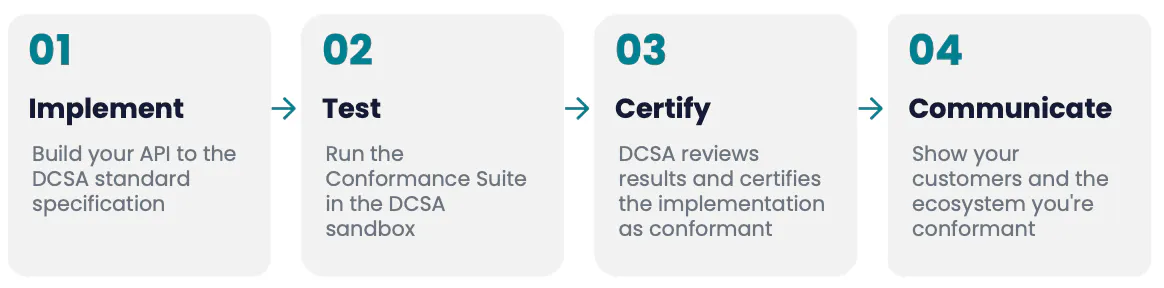
Conformance closes the gap between adopting a standard and demonstrating that it works as intended.It is a structured process that tests a real implementation against a shared set of business and technical scenarios. The same requirements are applied every time, so that “conformant” has a clear and consistent meaning, regardless of which organization is making the claim.The process is straightforward:
- Implement the API according to the DCSA standard.
- Test it against shared scenarios using DCSA’s conformance framework.
- Confirm that the implementation behaves as the standard requires.
- Communicate the result so customers and partners can see what has been verified.
Making conformance public accelerates adoption
DCSA publishes a conformance overview showing the implementation and conformance status of DCSA standards across its member carriers.That transparency is helping the industry move faster. Since conformance reporting was made public, the number of certified implementations has doubled. Based on current implementation plans, it is expected to reach three times the original number by the end of 2026.This matters because visibility drives action. When progress is openly communicated, organizations can see where the industry is moving, customers can make more informed integration decisions and adopters have a stronger incentive to complete and verify their implementations.The overview is not intended as a ranking or as a way to single out individual organizations. Every participant in the ecosystem is working through the same challenge: translating a shared specification into systems that work together in practice. Conformance gives that collective effort a clear and visible measure of progress.
From a shared standard to a better customer experience
Certified conformance turns the ambition of speaking one digital language into something demonstrable.Standards define the common language. Conformance provides evidence that systems can actually use it to understand one another. Together, they make it easier for customers to connect with multiple carriers and service providers, automate processes and receive reliable information without repeatedly navigating different interpretations and technical requirements.DCSA will continue to make conformance clearer, more visible and easier to access, so that proving interoperability becomes a normal part of implementing a standard rather than an afterthought.An industry as large and complex as container shipping will never transform overnight. But the pace of adoption is increasing. With shared standards, transparent conformance and a growing number of verified implementations, we are moving closer to the outcome that matters: a seamless digital experience for customers, regardless of which carrier or service provider they choose.



Related News.

Greece has the most to lose from delays in shipping’s green transition, new analysis finds
UCL and WWF Greece report finds the IMO Net-Zero Framework offers Greek ship owners the clarity they need, and the best protection against a…

Snow Land joins Cool Carriers as the world’s first reefer with a gate rudder, a new chapter for sustainable and efficient reefer shipping
Cool Carriers, the world’s largest operator of specialised reefer vessels, took delivery of Snow Land from Kitanihon Shipbuilding in Japan on 12…

IBIA launches Marine Energy Outlook Survey as Annual Convention in New York
IBIA - The International Bunker Industry Association officially launched its Marine Energy Outlook Survey during the IBIA Annual Convention in New…

Why did ITF staff vote to strike again?
Staff at the International Transport Workers’ Federation (ITF) headquarters in London have voted to give their union a strike mandate. According to…

Nearly half of maritime crew tickets booked a week ahead are cancelled
Two new C Teleport reports show when maritime and aircrew teams book crew flights, how often they cancel, and what late booking costs, with a…

Kpler completes $1.5bn+ Sixth Street investment and continues accelerating growth
Investment backs Kpler's bold ambition to shape the future of global trade intelligence. Kpler, a leading provider of global physical trade…

How SAL and DNV are strengthening heavy-lift shipping
From classification and newbuilding support to operational tools and advisory expertise, SAL and DNV have been collaborating for decades. The…

PSA Singapore breaks ground on Tuas Port Phase Two to strengthen Global Trade Connectivity
PSA Singapore marked the groundbreaking of Tuas Port Phase Two, a significant step in the development of the world’s largest fully automated…

 …

BIFA welcomes UK–EU trade progress and calls for clarity on implementation
The British International Freight Association (BIFA) has welcomed progress made at today's UK–EU Summit in Brussels, highlighting the potential…
Subscribe to our newsletter!
if you dont want to swim alone in the ocean of news, sign up for the newsletter, and you will receive daily all the important news of world shipping!
