

Hormuz, $100 oil and the question shipowners should ask before buying their next vessel
The Strait of Hormuz is not closed.
That may be precisely what makes the present situation more difficult for shipowners.
A closed waterway produces a clear decision. An open waterway produces another clear decision. But a passage that remains technically open while traffic collapses, ships are attacked, insurance conditions change rapidly and the political situation can deteriorate between fixture and arrival creates something much harder to manage:
commercial ambiguity.
On 9 September, preliminary vessel-tracking data showed only seven commodity vessels transiting Hormuz. At the same time, Brent crude was trading above USD 100 per barrel following the latest escalation in the Middle East, including attacks on commercial shipping and Saudi energy infrastructure. Before the present conflict, Hormuz was one of the principal arteries of global energy trade. Today it remains operational — but no prudent owner can treat passage through it as ordinary navigation.
This distinction matters because the Middle East crisis is now moving beyond the voyage P&L.
It is beginning to influence the balance sheet.
THE COST OF WAR IS NO LONGER ONE NUMBER
For years, when geopolitical risk increased, the shipping conversation often became surprisingly narrow.
What is the Additional War Risk Premium?
Can Charterers pay it?
Can we obtain Kidnap & Ransom cover? Loss of Hire?
Can we fix the voyage?
Those questions remain important. But they are no longer sufficient.
The Extra War Risk cost attached to a voyage is only one visible price within a much larger economic exposure.
Public market reporting shows how dramatically the insurance environment has changed. War-risk pricing for Gulf transits has increased sharply, while cargo insurance costs have also become substantial. At the same time, underwriters are increasingly differentiating between vessels according to ownership, chartering relationships, cargo, trading history, nationality nexus and the precise characteristics of the proposed voyage.
This is rational.
An underwriter is not merely pricing the probability that one particular vessel will be struck.
He is pricing correlation.
A single escalation can expose multiple vessels simultaneously. Ports can become inaccessible. Vessels may enter an area and find that the conditions governing their exit have changed. Reinsurance capacity can tighten. Sanctions can alter the legality or practicality of transactions. Political events can transform what appeared to be an acceptable risk on Monday into something materially different by Friday.
This is why an EWR quotation should not be viewed as a simple commodity price.
It is the temporary price of scarce risk capital against a moving exposure.
And the cheapest quotation is not necessarily the best transfer of risk.
THEN OIL ENTERS THE EQUATION
The second transmission mechanism is energy.
Brent has again moved above USD 100 per barrel, while marine-fuel markets remain materially more expensive than before the war. In Singapore, benchmark low-sulphur bunker prices have recently been reported at more than 60% above pre-war levels, despite improvements in physical fuel availability.
That affects much more than tanker owners.
A dry-bulk owner trading far from the Gulf still buys bunkers.
A container operator still pays for diversion.
A shipyard still consumes energy.
A manufacturer still passes higher energy costs into equipment prices.
And a shipowner financing an acquisition may eventually discover that an oil shock affects not only operating expenditure but also inflation expectations and borrowing costs. US long-term yields have remained elevated as markets reassess the inflationary consequences of energy disruption.
This creates an unusual combination:
high freight opportunities, expensive fuel, elevated asset values, costly insurance and expensive capital — all at the same time.
That combination deserves considerably more attention than the freight market alone.
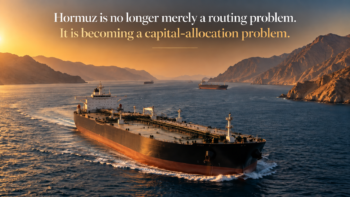
DISRUPTION ALSO CREATES TRADE
There is another side to the story.
Shipping has rarely experienced geopolitical disruption without simultaneously discovering new commercial opportunities.
When a traditional cargo route becomes difficult, cargo does not necessarily disappear.
It often moves differently.
Alternative Gulf export routes, ship-to-ship operations, increased use of terminals outside traditional chokepoints and substitute product flows are already changing trading patterns. Gulf producers and national oil companies have also been taking greater control of shipping capacity as transport security becomes strategically important.
Longer routes can increase tonne-mile demand.
Dislocated refining systems can create new product trades.
Regional shortages can increase freight spreads.
Vessels positioned on the correct side of a disrupted chokepoint may obtain an advantage that did not exist months earlier.
This is one of shipping’s enduring paradoxes:
risk destroys efficiency — and inefficiency can create shipping demand.
But owners should be careful not to confuse earnings generated by disruption with permanent earning power.
That distinction brings us to perhaps the most difficult capital-allocation question in shipping today.
SECOND-HAND: BUYING EARNINGS NOW
The argument for acquiring second-hand tonnage is obvious.
The vessel exists.
It can trade immediately.
It can participate in today’s market rather than the market of 2028.
For an owner who believes that geopolitical fragmentation, longer voyages and energy-security concerns will remain structural, immediate exposure may be attractive.
But there is a problem.
Everybody else can see the same earnings.
Tanker asset values have risen dramatically during 2026. Lloyd’s List Intelligence recently reported that five-year-old VLCC values were approximately 35% higher year on year, while ten-year-old units had risen around 54%. Strong balance sheets and limited willingness among existing owners to sell have contributed to the increase.
This changes the calculation.
A second-hand vessel offers immediate cash flow, but the buyer may already be paying the seller today for several years of expected geopolitical advantage.
There is therefore a dangerous circularity:
War disruption raises freight.
Higher freight raises vessel values.
Higher vessel values encourage investment.
The investment then requires elevated freight to justify the acquisition price.
The owner must ask whether he is purchasing an asset — or capitalising today’s exceptional market conditions into tomorrow’s balance sheet.
NEWBUILDING: BUYING 2028 TODAY
The newbuilding argument is equally powerful.
A modern vessel provides lower consumption, greater environmental efficiency, longer remaining economic life and potentially better positioning against future regulatory requirements.
But a newbuilding ordered today for delivery eighteen to twenty-four months ahead is not simply a shipbuilding decision.
It is a forecast.
Recent tanker contracting illustrates that owners placing orders today are securing delivery positions in 2028 and beyond.
By delivery, Hormuz may have normalised.
Or it may not.
Oil may be USD 70.
Or USD 120.
Interest rates may have fallen.
Or inflation generated by energy and defence expenditure may keep capital expensive.
Today’s exceptionally strong tanker earnings may remain.
Or the inefficiencies producing them may disappear surprisingly quickly.
Regulation may also have moved.
The owner ordering today is therefore committing capital against several futures simultaneously.
The most important question is not:
“Will this be a good ship?”
Modern yards can build very good ships.
The better question is:
“How many different futures must turn out correctly for this investment to produce the return we expect?”
That is a much harder question.
SO WHICH SHOULD AN OWNER BUY?
I would resist anyone who gives a universal answer.
A modern second-hand vessel may be the better decision for an owner with identified employment, low leverage and confidence that the acquisition remains profitable under normalised freight.
A newbuilding may be superior for an owner with patient capital, strong charter backing, a clear efficiency advantage and sufficient technical flexibility to survive several possible regulatory and fuel outcomes.
But neither transaction is attractive simply because today’s market is strong.
Before approving either, I would want the Board to run one uncomfortable scenario:
Assume that the Middle East crisis improves materially twelve months from now.
Freight normalises.
War-risk premiums retreat.
Route inefficiencies decline.
Vessel availability improves.
But the purchase price — or the newbuilding commitment — remains.
Does the investment still work?
If the answer is yes, the owner may be buying a ship with genuine underlying economics.
If the answer is no, a significant part of the expected return is not coming from the vessel.
It is coming from an assumption that today’s disruption will still be there tomorrow.
THE RISK UNDERWRITERS AND OWNERS SHARE
There is an interesting symmetry between shipowners and marine underwriters today.
Both are being paid to accept uncertainty.
The underwriter commits risk capital to a voyage whose geopolitical environment may change before the vessel arrives.
The owner commits financial capital to a ship whose commercial environment may change before the investment is recovered.
Both can make substantial returns by accepting risks others will not.
Both can also suffer when a temporary condition is mistaken for a permanent one.
The discipline required is therefore remarkably similar:
Understand the downside.
Price the uncertainty.
Preserve the ability to change course.
And never allow a favourable market to convert an assumption into a certainty.
THE MARASCO PERSPECTIVE
The Middle East crisis has demonstrated something larger than the vulnerability of one maritime chokepoint.
It has shown how quickly geopolitical risk can travel through the entire shipping system.
From Hormuz into oil.
From oil into bunkers.
From bunkers into inflation.
From inflation into interest rates.
From freight into vessel values.
And from vessel values into the investment decisions that will shape fleets for the next twenty years.
That is why today’s most important shipping decisions should not be based upon a forecast of when the Middle East crisis will end.
Nobody knows.
The objective should instead be to build decisions capable of surviving both outcomes.
A prolonged crisis.
And an unexpectedly rapid return to normality.
Shipping has always rewarded calculated risk.
What it has punished, repeatedly, is paying a permanent price for a temporary advantage.
The owner considering his next vessel should therefore ask one final question:
If the war premium disappears before I recover my investment, would I still want to own this ship?
If the answer is yes, there may be an investment.
If the answer is no, there may only be a bet.
Anastasios Maraslis
President
Marasco Marine Ltd



Related News.

Spyros Papavassiliou honoured with the “Ge’ Néo Epicheirein” 2026 Award in the Shipping Enterprises category
Celebrating leadership, entrepreneurial excellence and a strong contribution to Cyprus shipping. Island Energies is proud to announce that Mr Spyros…
ABP welcomes HANSEATIC spirit the largest ever cruise ship to visit the Port of Ipswich
Hapag-Lloyd Cruises’ expedition vessel, HANSEATIC spirit, becomes the largest cruise ship ever to visit Ipswich, highlighting the growing appeal of…
Prime Tanker Management deploys ShipIn across its entire fleet to improve safety performance
Master-led use of operational insight supports measurable improvement across PPE, bridge, and technical performance while strengthening fleet-wide…

Goltens Worldwide enters into agreement for sale to HD Hyundai Marine Solution
Proposed acquisition supports long-term growth while preserving Goltens’ independence and commitment to customers Goltens Worldwide announced that it…

Port of Piraeus receives special award marking 10 years since COSCO SHIPPING joined its Shareholding Structure
Award presented at the 9th Infrastructure and Transport Conference ITC 2026 A significant milestone in the history of Piraeus Port Authority and the…

Seafarers’ voices must shape the future of mental health support at sea, says OneCare Group
The shipping industry must listen more closely to the lived experiences of seafarers if it is to build working environments that genuinely protect…
Bangladesh’s Chittagong Port Authority and DP World sign 15 year concession for new Mooring Container Terminal
The Chittagong Port Authority and DP World have signed a 15-year concession agreement for the operation and maintenance of the New Mooring Container…

ABP’s HELM Immingham opens for business
Associated British Ports marked the official opening of its HELM Immingham site, a 227-acre industrial and logistics development site. Seen as one…

Veson Nautical and Marcura expand partnership to Streamline Demurrage Management
Marcura Claims now integrates with IMOS, giving joint clients another way to manage demurrage. Global maritime technology leaders Veson Nautical and…

Thermal Weakness Drags Global Coal Flows Lower
Global seaborne coal flows fell 6.7% year on year in September 2026 to 115 Mt. Thermal coal drove the decline, and a rise in met coal flows was not…
Subscribe to our newsletter!
if you dont want to swim alone in the ocean of news, sign up for the newsletter, and you will receive daily all the important news of world shipping!
