Vaisala targets growing hydrogen and renewable gas markets with its first intrinsically safe dew point instrument DMP370
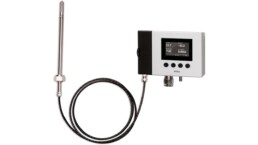

Designed for hydrogen, biomethane and industrial gas infrastructure, the DMP370 delivers continuous dew point monitoring in hazardous locations.
Vaisala, a global leader in measurement instruments and intelligence, launched the Vaisala DMP370 Intrinsically Safe Dew Point Instrument for hazardous locations. The new instrument extends Vaisala’s proven DRYCAP® dew point technology into hazardous locations.
Announced at Gastech 2026 in Bangkok, the world’s largest exhibition and conference for natural gas, LNG, low carbon solutions, and energy innovation, the DMP370 enables continuous, drift-compensated moisture measurement in hydrogen production, renewable and natural gas infrastructure, chemical processing and other industrial applications where combustible gases or dust may be present.
Growing industrial gas markets increase the need for reliable moisture measurement
According to the International Energy Agency’s Global Hydrogen Review 2026, global hydrogen demand surpassed 100 million tonnes already in 2025. Much of this demand comes from industrial processes where gas quality directly affects safety, equipment performance, and operational reliability.
As hydrogen and biomethane production and other decarbonized gas applications expand, reliable moisture measurement is becoming increasingly important across both new and existing gas infrastructure.
Moisture plays a critical role in many gas processes. Excess moisture can compromise fuel cell performance, reduce process efficiency, shorten equipment lifetime, and increase operational risks in gas infrastructure, electrolyzers, and industrial processing facilities.
In many of these environments, only equipment certified for hazardous locations may be used.
Existing measurement solutions often require compromises
Measuring moisture in hazardous locations has traditionally involved trade-offs. Some solutions require additional protective enclosures or introduce installation constraints, depending on the protection concept and application. Other technologies periodically interrupt measurements during regeneration or heating cycles, creating gaps in monitoring data.
The new DMP370 addresses these challenges by combining intrinsic safety with uninterrupted measurement. The solution is enabled by Vaisala’s proven DRYCAP® dew point technology and an innovative drift-compensation solution.
Bringing Vaisala’s DRYCAP® technology to hazardous locations for the first time
The DMP370 combines Vaisala’s DMP37X probe and HMT370EX transmitter into a single intrinsically safe solution.
Intrinsic safety limits the instrument’s electrical energy by design, preventing it from becoming an ignition source in explosive atmospheres.
The DMP370 measures continuously, combining fast response with long-term stability, providing operators with uninterrupted gas-quality data without measurement gaps.
“As hydrogen and renewable gas projects move from pilot installations to full-scale industrial operations, the need for reliable, continuous gas-quality monitoring is growing. Operators need measurement solutions that support both process performance and safety in hazardous locations,” said Antti Heikkilä, Product Line Manager of Industrial Decarbonization at Vaisala.
“With the DMP370, we’re bringing Vaisala’s proven DRYCAP® measurement technology into hazardous locations, enabling continuous dew point measurement in applications where explosion safety is essential,” he added.
Designed for emerging and established industrial applications
The DMP370 supports gas quality measurement and gas purity monitoring across a wide range of hazardous industrial environments, including:
- Hydrogen: hydrogen production, storage, fuel cell, and electrolyzer output monitoring applications
- Natural gas and biomethane: biogas upgrading into biomethane, grid injection and monitoring of gas infrastructure, including natural gas pipelines
- Chemical and industrial processing: synthetic fuels including eSAF, methanol production, pharmaceuticals, electronics manufacturing, and oil and gas
- Battery manufacturing: dry-process applications where combustible carbon dust may be present
- Compressed air and nitrogen: inerting, purge gas and hazardous-location moisture monitoring
Key facts
- Product: Vaisala DMP370 Intrinsically Safe Dew Point Instrument
- Configuration: Vaisala’s DMP37X probe + HMT370EX transmitter, certified as a single intrinsically safe unit
- Technology: Vaisala DRYCAP® dew point sensor with an innovative drift-compensation solution
- Measurement range: -70°C … +10°C Td/f
- Measurement accuracy: ±2°C Td/f (typical)
- Temperature range: -40…+60°C
- Pressure range: 0…40 bar (abs)
- Intrinsically safe (Ex i), for up to Zone 0 / 20 (ATEX, IECEx)
- FM approved for Class I, II, III, Division 1, Groups A, B, C, D, E, F and G, T4 (US and Canada)
- Traceable calibration (certificate included)
- Availability: First deliveries begin Q1 2027
- Markets: Hydrogen, natural gas/biomethane, chemical and industrial processing, battery manufacturing, compressed air and nitrogen



Related News.

Poland’s additional national requirements distort competition says Danish Shipping
Poland has introduced a national survey requirement for smaller foreign-flagged vessels operating in Polish waters. This creates significant…

Battery Vessels could help electrify most of Global Shipping Emissions
Battery-electric ships are economical only if the pack is cycled frequently, so they have been confined to short-sea, ferry and harbour vessels…

Mintra and Ledgid explore collaboration to connect Maritime digital identity, learning and workforce development
Mintra® and LEDGID are exploring opportunities to bring together complementary capabilities in digital learning, maritime training, professional…

World Shipping Council calls for global agreement on shipping emissions as industry investment surpasses $200 billion USD
The World Shipping Council (WSC) is calling on governments to agree on binding global greenhouse gas regulations for international shipping without…

What happened to the ITF whistleblower’s complaint?
In January 2026, a whistleblower complained that International Transport Workers’ Federation (ITF) General Secretary Stephen Cotton had manipulated…

Growing regulatory scrutiny puts seafarer wellbeing firmly on maritime safety agenda, VIKAND warns
Seafarer wellbeing is coming under greater regulatory scrutiny as international rules and guidance increasingly recognise crew health and welfare as…

Good Times Bad Times the Premium Stays with the Strait
In October, we wrote that if the transfer network off Oman kept pace, Gulf crude would carry China's refill and keep drawing tonnage east,…

Allied Weekly Market Review Week 47
Pls find below the Allied - Weekly Market Review - Week 47 ALLIED - Weekly Market Report- Week 47


Climate TRACE releases September 2026 Emissions Data
Climate TRACE reported that global greenhouse gas (GHG) emissions for the month of September 2026 totaled 4.7 billion tonnes CO₂e. This remains…
Subscribe to our newsletter!
if you dont want to swim alone in the ocean of news, sign up for the newsletter, and you will receive daily all the important news of world shipping!
