DNV and Fassmer to cooperate on autonomous naval vessels
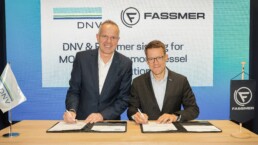

DNV and Fr. Fassmer GmbH & Co. KG have signed a Memorandum of Understanding (MOU) to collaborate on the development and classification of autonomous and remotely operated vessels and systems for naval and governmental customers. The signing took place at the SMM Trade Fair in Hamburg.
The new collaboration will support Fassmer’s growing unmanned systems portfolio, seeing the partners applying DNV’s range of assurance guidelines, frameworks, and Autonomous and Remotely Operated Ships (AROS) class notations and supporting technical standards to Fassmer’s unmanned vessel programmes. The cooperation will cover the review of concepts of operations for autonomous vessels, qualification of novel technologies supporting autonomous functions, and the development of certification roadmaps under the AROS framework.
The goal of the cooperation is to work towards the potential award of an Approval in Principle (AiP), in line with DNV’s AROS notation, assessing the autonomous ship functions requirements, including navigation, engineering, operational, and safety aspects. In addition, the partners intend to contribute their findings to the development of international standards and regulatory frameworks for autonomous shipping, strengthening Germany and Europe as centres for maritime autonomy.
Thomas Sass, Fassmer, said: “Autonomous shipping will fundamentally transform the maritime industry. At Fassmer, we see this as a major opportunity to further enhance the safety, efficiency, and operational capabilities of our specialized vessels. That is why we have been actively engaged with autonomous systems and the requirements of DNV’s AROS class notation. The signing of the MoU with DNV marks an important milestone for us, enabling closer collaboration on bringing innovative concepts into practical application and helping to shape the future of shipping [Fassmer spokesperson], Fassmer, said:
Rasmus Stute, DNV, added: “Over the last several years we have seen how the development and use of autonomous systems is becoming one of the key pillars in defence and naval operations. Frameworks for their developments and ensuring that we can deliver safety levels equivalent to conventional vessels are still under development and our AROS family of notations has been designed to support the industry as autonomous shipping technologies are deployed more widely. The nature of autonomous ships means there are many novel concepts, which require a flexible approach to any set of requirements, so we are very pleased to be working with Fassmer, who can add their operational experience, to our technical expertise, helping to sharpen our understanding and bring new perspectives to our work.”
The AROS notations, available since January 2025, set functional requirements across navigation, engineering, safety and operations, and cover modes of operation ranging from remote control and decision support to supervised and full autonomy, whether a vessel is controlled onboard, from shore, or both. The framework is designed to demonstrate that autonomous vessels achieve safety equivalent to conventional ships.



Related News.

Poland’s additional national requirements distort competition says Danish Shipping
Poland has introduced a national survey requirement for smaller foreign-flagged vessels operating in Polish waters. This creates significant…

Battery Vessels could help electrify most of Global Shipping Emissions
Battery-electric ships are economical only if the pack is cycled frequently, so they have been confined to short-sea, ferry and harbour vessels…

Mintra and Ledgid explore collaboration to connect Maritime digital identity, learning and workforce development
Mintra® and LEDGID are exploring opportunities to bring together complementary capabilities in digital learning, maritime training, professional…

World Shipping Council calls for global agreement on shipping emissions as industry investment surpasses $200 billion USD
The World Shipping Council (WSC) is calling on governments to agree on binding global greenhouse gas regulations for international shipping without…

What happened to the ITF whistleblower’s complaint?
In January 2026, a whistleblower complained that International Transport Workers’ Federation (ITF) General Secretary Stephen Cotton had manipulated…

Growing regulatory scrutiny puts seafarer wellbeing firmly on maritime safety agenda, VIKAND warns
Seafarer wellbeing is coming under greater regulatory scrutiny as international rules and guidance increasingly recognise crew health and welfare as…

Good Times Bad Times the Premium Stays with the Strait
In October, we wrote that if the transfer network off Oman kept pace, Gulf crude would carry China's refill and keep drawing tonnage east,…

Allied Weekly Market Review Week 47
Pls find below the Allied - Weekly Market Review - Week 47 ALLIED - Weekly Market Report- Week 47


Climate TRACE releases September 2026 Emissions Data
Climate TRACE reported that global greenhouse gas (GHG) emissions for the month of September 2026 totaled 4.7 billion tonnes CO₂e. This remains…
Subscribe to our newsletter!
if you dont want to swim alone in the ocean of news, sign up for the newsletter, and you will receive daily all the important news of world shipping!
