On ever thinner ice reducing black carbon demands urgent action
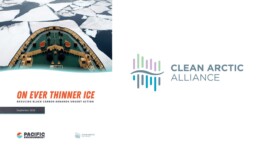

International Maritime Organization deliberations are underway on an Arctic polar fuel requirement to help stop the Arctic meltdown and cut black carbon emissions
A new report released demonstrates why the International Maritime Organization should immediately act to reduce black carbon pollution by requiring the use of cleaner marine fuels in the Arctic.
The report by Pacific Environment, “On ever thinner ice: Reducing black carbon demands urgent action,” takes an up-to-date look at the threats facing the Arctic, and the opportunities IMO must take to address black carbon emissions. This report is released on the heels of a new spotlight report by the UN Environment Programme which underlines that the world must strive to return to below 1.5°C as soon as possible and simultaneously reduce the vulnerability of societies, communities and economies to climate impacts.
The report will be presented during a webinar on September 17th, On Ever Thinner Ice.
Download report:
Download: On ever thinner ice: Reducing black carbon demands urgent action
“The threat to the Arctic is at a tipping point. Black carbon emissions from shipping are underestimated and continue to rise, while sea ice melt is accelerating and weakening the marine food chain. The International Maritime Organization has an opportunity to protect the Arctic by requiring ships to use cleaner fuels such as distillates in the wider Arctic, including areas near the Aleutian Islands and the Northern European coast. The IMO must respond to this Arctic crisis by immediately addressing the growing health and climate impacts of black carbon,” said Kay Brown, Arctic policy director, Pacific Environment.
“The urgency has never been greater, and the coming 12 months are critical to addressing the threat to the Arctic from black carbon”, said Dr Sian Prior, Lead Advisor to the Clean Arctic Alliance. “When the IMO’s Marine Environment Protection Committee (MEPC 85) meets in November-December 2026, it must address the pending issue of defining the sea area where a polar fuels measure will be most effective.”Then, when IMO’s Pollution Prevention and Response Sub-Committee (PPR 14) meets in January 2027, it must act to protect the Arctic by recommending a mandatory switch from residual fuels to polar fuels such as cleaner distillate MGO for ships operating in the wider Arctic, to take effect as soon as possible. Finally at MEPC 86 in October 2027, IMO member states must then act on PPR 14’s recommendations by adopting a mandatory polar fuels requirement for ships operating in the wider Arctic.”
Join webinar on Sept 17 2026: On Ever Thinner Ice
Black carbon: climate super-pollutant
A super-pollutant that results from incomplete combustion of fossil fuels, black carbon consists of small particles of soot that have a relatively brief lifespan in the atmosphere compared to long-lived greenhouse gases like carbon dioxide. Black carbon has a warming impact up to 1,500 times greater than carbon dioxide per unit of mass on a 20-year global warming potential basis, making it a powerful short-lived climate forcer.
International maritime shipping is one of the biggest emitters of greenhouse gases — making up 2-3% of emissions — comparable to the world’s fifth biggest emitting country, Japan, and, by consuming heavy fuel oil (also known as HFO or residual oil, the dirtiest of all transport fuels), is also a major source of black carbon. Around 20% of the sector’s climate impact is the result of black carbon emissions. Despite long-running attempts by the IMO to address the problem, black carbon remains unregulated in the shipping sector while its devastating consequences continue to increase.
Climate threats facing the Arctic
Collectively, these developments referenced below reinforce the urgency and legal necessity for the member states of the IMO to act expeditiously to reduce climate harm to the Arctic caused by black carbon emissions from shipping.
- Climate tipping points are alarmingly closer or exceeded.
- Sea ice loss is accelerating and weakening the marine food chain for fish, marine mammals and whales, newly-published research shows.
- Ice losses on land and in seas around the Arctic portend major sea level rise and disruption of ocean circulation currents such as the AMOC.
- Black carbon emissions from shipping have been significantly underestimated and continue to rise.
- The International Court of Justice’s climate decision requires action to prevent climate harm.
- A new spotlight report by the UN Environment Programme underlines that the world must strive to return to below 1.5°C as soon as possible and simultaneously reduce the vulnerability of societies, communities and economies to climate impacts.
Arctic polar fuels proposal introduced; IMO deliberations underway
A proposal to require cleaner fuels in the Arctic was introduced in December 2025 by Denmark, France, Germany and the Solomon Islands and likely will be on the agenda at upcoming IMO meetings (Denmark et al., 2025). The proposed measure would limit fuel use in the Arctic to lighter distillate MGO blends and suitable alternative fuels. Fuel eligibility is expected to be based on International Organization for Standardization (ISO) fuel quality parameters, including density, viscosity and micro-carbon distillation residue content.
The measure would require use of cleaner fuels, including the distillate marine gas oil (MGO) blends DMA and DMZ, as well as other new fuels entering the market such as methanol, ammonia and hydrogen and other forms of propulsion such as wind power and batteries. Liquefied natural gas (LNG) is allowed but should be discouraged because of its ship engine and life cycle methane emissions.
Call for a wide geographic scope
The biggest unresolved issue for polar fuels is determining the sea area that would be covered by a regulatory mandate. Coverage of the entire wider Arctic where shipping occurs is essential to capture the significant sources of black carbon emissions. The “Polar Code Arctic waters” defined in MARPOL Annexes I, II, IV and V is too small to capture most of the black carbon emissions of ships operating in Arctic waters. The broader ecological boundaries defined by the Arctic Monitoring and Assessment Program (AMAP) and the Arctic Human Development Report (AHDR) are options that would best meet the goal of capturing maximum black carbon emissions near the Arctic. Discussion has also included a limit covering all Arctic waters north of 60 degrees north latitude.



Related News.
Italy and Cyprus chart a shared course for the blue economy: Italy-Cyprus Maritime Business Forum in Limassol on 9 October
Institutions and businesses from both countries will meet at the DP World Terminal for three sessions on sustainable ports, shipping and maritime…
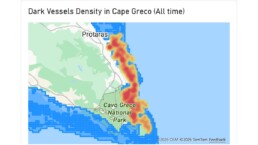
Satellite monitoring reveals recurring vessel activity across three of Cyprus’s marine protected areas
More than two thousand detections at Lady’s Mile, Latsi-Akamas and Cavo Greco within the months of June-August highlight distinct activity patterns…

Shipbuilding Labor talks hit fresh snags after tentative deal rejected
This year’s wage and collective bargaining negotiations in the shipbuilding industry are drifting back into uncertainty just as they appeared to be…

SEA.AI brings Machine Vision to multiple USV platforms at NATO’s REPMUS 2026
Maritime AI specialist demonstrated a shared perception layer across crewed and uncrewed vessels during the Portuguese Navy-led exercise, held in…
Clean tanker markets size up impact of potential US diesel export curbs
HIGHLIGHTS Trump floats diesel export ban amid soaring prices MR tanker demand could fall by 1.35 million b/d Russian diesel exports…
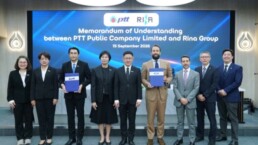
RINA and PTT sign strategic agreements to advance innovation and decarbonization across the energy and maritime sectors
RINA, the inspection, certification and engineering consulting multinational, announces the signing of two Memoranda of Understanding with PTT…

IMEC and The Hood launch Sisterhood Box to support the next generation of female seafarers
The International Maritime Employers’ Council and The Hood Platform have joined forces to launch the Sisterhood Box, a new initiative providing…

The Port Authority and Valencia City Council launch the countdown to the River Mouth Park
The Port Authority of Valencia (APV) and Valencia City Council have reached an agreement on the River Mouth Park setting out the commitments of both…
Newbuild order for two very large ammonia acriers in combination with long term time charters
SFL Corporation announced that it has agreed to build two 93,000 cbm Very Large Ammonia Carriers. The vessels will be able to carry a wide range of…

xclusiv S&P Report 05th October 2026
Pls find below the [xclusiv] S&P Report 05th October 2026 [xclusiv] 2026_10_05
Subscribe to our newsletter!
if you dont want to swim alone in the ocean of news, sign up for the newsletter, and you will receive daily all the important news of world shipping!
