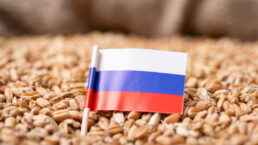

When Russian President Vladimir Putin spoke in 2014 about Russia’s motives for annexing the Ukrainian peninsula of Crimea, and thus violating international law, he justified it by saying: “We could not allow NATO forces to eventually come to the land of Crimea and Sevastopol, the land of Russian military glory, and cardinally change the balance of forces in the Black Sea area.”
What now? Intensified Ukrainian attacks on Novorossiysk, Russia’s largest commercial Black Sea port, have caused significant disruptions to oil and grain shipments in recent weeks. The Russian navy no longer dominates the region. And exporting goods via the Black Sea is becoming increasingly difficult for Russia because of Ukraine’s drone strikes. It is only possible to reorganize logistics partially.
If the attacks continue at such intensity, the consequences for Russian exporters and the national budget could be significant, experts told DW.
Novorossiysk major Russian hub for exports
Novorossiysk has been a major hub for Russian exports since the 19th century and even today it remains Russia’s largest port in terms of cargo volume, as well as one of the largest in Europe. Up to a third of Russia’s grain exports are handled through the hub, which is located close to the country’s major agricultural regions. Crude oil, metals and containerized goods also pass through the port.
Recent Ukrainian maritime and aerial drone attacks have severely disrupted shipments, particularly of grain. Andrei Sisov, the head of SovEcon, a research and consulting firm specialized in agriculture, uses Telegram to follow the developments. On August 12, he posted that the Novorossiysk Bread Products Plant (NKHP ) — one of Russia’s largest grain export terminals — and the Novorossiysk grain terminal had ceased operations. A day later, KSK, one of Russia’s largest deep-water grain terminals, also halted its operations. Operations at a major grain terminal in Taman had already come to a standstill at the end of July. Prior to that, Ukraine paralyzed operations at the shallow-water ports of the Sea of Azov.
At the time of publication, only Tuapse, the smallest of Russia’s deep-water grain terminals, was still in operation. “This means that virtually all Russian grain exports via the Azov-Black Sea basin are blocked,” Sisov said.
Oil exports also affected
The situation regarding oil exports is not quite as dramatic but while they have not come to a complete standstill, they are frequently disrupted. According to the British news agency Reuters, the Sheskharis terminal — Russia’s main oil export facility on the Black Sea, handling some 700,000 barrels of crude oil per day — halted loadings on August 14, which resumed only two days later.
According to London-based Argus Media, a global energy and commodity price reporting agency, Russia could have 45 million metric tons of wheat — Russia’s main agricultural export good — for export in 2026 to 2027. However, the situation in the Black Sea, through which about 90% of shipments are usually routed, will make it almost impossible to supply the global market.
Sisov of SovEcon estimated that “many Russian producers will not survive this season, especially after several years of deteriorating financial conditions.”
Because exports have come to a standstill, surplus grain will have to be sold on the domestic market, which is already putting downward pressure on prices. Even if exports were to recover over time, there will still be problems. August is usually when shipments peak and it will be difficult to deliver anything no sent this month because terminals tend to operate at full capacity during the autumn anyway.
The escalation of hostilities in the Azov and Black Sea regions will also be felt on the global market since Russia is the world’s largest wheat exporter.
Ukrainian grain exports have also fallen sharply since there are attacks on both sides. In the past month, Russia too has stepped up its attacks on Ukrainian ports and ships that are docked there.
“The disruptions have blocked out good wheat harvests in Ukraine and Russia from accessing global market,” Xiaoyi Deng from Argus Media told DW. “Both have struggled to work with alternative infrastructure, such as Baltic ports (via rail) or Danube River ports but the alternatives would not be up for full replacement.”
According to the Center for Research on Energy and Clean Air (CREA), a Helsinki-based think tank, the port of Novorossiysk “loaded 30% less oil than during the same period last year” in the first two weeks of August. The decline was preceded by a Ukrainian strike on the Caspian Pipeline Consortium (CPC) marine terminal on July 19.
Isaac Levi, an energy analyst at CREA, pointed out that damage to infrastructure was not the only reason for shipments to fall. He said that “strikes on vessels have discouraged ships from calling at ports considered major targets.” According to US business news channel Bloomberg, a Greek tanker believed to be carrying Russian oil came under attack on August 17.
“If these constraints persist through August, Russia will find it increasingly difficult to simply defer shipments and make up the lost volumes later,” Levi said. “Russia can reroute barrels, but it cannot reroute infrastructure. The most plausible alternatives include the Baltic ports of Primorsk and Ust-Luga.
“But rerouting oil through the Baltic Sea ports would significantly increase transportation times and costs compared with Black Sea exports, while available capacity remains too small to replace significant volumes from Novorossiysk.”
Source: Deutsche Welle



Related News.

Intelligent Skies, Secure Seas: Navigating Connectivity, Cyber Resilience, and AI Liability at the 5th CSN Greece ICT Conference
The 5th CSN Greece ICT Conference, held on 19th November 2026 at the Ploes Floating Venue in Paleo Faliro, Athens, successfully convened maritime…

EU moves to ban tankers insured in Russia, repair services at Russian refineries
EU targets Russian-insured tankers, refineries Von der Leyen announces 22nd sanctions package All 27 member states must approve new…
IMO tackling fraudulent registries together
Strong national systems and international information sharing are crucial to tackling fraudulent registries and fraudulent ship registration…

Open letter on freedom of navigation and the protection of seafarers
Dear High Representative Kallas, Dear Foreign Affairs Ministers, European Shipowners | ECSA, BIMCO, the Cruise Lines International Association…

Davies Turner warns of Rising Asia-UK Container Disruption and European Port Congestion
Davies Turner, one of the UK’s largest independent freight forwarding and logistics companies, says that disruption to container shipments from Asia…
Disruptions still dominate tanker market outlook
"This year, tanker markets have been affected by disruption to transits through the Strait of Hormuz, the Houthi blockade of Saudi Arabian Red Sea…
Panama’s President called on to match COP31 Heroism with action at shipping climate talks
As a series of crucial meetings tasked with cutting greenhouse gas emissions from global shipping takes place this week and next, environmental NGOs…

Trafigura appoints Helio Cumbi as Executive Director, Mozambique
Trafigura has appointed Helio Cumbi as Executive Director, Mozambique, and Business Development Lead for East and Southern Africa Oil. Helio is a…

“K” LINE holds FY2026 Global Dry Bulk Meeting
Kawasaki Kisen Kaisha, announces that it held a global meeting for its dry bulk business at the company’s head office on November 9 and 10. The…
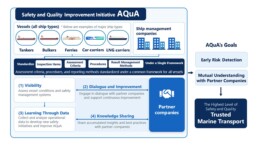
MOL launches ‘AQuA’ safety and quality improvement initiative
Standardizing Group-wide Safety and Quality Assessment Criteria to Enhance Vessel Safety and Quality Mitsui O.S.K. Lines, announced the launch of…
Subscribe to our newsletter!
if you dont want to swim alone in the ocean of news, sign up for the newsletter, and you will receive daily all the important news of world shipping!
