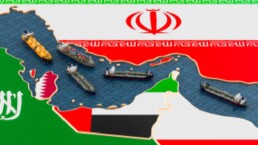

The Iranian crude that reached Asia is being taken. The crude that has not reached it is standing at the strait and behind it, and there is nearly twice as much of that.
AXSMarine · Data to 15 August 2026 · All volumes million barrels
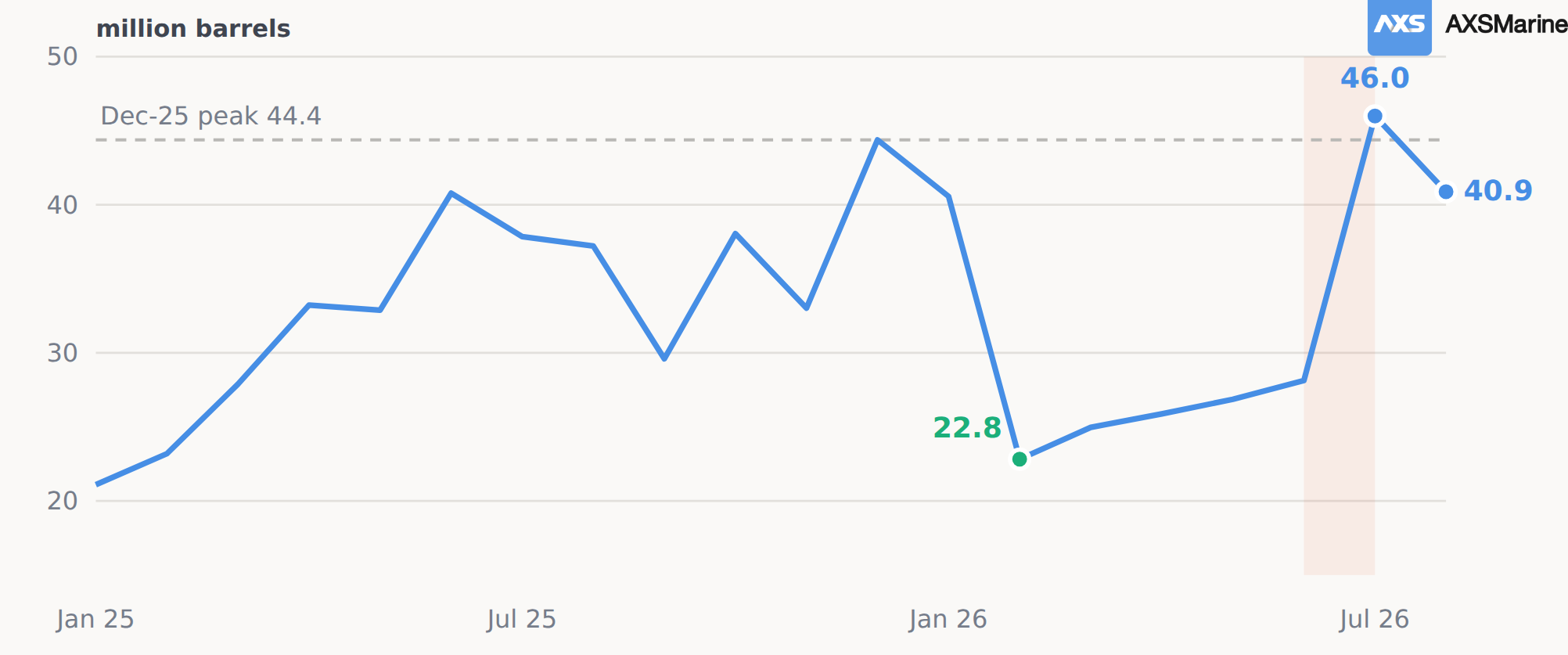
Iranian crude sitting in Asian waters peaked at 44.4 million barrels in December. By February it was 22.8, a fall of nearly half in two months.
The pile did not stay down. From February it rose every single month. Slowly, but in one direction. By the time the US sanctions waiver opened on 22 June the refill was already four months old.
The window ran three weeks. By the end of July, the pile stood at 46.0 million barrels, above its December peak. So, the waiver finished a refill that was already under way and did in one month what the previous four had managed between them.
The region emptied around it
What makes the Iranian build stand out is that it ran against the tide. Asia’s total crude on water fell 23.6% between January and July. Both halves fell together, floating storage by 30.6% and crude in transit by 19.0%, which is the detail that matters: had one fallen while the other rose, barrels would simply have been changing state.
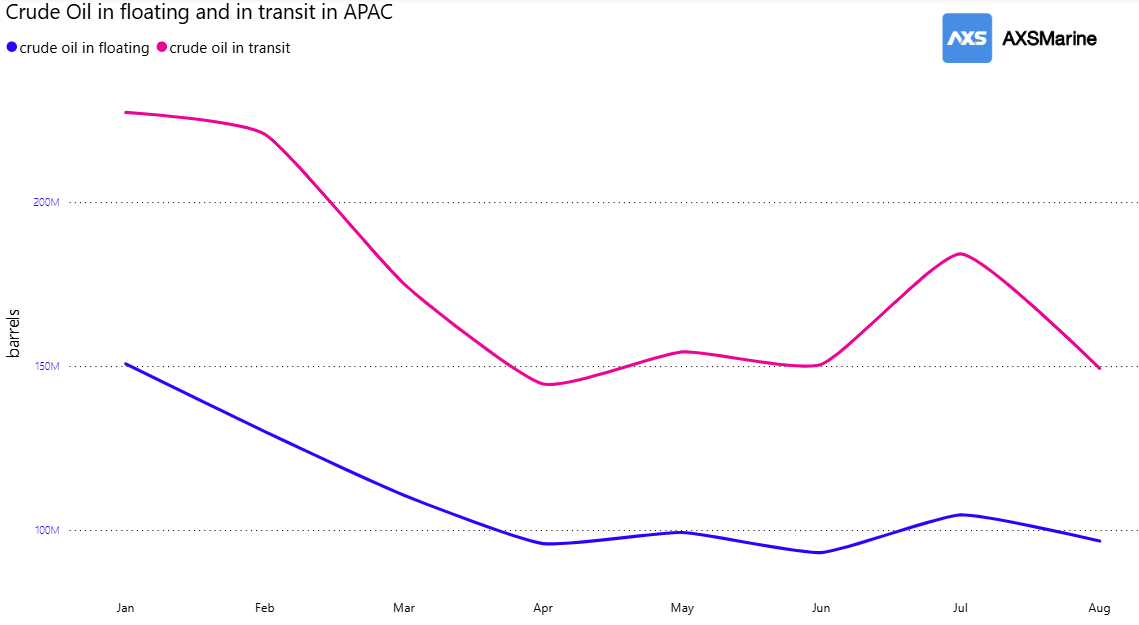
Two months break the pattern and they belong together. July is a surge in cargo moving, up 22.4% on June and the busiest month since February. August gives all of it back. Barrels moved, then they stopped moving.
More of what stays is standing still
Divide crude into floating storage and in transit and you get a rough measure of how long a barrel floats before someone takes it. For three years that ratio sat around 0.50. Since October 2025 it has averaged 0.63.
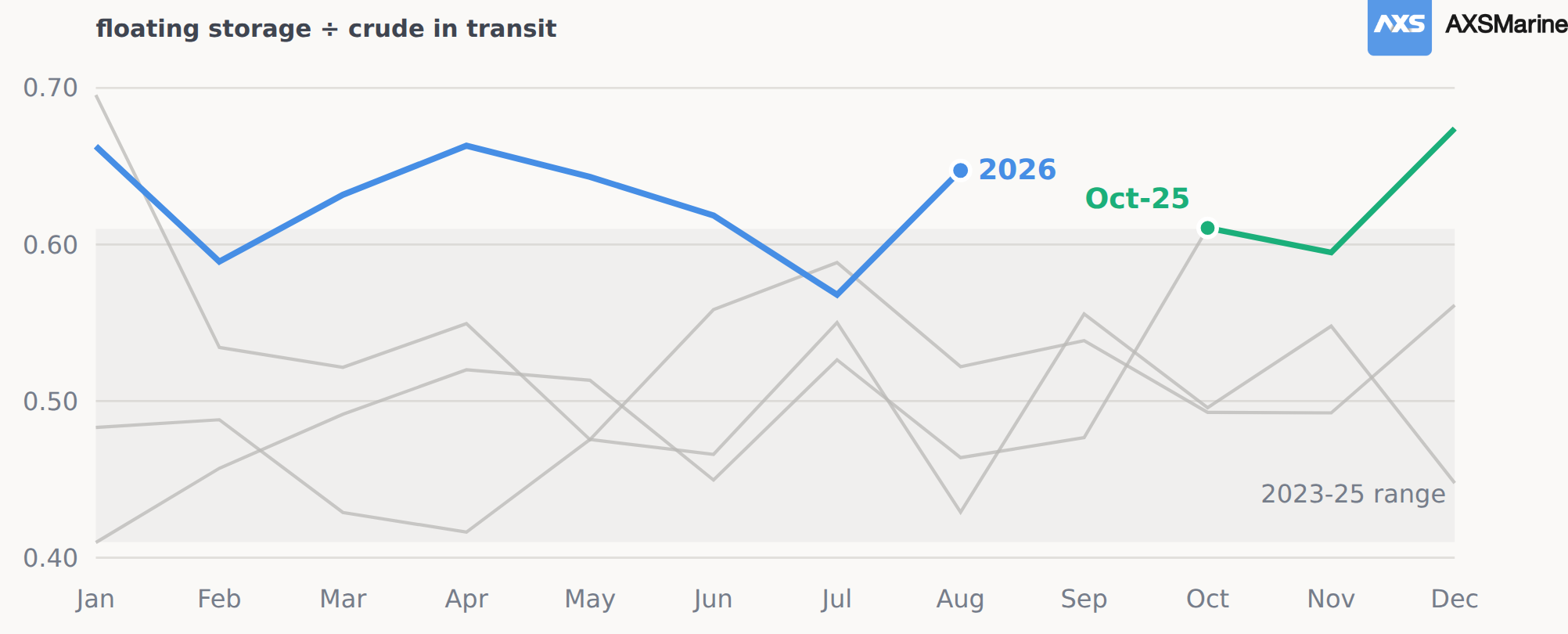
The number itself is not unprecedented. January 2023 printed higher than any month of 2026 and reverted within weeks. What is new is that it took longer to revert. Eight of the eleven months since October 2025 have printed at or above 0.61; one month in the previous thirty-three did. And the fourth quarter of 2025 averaged 0.63 the same as for the eight months of 2026.
July was relocation, and the queue starts at the strait
The measured part is the split at Hormuz. 39.8 million barrels stand east of the strait in the Gulf of Oman and 37.1 million remain west of it, 76.9 million of Iranian crude across the Gulf region on 47 hulls, seven in ten of them VLCCs. Asian waters held 40.9 million in August.
The fleet tells the same story as the volumes, and it tells it the whole way along. West of Hormuz the cargo sits in big parcels waiting for the door: 21 hulls, 17 of them VLCCs, averaging 1.77 million barrels each. East of the strait the mix breaks up, 26 hulls averaging 1.53. Inside Asia the fleet went from eighteen hulls to thirty-four across the window, the growth all in the smaller sizes, and the average parcel fell to 1.35. Parcel size declines at every step from MEG to a Chinese berth, which is what ship-to-ship redistribution looks like rather than bulk storage.
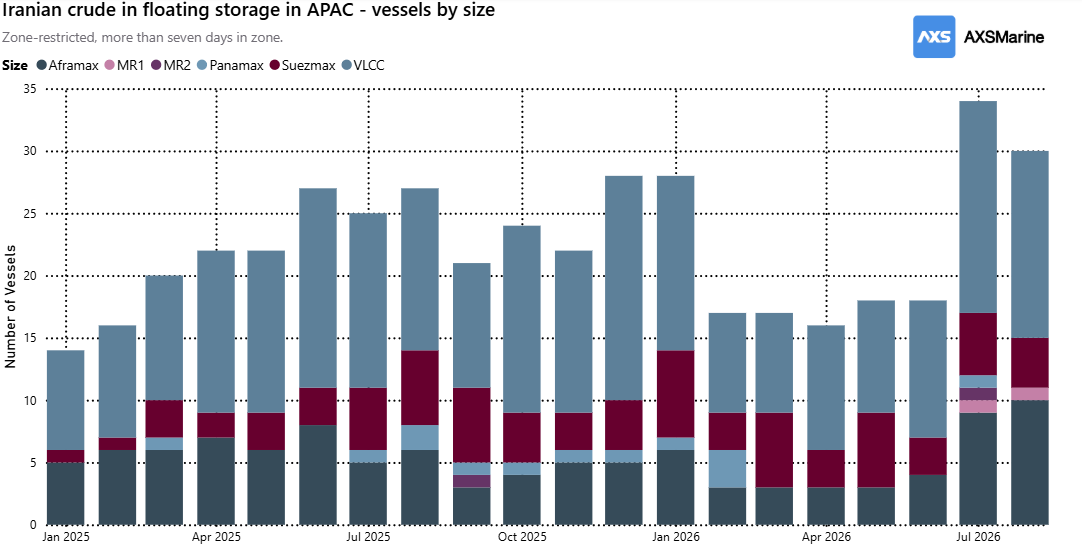
August looks like a stoppage. It is not one.
The floating to transit ratio (Figure 3) jumped again in August, and the intuitive reading is exactly wrong. Crude in floating storage fell 7.6% that month. Crude in transit fell 18.9%. The ratio rose because the denominator collapsed. Had refiners shut the door, floating storage would have climbed. It did the opposite.
So, the same indicator has now risen twice for opposite reasons. In October 2025 the numerator did the work: crude in floating storage jumped 24% in a single month while crude in transit barely moved, which is cargo arriving faster than it could be taken away. In August 2026 the denominator did the work: crude in transit fell 18.9% while floating storage fell too, just more slowly. Less crude heading for the region at all.
Chinese refinery runs were cut hard, from 14.6 million barrels a day in March to 12.7 in May. But China built crude stocks through the disruption and drew only marginally afterwards. Throughput fell from 14.6mbpd to 13.4 to 12.7 across March, April and May, a drop of 1.9mbpd. Over the same three months crude imports fell from 11.8mpbd to 9.4 to 7.8. Both fell, but not by the same amount, and the gap between them is the whole story.
It is not one pile. It is a queue with two stages.
Which points to the reading that ties the year together. Iranian crude floating off Malacca is best understood as Chinese inventory that has not yet crossed customs. Drawing it down never shows up in import statistics, which is precisely what makes it useful.
Singapore Chinese coastal zones
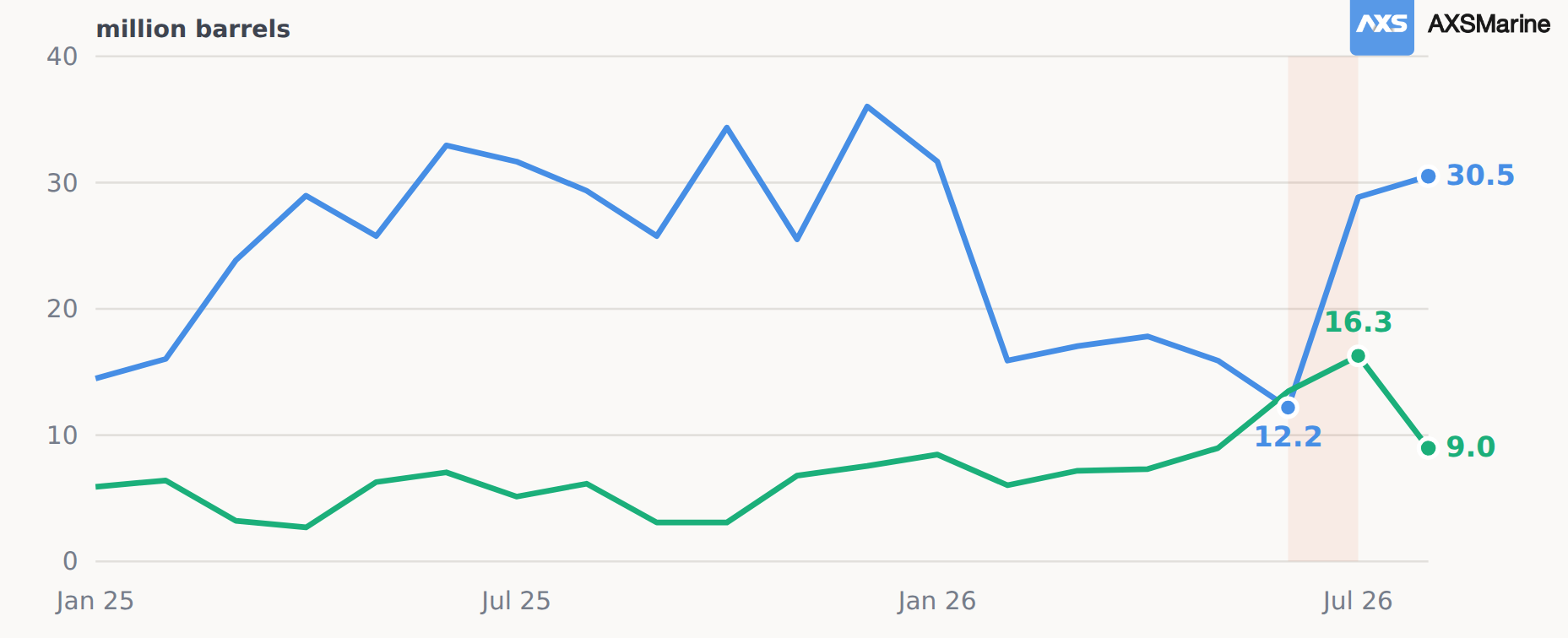
August is the part worth stopping on. Chinese-zone holdings fell 45%, from 16.3 million barrels to 9.0, while the Malacca hub grew 6%. That is what discharge looks like in this dataset, and it is the first clear instance of it all year.
What to watch
Whether the Chinese leg keeps drawing. This pile has only fallen substantially once this year, from 44.4 million barrels in December 2025 to 22.8 in February, and it rose every month after that. August’s fall was the first decline since. The Chinese-zone portion alone fell 7.3 million barrels in the month, while Singapore rose by a far smaller 1.7 million. Refiners are expected to accelerate their commercial inventory drawdown over the next two to three months to bridge the feedstock gap. And on market-circulated information most of the floating barrels have already been sold, even if that has yet to show through in the regional total, so the demand is there. And the pile is now the nearest crude in the region: Malacca to a Chinese berth is about a week, against three weeks from the Gulf and rather more than that from a Saudi cargo going the long way round Africa.
Fundamental data from AXSMarine. Chinese production, throughput and customs data are official.
Source: Signal Ocean



Related News.

GNSS is an opinion: Apostolos Giannetsos on the Geopolitical Realities of Maritime Cyber Security
In an industry undergoing rapid digital transformation, the operational interface between vessel, satellite, and shore has become maritime’s most…
MOL holds joint naming ceremony for world’s 1st 3 ammonia-fueled capesize bulk carriers
New Beginning for Vessels Powered by Next-Generation Fuels as Group Moves toward Net-zero Emissions by 2050 Mitsui O.S.K. Lines, announced that on…

Infleqtion demonstrates timing and navigation capabilities during the Maritime Big Play Pacific Military Exercise
Infleqtion operated its Tiqker optical atomic clock continuously aboard the U.S. Navy’s RV Merlin support vessel, also in support of the BARB-26…

Offshore industry sends urgent call to EU policymakers for fit-for-purpose EU ETS and MRV framework
OFFSHORE INDUSTRY SENDS URGENT CALL TO EU POLICYMAKERS FOR FIT-FOR-PURPOSE EU ETS AND MRV FRAMEWORK Eight maritime associations including the Royal…

International Transport Employees Federation (ITEF) formed in Chennai to strengthen Seafarers’ Rights, Welfare, Safety and Justice Worldwide
Representatives of seafarers’ unions and transport workers’ unions, seafarers’ welfare organisations and maritime charitable institutions from across…

Indian Register of Shipping showcases five decades of Maritime Contribution and future-ready capabilities at INMARCO 2026
Indian Register of Shipping had an extensive presence at INMARCO 2026, held in Mumbai from 27–29 October 2026, with senior IRS professionals…

“Cut Shipping’s Black Carbon to Protect the Arctic” Clean Arctic Alliance response to ICCI & UNEP overshoot & Cryosphere reports
Responding to publication of two reports, Overshoot and the Cryosphere: Averting Global Meltdown and State of the Cryosphere 2026: The Cost of…

“K” LINE’s top management speak at TradeWinds Shipowners Forum Japan 2026
Sharing Information about the Resilience of the Maritime Shipping Industry in a Changing Business Environment Kawasaki Kisen Kaisha, announces that…
DP World strengthens China-Africa corridor with new shipping link
The China Africa Link strengthens maritime connections between the Far East and Africa, supporting more flexible supply chains and access to growing…

2026 Abu Dhabi Maritime Awards receives Record 132 Submissions, underlining Regional Industry Strength and Awards’ Rising Influence
Etihad Airways, Forbes Middle East, Caliber Watches, ADNEC Group, and Abu Dhabi International Boat Show announced as event partners Public voting…
Subscribe to our newsletter!
if you dont want to swim alone in the ocean of news, sign up for the newsletter, and you will receive daily all the important news of world shipping!
